Páginas

sábado, 2 de julio de 2022

Adult video mosaic destroyer’s trial ends with guilty verdict in Kyoto district court

https://ift.tt/FVYgIch Casey Baseel


Machine-learning A.I. used to try to skirt Japanese censorship laws.

Last October, officers from the Kyoto Prefectural Police arrested Masayuki Nakamoto, a resident of the city of Takasago, in Hyogo Prefecture. Nakamoto stepped into the sights of law enforcement when he began selling copies of adult videos online, and on Wednesday a verdict was reached in his trial.

The videos the 44-year-old Nakamoto had been selling weren’t just simple pirated copies, though, but videos that he had altered to appear uncensored. Japanese adult videos are required by law to obscure the performers’ genitals, with placing a mosaic over them the most common form of compliance. Nakamoto, though, was selling adult videos that looked like they had their mosaics removed.

“Looked like” is because since the mosaic is hard-coded into the image of the commercially released video, it can’t really be removed. Instead, Nakamoto used an A.I. program, which via machine learning gained an understanding of what uncensored genitals look like, then used that knowledge to create a photorealistic simulated visual representation. Nakamoto then placed the simulated image over the mosaic, making the on-screen performers appear completely uncensored, despite this actually being the second round of digital additions to the original footage, and offered his doctored videos for sale online.

All of that brought charges of copyright violation and “display of obscene electromagnetically recorded media” down on Nakamoto once the authorities caught wind of what he’d been doing. Though he was released on his own recognizance, Nakamoto was back in the courtroom of Kyoto district court on June 29, where presiding judge Shinsuke Danjo sentenced him to two years in prison, with the sentence suspended for three years. The harsh two-year sentence, Danjo explained, was because Nakamoto had regularly and repeatedly engaged in selling the videos over the course of roughly 10 months, while the three-year suspension, which gives him the opportunity of avoiding doing any actual jail time, was in recognition of the remorse he has shown since his arrest. Nakamoto was also fined two million yen (roughly US$15,000), which isn’t chump change, but is still quite a bit less than the approximately 11 million yen he reportedly earned selling the videos.

Twitter reactions to the verdict have included:

“So close!”
“[He] made the dream that men have had for so long come true, but has now been suppressed by the power of the state.”
“Thank you for making our impossible dream come true.”
“Our modern-day Jesus has been crucified. How could they treat a man of such holiness like this…”
“Nowadays, you can find uncensored foreign adult videos online pretty easily, but he wanted to see uncensored Japanese ones so much that he went to all that trouble to try to get around the mosaic? I don’t know if that makes him amazing or an idiot.”

Regardless of how clever Nakamoto’s technique may have been, let his case serve as a cautionary tale and a reminder that other uses for A.I., like using it to design a cool-looking katana or turn a hugely popular anime character into an office building receptionist, is less likely to have you ending up in court.

Source: Sankei News via Otakomu, Twitter (1, 2)
Top image: Pakutaso
● Want to hear about SoraNews24’s latest articles as soon as they’re published? Follow us on Facebook and Twitter!

viernes, 1 de julio de 2022

We visit izakaya in Thailand billed as “Middle Aged Man’s Paradise”, try food that’s illegal in Japan

https://ift.tt/XU2BN73 Katie Pask

Thankfully our reporter lived to tell the tale.

If we had to say one thing about our Japanese language reporter Ikuna Kamezawa, it’s that she loves to travel. If we had to say one more thing about Ikuna, it’s that she loves finding Japanese restaurants in other countries. Whether it’s French ramen or Indian sushi, Ikuna is always happy to chow down on other countries’ takes on Japanese cuisine.

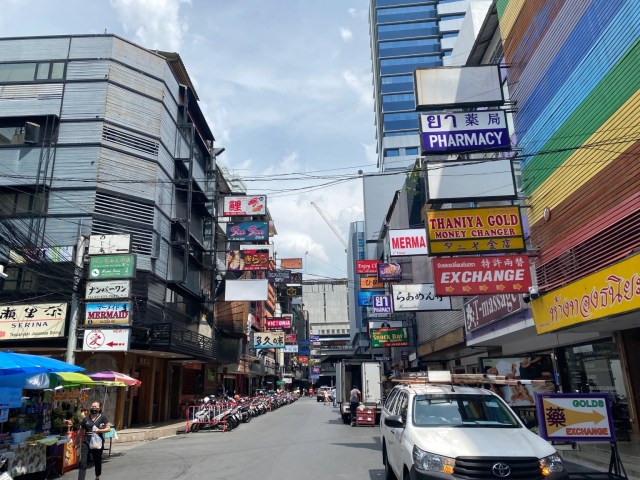
Her recent travels took her to the streets of Bangkok, Thailand, although you might be forgiven for initially thinking Ikuna was still somewhere in Japan, given the number of signs written in Japanese in this picture. In fact, something Ikuna finds particularly charming about Bangkok is the abundance of Japanese signs out and about, which at times makes her feel like she’s travelling somewhere closer to home, like Okinawa.

But amongst all the Japanese restaurants dotting the streets of Thailand, Ikuna found one spot that managed to ‘out-Japanese’ all the rest; so much so that it felt like someone had teleported it directly from the middle of Osaka.

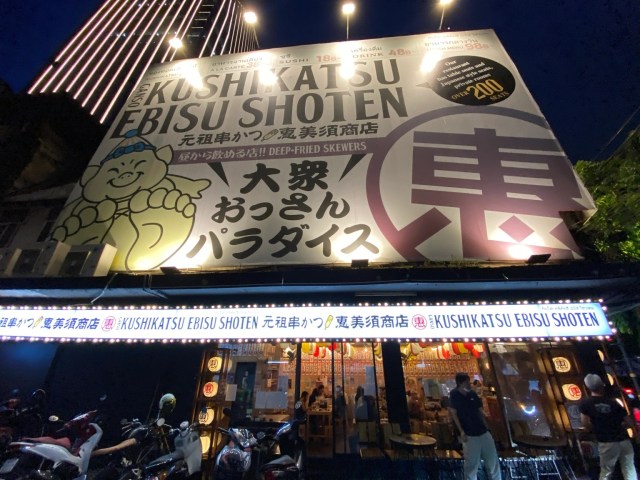
Ikuna had found an izakaya, a Japanese traditional pub. It’s called Ganso Kushikatsu Ebisu Shoten and has a huge neon sign proclaiming the place “a paradise for the common man“. More specifically, the term used for ‘man’ is ‘ossan‘, but ‘paradise for the middle-aged-and-slightly-uncool-common-man’ isn’t quite as punchy in English.

The pub specialises in kushikatsu, delicious deep-fried sticks of pretty much anything tasty. And while Ikuna was decidedly not an ossan, she couldn’t say no to a spot of kushikatsu, and decided to check it out.

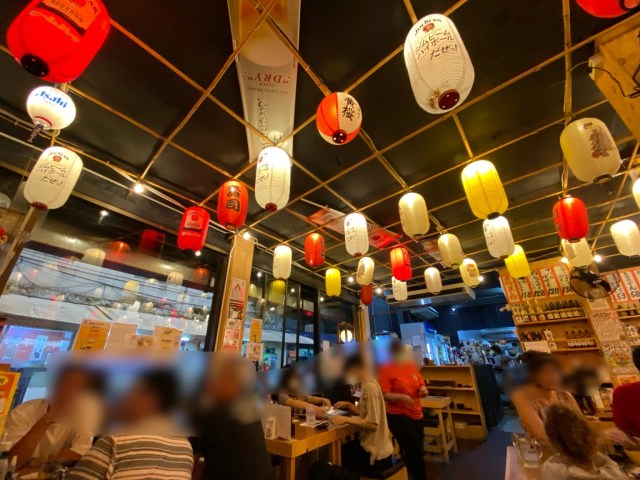
It turned out this place is a paradise for ossan and non-ossan alike, as the restaurant was absolutely packed! By some stroke of luck, Ikuna was able to be seated quickly, but this was one of her first experiences in an izakaya unaccompanied. Izakaya pubs are usually a place to relax with some drinks and share a few nibbles with friends, and Ikuna was a little worried people might judge her for being there by herself. But as she looked around, she saw that she wasn’t the only solo diner there that night. In fact, there were a lot of old guys there by themselves, whom Ikuna suspected were Japanese ossan living in Thailand.

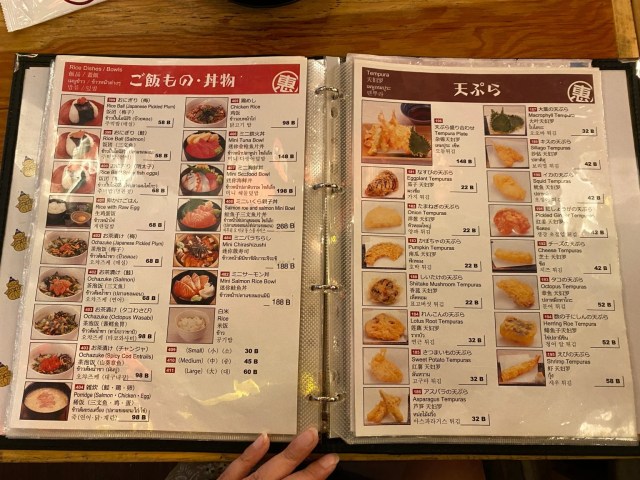
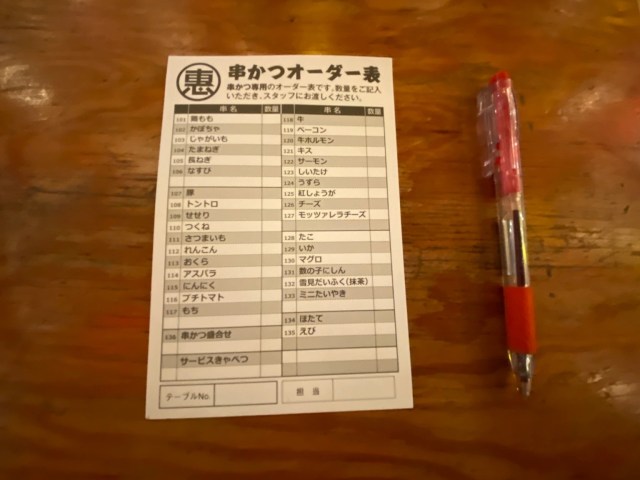
Ikuna was ready to order, and she was handed a form written entirely in Japanese. The menu for things available to deep-fry included shrimp, fish, shiitake mushrooms, lotus root, pumpkin and, strangely, popular Japanese sweet Yukimi Daifuku.

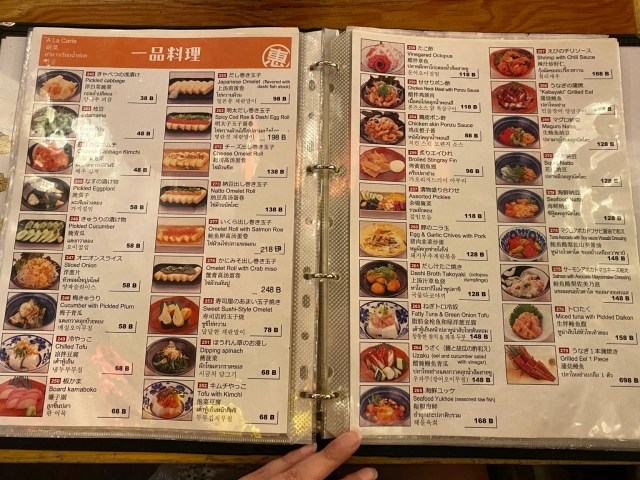
There was also an a la carte menu with sashimi, pickles, sushi, curry, hot pots, soba noodles…

… and rice dishes and tempura were also available to order.

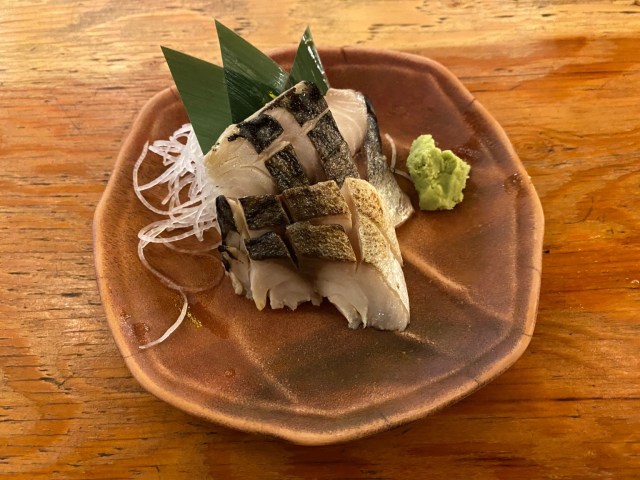
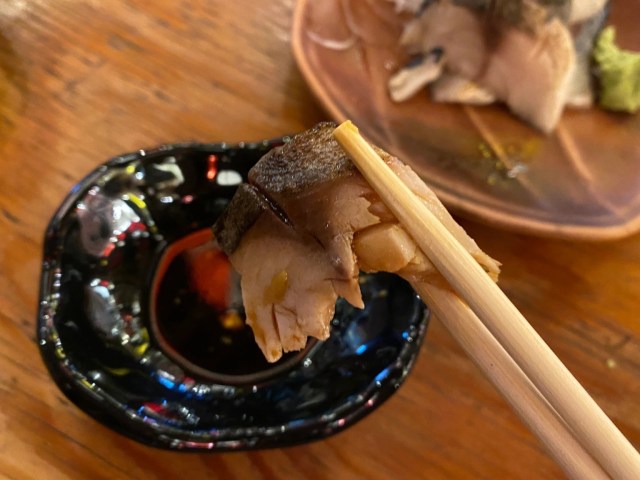
To get things started, Ikuna ordered the seared mackerel, which cost 148 baht (US$4.20). While there’s an image of food in Thailand being very cheap, this was around the same price you’d expect to pay for seared mackerel in Japan. It wasn’t just the price that resembled that of Ikuna’s home country, though, but the flavor too, as the dish tasted delicious, just as good as she’d expect it to in a restaurant in Japan!

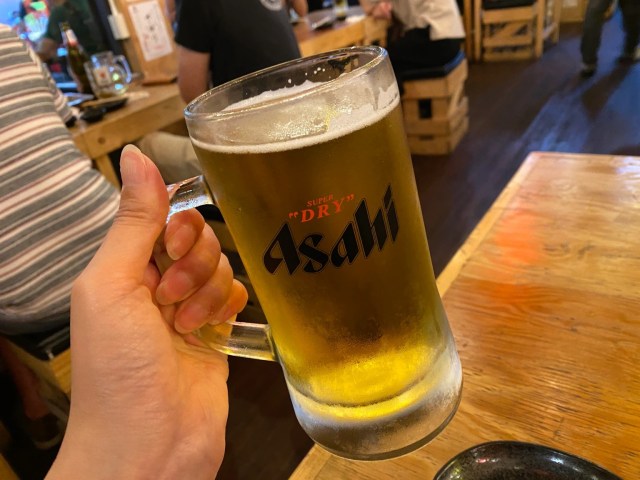
Of course, no trip to the izakaya is complete without a cheeky beer or two, and luckily the Thai izakaya has Asahi Super Dry on tap. One glass cost 135 baht (US$3.84) — again, about what you’d expect to pay in Japan.

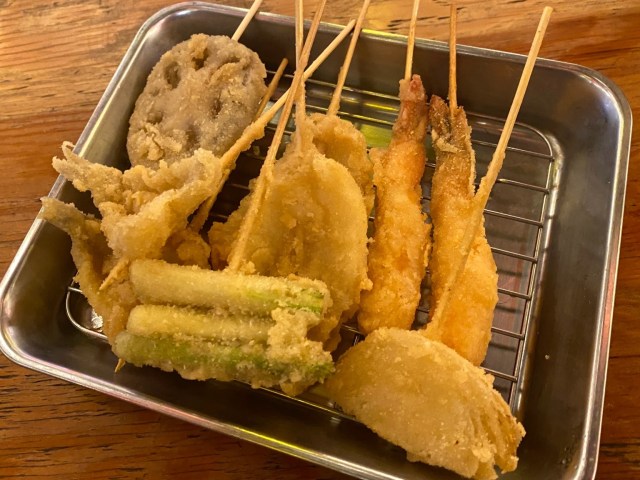
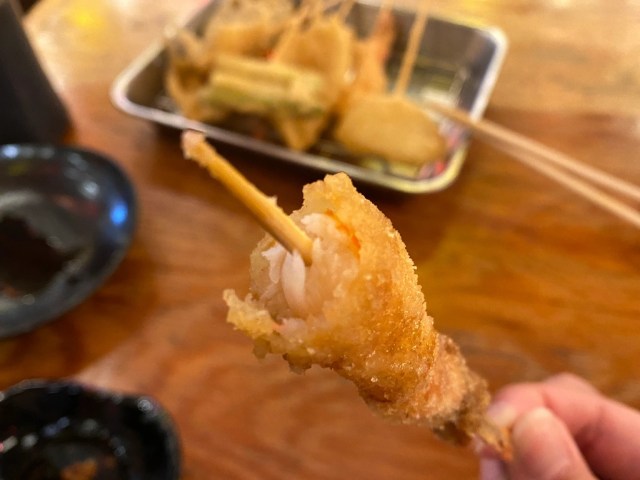
Next up were the kushikatsu. They were deep-fried to perfection, and looked absolutely divine.

They didn’t just look good, though; they tasted amazing, too. In fact, Ikuna thought they tasted better than what most kushikatsu restaurants serve back in Japan.

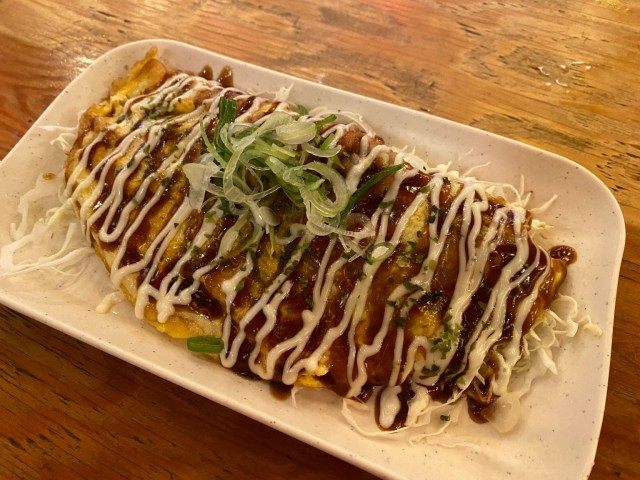
It wasn’t just the kushikatsu that was good, either. Osaka’s famous tonpeiyaki (okonomiyaki with grilled pork) tasted just like it does in Japan. While soy sauce is available pretty much anywhere in the world, okonomiyaki sauce isn’t as easy to get your hands on outside of Japan.

But actually, there’s a certain menu on the item that Ikuna had come in specifically to try. The ‘forbidden’ dish on the menu. So forbidden is this dish that it was actually banned from being served in restaurants in Japan back in 2012, after it was deemed unsafe due to the potential risk of E. coli. But in Thailand, a number of restaurants are still serving it, including the izakaya Ikuna was in.

The dish in question is…

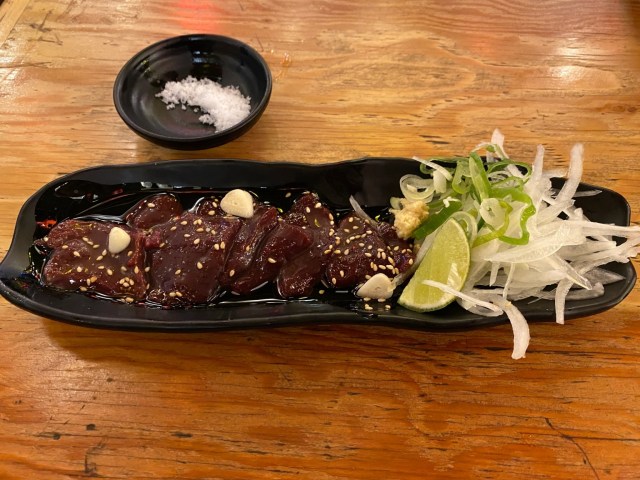
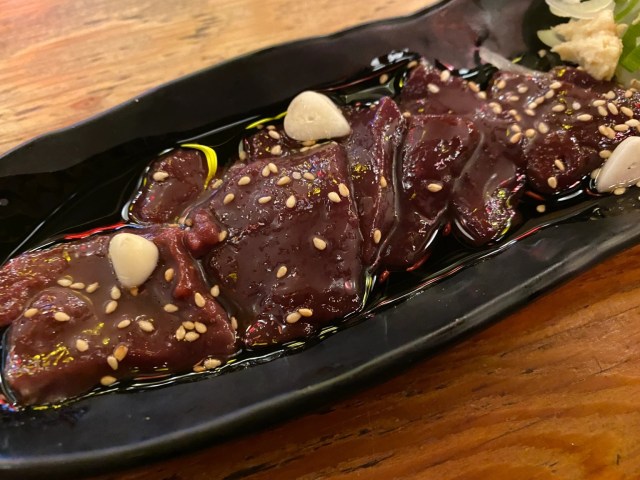
Liver sashimi – 98 Baht (US$2.78)

Liver sashimi, specifically raw cow liver, can’t be sold at restaurants in Japan by law, but it was a very popular dish with salarymen back in the day. If you’ve been missing the delicious, uncooked taste of raw beef liver, this pub might be the perfect place for you — just be aware of the potential health risks.

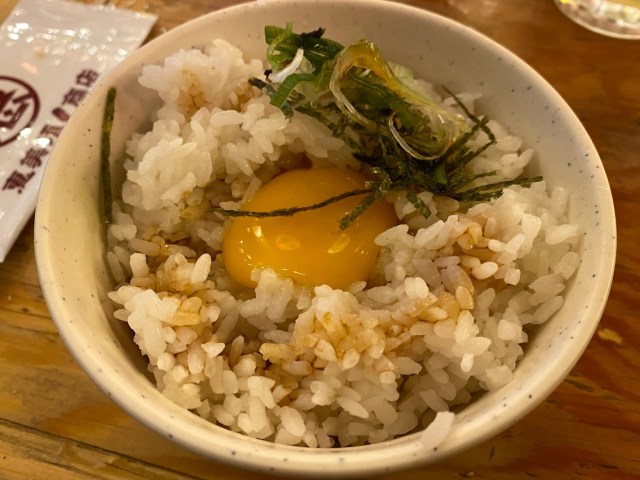
▼ Raw egg with rice – 68 baht (US$1.93)

As well as raw liver sashimi, the restaurant also offers rice with a raw egg on top. Such a dish is commonplace in Japan, but in some other countries eating a raw egg is absolutely unthinkable. Ikuna was pretty surprised that she was able to eat raw egg in a tropical country like Thailand, and got so excited that she ended up doing what most people do when they visit an izakaya, and got pretty tipsy.

All in all, Ganso Kushikatsu Ebisu Shoten was like a little piece of Japan right in the heart of Bangkok. Even as she looked around, about 70 percent of the customers in the izakaya that day were from Japan, and the room was filled with people chatting happily in Japanese. Ikuna suspected around half of the Japanese customers were people who lived in Thailand, and for those missing home-country grub, this izakaya must be, as the sign outside said, a paradise for them.

If you’re in Bangkok and are craving for some decent Japanese food, check out Ganso Kushikatsu Ebisu Shoten. If the pub is full to the brim with ossan and doesn’t have any available seats, though, this philosophical Japanese restaurant located nearby might have a table or two free.

Restaurant information
Ganso Kushikatsu Ebisu Shoten
Address: 12, 14-16 Soi Sukhumvit 26, Klongtan, Klongtoey, Bangkok 10110, Thailand
Open 11:30 a.m – midnight

Photos © SoraNews24
● Want to hear about SoraNews24’s latest articles as soon as they’re published? Follow us on Facebook and Twitter!
Sega’s old arcades are making money again as new owners announce 3.175-billion yen profit

https://ift.tt/bgqxA0s Casey Baseel

Game centers are back in the black after a 2-billion-yen-plus loss just a year earlier.

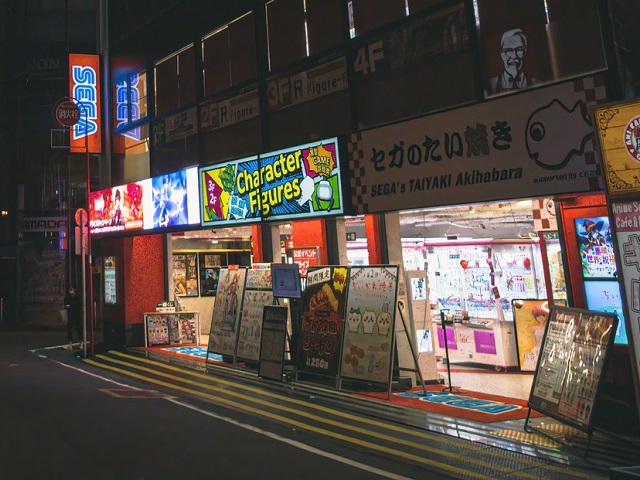
A year and a half ago gamers in Japan were saddened when Sega left the arcade management business, selling off its nationwide amusement facilities. Though it had been almost 20 years since Sega had stopped producing its own home consoles, the company had remained a stalwart of the arcade scene in Japan with over 190 branches, and its departure seemed like a blow not just to Sega, but to Japan’s game center culture in general.

So it’s heartening to hear that Sega’s old arcades are now once again making a profit under their new owners.

Sega’s exit from the arcade management industry took the form of selling the stock of Sega Entertainment (the Sega subsidiary in charge of arcade management) to a Tokyo-based company called Genda. Genda first changed the company’s name from Sega Entertainment to Genda Sega Entertainment, and then to just Genda GiGO Entertainment. The important thing to take away here is that Genda GiGO Entertainment is specifically the Genda subsidiary that’s managing Sega’s old arcades today, and in its most recent financial report, Genda GiGO Entertainment has posted a profit of 3.175 billion yen (roughly US$23.7) for the year, a major reversal from the 2.308 billion-yen loss it suffered the previous year, nine months of which the arcades were still being managed by Sega for.

People must be swarming to the arcades under Genda GiGO’s management, right? Well, not exactly. Genda GiGO released its most recent financial report on May 26, and it covers the period from March to December of 2021 (it’s not quite a full 12 months because Sega Entertainment used to start its business year in the spring, but Genda GiGO has chosen to start its in January). Compared to March-December 2020, when Sega was still in charge, the arcades’ sales, i.e. their earnings from customers coming in and putting coins in the machines, were up 5.1 percent for 2021.

That’s a nice increase, but not nearly enough to account for the nearly five billion-yen turnaround the company reported. So what does account for it? Accounting.

Arcade game machines aren’t cheap, which means their deprecation costs, calculated as a proportion of their listed value, can be enormous. Following the transfer of ownership, Genda GiGO began reevaluating the value of those assets and taking what’s known in accounting as an impairment loss, according to Japanese financial portal Dime. In simplified terms, an impairment loss is a reduction in the value of a company’s assets that can be triggered when its fair value is considered to be less than the value listed on its balance sheet, which begins as the full purchase price of the asset. By taking impairment losses that lower the listed value of their assets, Genda GiGO can now enjoy the benefits of lower depreciation costs (again, since depreciation costs are calculated as a percentage of asset value), making it much easier to turn bigger profits off of the machines even without a significant increase in revenue.

For reference, in March of 2020, the last full business year with Sega in charge, the company’s fixed assets were listed at slightly less than 24.8 billion yen, while in January of 2022, the first all-Genda GiGO management period, its fixed assets were listed at less than half of that, roughly 11.5 billion yen.

So boiling down all of those numbers, Genda GiGO hasn’t so much ushered in a renaissance for arcades in Japan so much as extensively restructured its expenses while achieving a modest uptick in convincing people to come in and play some games. Still, arcades are, after all, businesses, and being back in the black is itself an encouraging sign of life right now for the ones Genda GiGO is running.

Sources: Dime via Hachima Kiko, Genda GiGO Entertainment
Top image: Pakutaso
Insert image: Pakutaso
● Want to hear about SoraNews24’s latest articles as soon as they’re published? Follow us on Facebook and Twitter!

Single snake sparks power outage for nearly 10,000 homes in Fukushima

https://ift.tt/ecCFivD Master Blaster

What’s wrong? Snake?! Snaaaaake!

For about a week now, the air conditioner has become a lifeline for many across Japan struggling to do anything in this intense heat. For example, in Nagoya a school’s AC broke down, causing 25 students to complain of heatstroke-like symptoms and classes being cancelled for the rest of the day.

So, you can imagine the disturbance in the force caused by 9,800 voices crying out at once when their air conditioners all got cut off at the same time. The incident occurred in Koriyama City, Fukushima Prefecture, on 29 June when a blackout swept through a large section of the city.

Normally, in cases like this, one would assume that there was too much load on the power station, but actually everything was running fine until about 2:10 in the afternoon. Tohoku Electric Power traced the outage to a substation in the city, and when they investigated it they found the charred remains of a snake. Smoke from the burning serpent had also caused six fire trucks to be dispatched to the scene.

▼ A news report on the outage

According to Tohoku Electric Power, the snake, which had possibly been looking for shade in all the wrong places, slithered into the substation and made contact with a live wire. This caused a short which triggered an automatic shutdown for safety.

Luckily, this meant it only took about an hour for the power to be restored, but one hour in this extreme weather during the hottest part of the day was still a lot for the residents to endure. Local businesses were affected too, such as a barber shop in the area who’s owner said he couldn’t operate without air conditioning.

In other parts of the country, however, there was an outpouring of sympathy for the snake in online comments, mixed with some finger-pointing at the power company for not snake-proofing its facilities better.

“It’s surprisingly easy to shut down important infrastructure that’s indispensable to our lives.”
“Oh, after 2 p.m. is the worst!”
“Poor snake. I was born in the year of the snake, so this hits hard.”
“Snakes have a long body, so it’s easy to cause a short.”
“Poor little thing…”
“If it was hit by lightning or something I would understand, but a snake? They should be better protected.”
“There’s a theory that some criminal group used the snake to cause a blackout.”
“Rest in peace, snake.”
“I guess I would rather deal with an hour of power outage than have a snake come into my own house.”
“Poor snake! The company should apologize and compensate its family.”

There were also many puns flying around since the Japanese word for “snake” is “hebi” which sounds a lot like the English word “heavy”. Many called this a “hebi story” and remembered government warnings against “hebi usage” to prevent power outages.

It’s hardly the first time animals have crossed paths with infrastructure around Japan either. Bird poop has disabled stop lights and dog pee made one come tumbling down altogether, while Japan’s extensive trains system has had to deal with all kinds of animal encounters over the years. Hopefully stronger countermeasures can set up from these experiences for both their sakes and ours.

Source: Asahi Shimbun, TV Asahi News, YouTube/ANNnewsCH, Yahoo! News Japan
Top image: Pakutaso
● Want to hear about SoraNews24’s latest articles as soon as they’re published? Follow us on Facebook and Twitter!

Annual Tokyo festival where guys get wrapped in straw and carried through streets returning【Vids】

https://ift.tt/DXeBFRc Casey Baseel

The story of a drought, dragons, and one of Japan’s craziest festivals.

Once upon a time, there was a village in Japan that desperately needed rain. One thing led to another, and now every year in Tokyo this happens:

Japan’s summer festivals often have their roots in traditional religious beliefs about the connection between gods, spirits, and forces of nature, and the Mizudome no Mai, which takes place at Gonshoji Temple in the Omori neighborhood of Tokyo’s Ota Ward, is no exception,

Many years ago, or perhaps we should say many, many years ago, since this happened all the way back in 1321, the people of Musashi no Kuni (as east Japan was called in those days) were suffering through a terrible drought. With the earth parched and crops withering, the people turned to the abbot of Gonshoji, asking him to beseech divine forces to bless them with rain.

Hearing the people’s pleas, the abbot constructed a statue of a dragon out of straw, since the creatures have long been associated with water and rainfall in Japanese folklore. The abbot then offered prayers, and before long they were answered, with rainclouds forming and shedding the long-awaited precipitation that ended the drought.

Things seem to have been more or less OK the next year, but the year after that the surrounding community found itself facing the opposite problem. Now there was too much rain, flooding the fields and ruining the efforts of the farmers as much as the drought had. Remembering that, to their knowledge, it was the abbot’s prayers that had brought rain two years prior, some villagers began to resent the priest, speculating that his prayers had been too effective and that they were now suffering the continuing consequences.

So once again, the abbot began crafting animal artwork. He made three lion masks, since the Japanese word for lion is “shishi,” but if written with different kanji characters and read in a somewhat obscure manner, shishi can also mean “stop the rain.”

This time the abbot distributed the masks to the villagers, instructing them to dance, and for others to bang taiko drums or blow into conch shells. This, the abbot said, would pacify the dragon who was causing the ceaseless storms, and once again, his proclamation proved true, as the weather returned to more moderate conditions and the floodwaters receded.

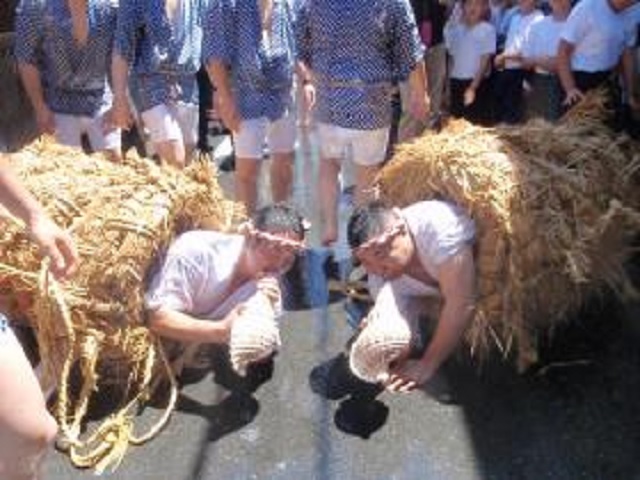
To commemorate this series of events, annually Gonshoji holds the Mizudome no Mai, or “Water-stopping Dance,” and the most dynamic part of the celebration is when two dudes, both usually quite large, are stuffed into cocoon-like straw sacks and carried through the streets of Omori, all while blowing on conch shells and being pelted with water.

Those two prone gentlemen represent the storm-bringing dragons, and the townspeople need to transport them to Gonshoji. The dragons, being somewhat rebellious types, won’t make the journey under their own power, and so groups of participants take turns carrying them, periodically dousing them in the creatures’ favorite element, and the blowing of the conch shells is meant to replicate their cries of draconic joy.

The Mizudome no Mai takes place in July, and coinciding with the hottest time of the year in Japan means bystanders are only too happy to be hit by stray splashes of water that were aimed at the dragons. Because of the dragons’ weight, frequent stops have to be made, but the procession/carrying has musical accompaniment from flutes and drums, and once the dragons finally do reach the temple, a team of dancers performs while wearing headgear symbolizing the three lion masks made by the abbot for the townspeople during the floods.

▼ You might notice many of the participants wear clothes with a triangular pattern, which is meant to be evocative of a dragon’s scales.

Sadly, the Mizudome no Mai could not be held in 2020 or 2021 due to coronavirus precaution protocols. For 2022, though, the procession will be retuning, with this year’s iteration starting at 1 p.m. on Sunday, July 10.

Temple information
Gonshoji / 厳正寺
Address: Tokyo-to, Ota-ku, Omori Higashi Sanchome 7-27
東京都大田区大森東三丁目7番27号

Source: Mizudome no Mai official website via Hamster Sokuho, Ota Ward
Top image: Ota Ward
Insert images: Pakutaso (1, 2)
● Want to hear about SoraNews24’s latest articles as soon as they’re published? Follow us on Facebook and Twitter!
Which Japanese conveyor belt sushi chain has the best hamburger steak sushi?【Taste test】

https://ift.tt/DaHPQYT Casey Baseel

No, no, not sushi hamburgers. That would be weird.

Sushi, as foodies and linguists are quick to point out, doesn’t mean “sliced raw fish.” That would be sashimi. The word sushi actually refers to vinegared rice, so while it’s true that the majority of sushi is made with some kind of uncooked seafood, other toppings are also viable candidates. For example, we recently did a teste-test comparison for anago (saltwater eel) sushi, and that’s a topping that’s always cooked.

Today we’re continuing our search for the best conveyor belt sushi with another cooked topping, and this time we’re not even dealing with seafood, as we’re eating hamburger steak sushi.

If you’re thinking the concept sounds pretty freaky, you’re not alone. Our Japanese-language reporter and taste tester for this article, P.K. Sanjun, had never once eaten this meaty sushi variety, though he had seen it on the menu at multiple kaiten sushi (conveyor belt sushi) restaurants. But after some gentle encouragement from fellow reporter Seiji Nakazawa, who told him there’s a lot of variation between the hamburger steak sushi at different restaurants, P.K. decided the time had come to expand his sushi-eating resume, and so he set off the make the circuit of Japan’s big four conveyor belt sushi chains, completed in the span of three hours.

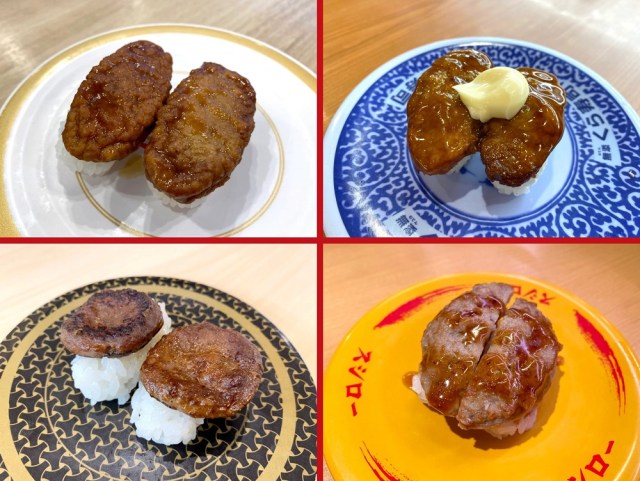
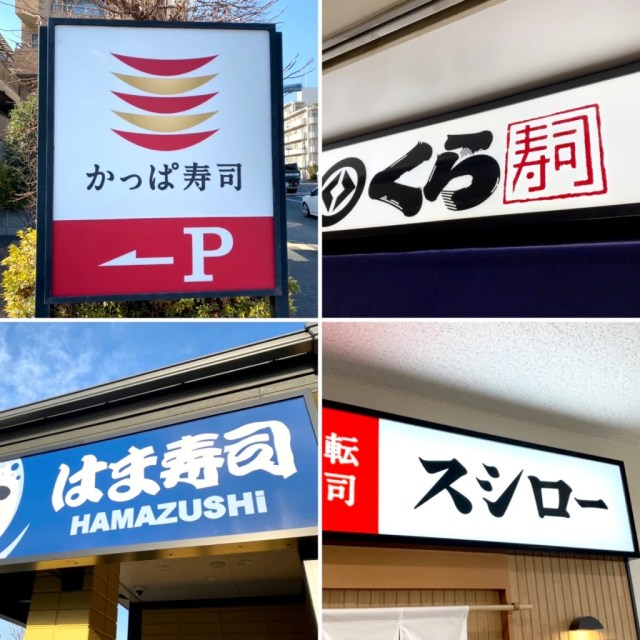
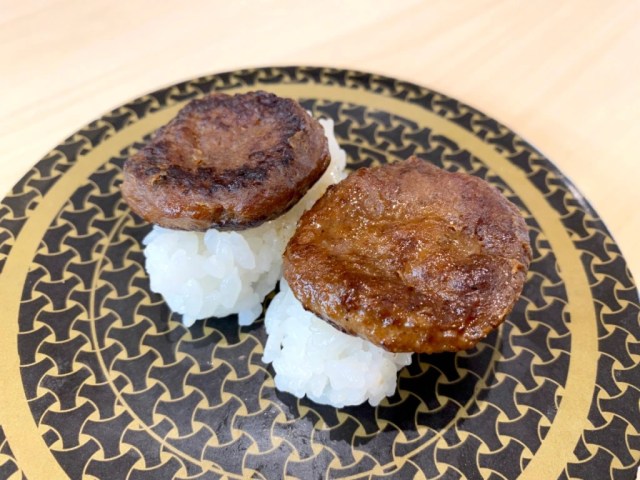
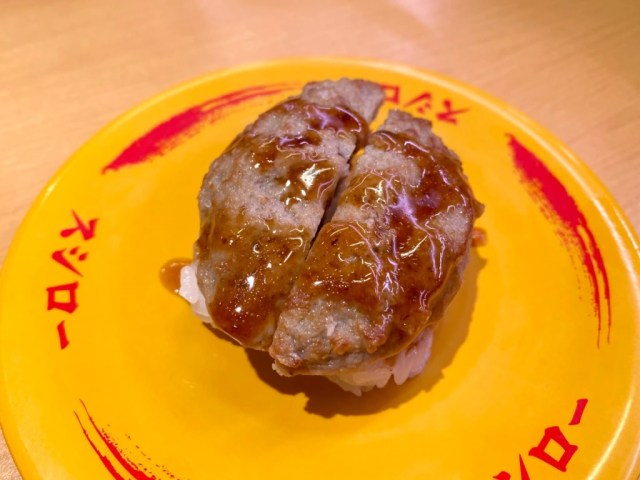
▼ Clockwise from top left: Kappa Sushi, Kura Sushi, Sushiro, and Hama Sushi. All four chains offer their hamburger steak sushi for 110 yen (US$0.82).

Let’s take a look at P.K.’s post-burger sushi memories.

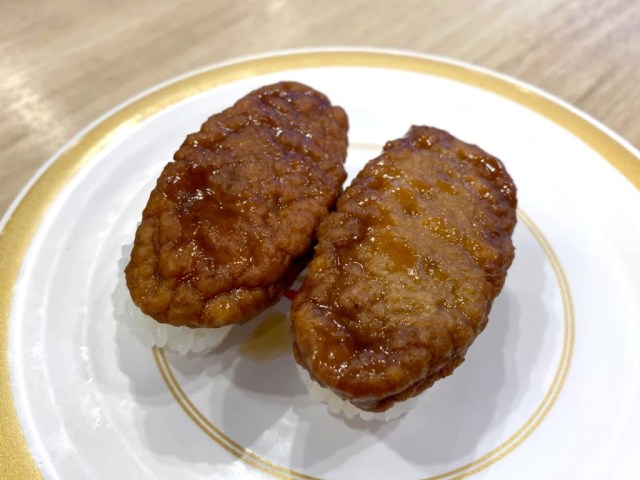
● Kappa Sushi

“The texture reminded me more of tsukune [chicken meatballs] than a hamburger patty, but this tastes great. After the milder flavors of more conventional sushi, this makes a huge impact, especially with the teriyaki sauce, and your taste buds instantly send the message ‘Good stuff here!’ This is a totally viable kind of sushi.”

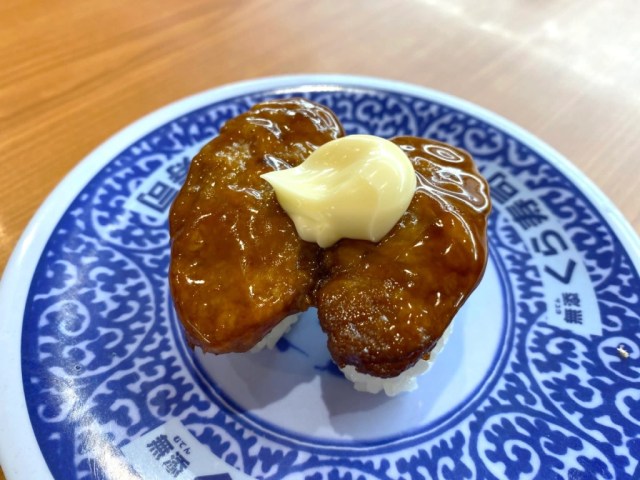
● Kura Sushi

“The quality of the meat isn’t all that different from Kappa’s, but the mayonnaise really makes its presence felt! This is as impactful as the Kura hamburger steak sushi, and I couldn’t help feeling ‘Yep, this is great!’ right away.”

● Hama Sushi

“The big difference here is that the Hama Sushi hamburger steak doesn’t have any sauce on it. That also loses it some points in the visual department, but the quality of the meat itself is really good. It doesn’t have the same level of impact as Kappa’s or Kura’s, but on the other hand the lack of sauce means you get the unaltered flavor of the meat, and it’s tasty.”

● Sushiro

“What sets this apart is the texture. Not that the other restaurants’ are stiff, but Sushiro’s hamburger steak is extra tender. That tenderness makes for a great mix with the rice, and it also has just the right amount of sauce.”

Despite P.K. going into this taste test feeling very skeptical about the concept of hamburger steak sushi as a whole, the chains went four for four, without a single bad-tasting one in the bunch, and each with their own unique appeal, just like Seiji had promised him. The stronger flavors of meat and sauce mean that you probably won’t want to make this the foundation of your sushi session, but as a mid-meal change of pace, hamburger steak sushi is surprisingly delicious, P.K. says, and he hopes you’ll find space in your stomach to try it at least once.

Photos © SoraNews24
● Want to hear about SoraNews24’s latest articles as soon as they’re published? Follow us on Facebook and Twitter!
Japanese city makes list of world’s top 10 most livable cities, but not one most people expected

https://ift.tt/a5dMPSj Dale Roll

If it’s not Tokyo, can you guess which city made the list?

There are thousands of cities in the world, and each one has its own charms, benefits, and challenges for the people that live in them. And as it turns out, there’s a rating for that. Designed by U.S. magazine Economist Intelligence, the Global Livability Index analyzes the challenges people face in 173 cities of the world and assigns each one a rating based on five factors: stability, healthcare, culture and environment, education, and social infrastructure.

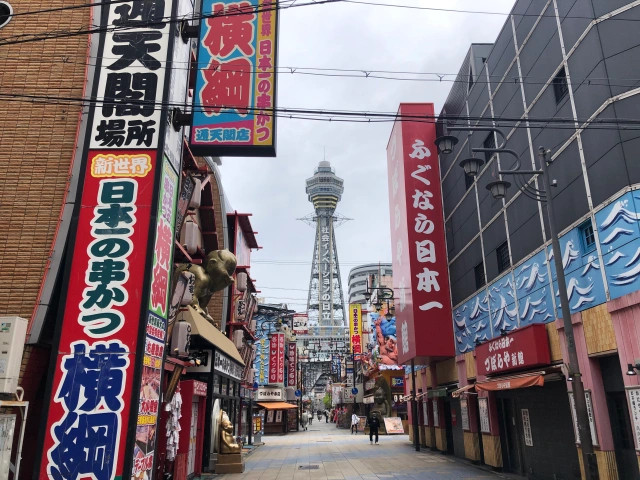
Due to a tie, this year eleven cities made the top ten, and in tenth place, tied with Melbourne, Australia, is one Japanese city that not many Japanese people expected to be the highest ranked for the country: Osaka.

The announcement came as a shock to many since a lot of Japanese people regard Osaka as a city that’s rough around the edges, compared to Japan’s other major metropolises. Though by international standards a relatively safe place, by Japanese standards Osaka has a reputation for more aggressive personalities, and dirtier streets, than other cities in Japan, and with Tokyo deemed the most livable city in the world in 2020 by a different organization, many were surprised to see Osaka ranked higher than the nation’s capital, and Japanese Netizens turned to Twitter to express their surprise.

“What is so livable about Osaka?”
“Even though it’s [often] where the most murders happen in Japan?”
“Personally I think Sapporo and Sendai are easy to live in. It doesn’t snow that much there and the summers are cooler than Tokyo or Osaka.”
“Is Osaka really more livable than Tokyo?”
“I would have thought it was Yokohama. Osaka doesn’t have a good reputation.”

But many other netizens came to Osaka’s defense.

“For some reason they never have any major natural disasters, like earthquakes, tsunami, heavy rains, and flooding.”
“I’ve heard Osaka is really welcoming to outsiders. It might be natural they’d make the list.”
“As an Osaka resident, I’m happy. It’s easy to get to sightseeing spots, the big city, and even natural environments. It really is easy to live here.”
“Rent in Kansai is cheaper than in Kanto, so economically speaking it’s probably more livable. And since safety was considered from an international perspective it’s probably about the same as Tokyo.”

The cost of living isn’t a factor included in the Global Livability Index scoring, so the comparatively inexpensive rent in Osaka probably didn’t play a role in its win over Tokyo or Yokohama, but many other factors likely did. For one, the index’s definition of “stability” includes more than just safety. Though crime rates are considered to be higher in Osaka than in other parts of Japan, it must have enough going for it in other categories–general stability, education, medical care, culture, and social infrastructure–to put it ahead of the rest of the country. After all, Osaka has just about everything Tokyo has, just with a bit more character.

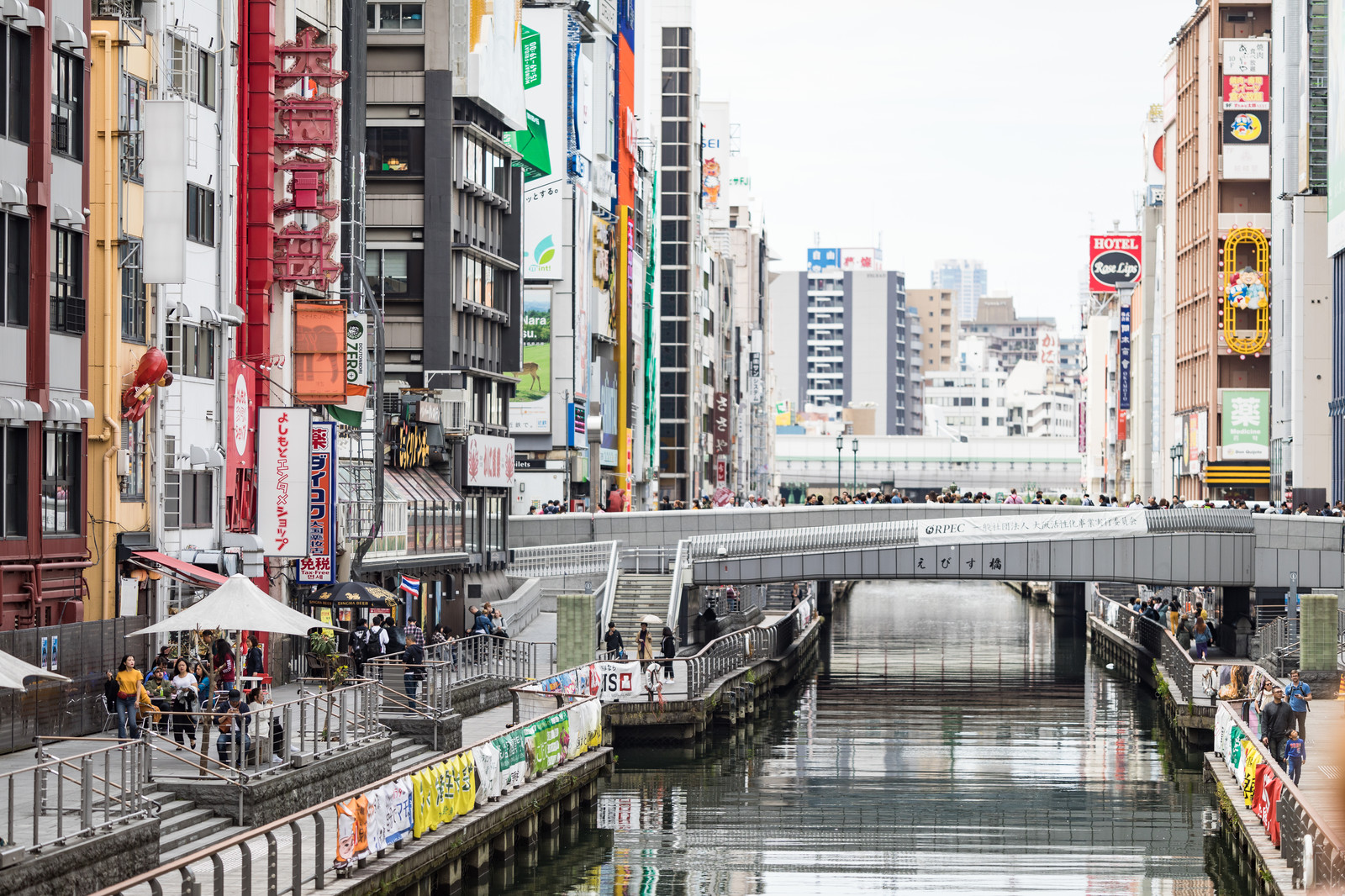
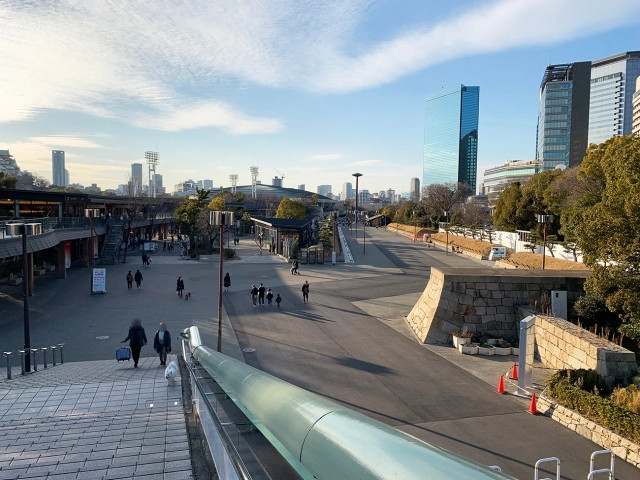
▼ The Osaka Castle Park area, for example, is a really nice shopping area that has a hidden tourist attraction.

The full ranking, by the way, is as follows:

1. Vienna, Austria
2. Copenhagen, Denmark
3. Zurich, Switzerland
4. Calgary, Canada
5. Vancouver Canada
6. Geneva, Switzerland
7. Frankfurt, Germany
8. Toronto, Canada
9. Amsterdam, Holland
10. Osaka, Japan / Melbourne, Australia

With so many European countries dominating the list, Japan should be proud to have a city that made it to the top 10…and to be the only Asian city on the list, to boot!

Source: Economist Intelligence via Yurukuyaru via My Game News Flash, Twitter (1, 2)
Top image: Pakutaso

Insert images © SoraNews24