Páginas

domingo, 1 de mayo de 2022

We try a can of Space Mackerel, designed for eating on the ISS by high school students

https://ift.tt/VRAY3ux Master Blaster

In space, no one can hear you slurp.

Given the many challenges of life in space, a lot of people probably assume the food there focuses so heavily on nutrition, safety, and digestibility in zero gravity, that things like taste and texture are very much an afterthought.

That’s what our writer Haruka Takagi thought until she came across Wakasa Space Mackerel Can in a small fishing town in Fukui Prefecture. Unlike the vacuum-sealed packets of baby-food like pastes she imagined astronauts eating, a can of mackerel dripping in juices seemed far too dangerous for consumption in space.

If just one globule of fish oil floated through the zero-gravity conditions of outer space, its savory goodness could make its way into sensitive equipment and disable the ship’s neutrino thrusters, cloaking device, or whatever it is they use up there.

That’s not the case with Wakasa Space Mackerel Can, however, and back in 2020 it was even dined upon by Japanese astronaut Soichi Noguchi during a mission.

▼ Noguchi enjoying a Wakasa Space Mackerel Can aboard the ISS.

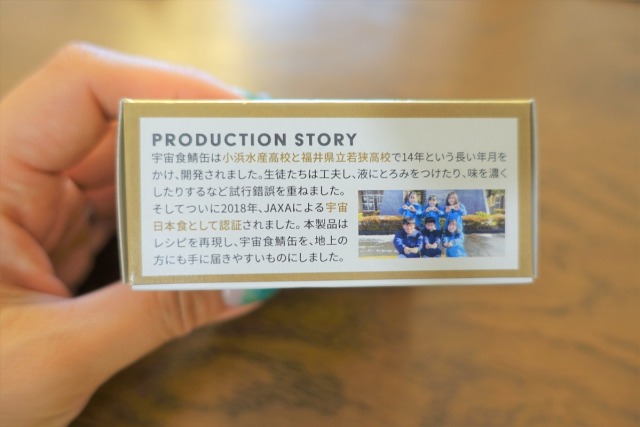
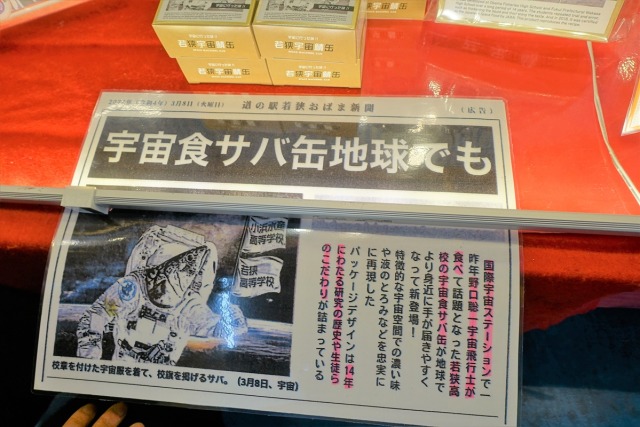
Even more impressive than a can of mackerel designed to JAXA specifications for space consumption, was the fact that it was made by the students of Wakasa High School in Fukui Prefecture. It was a project that took 14 years of trail-and-error experimentation passed down through the classes at the school, until they received certification in 2018.

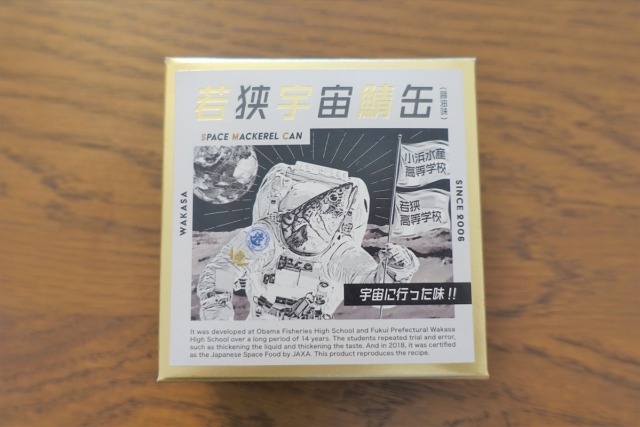
That was all quite amazing, but it was the cute picture of the mackerel in a spacesuit on the moon with the flag of Wakasa High that really sealed the deal for Haruka. So, she paid the understandably steep price of 700 yen (US$5) for a can and took it home to try out.

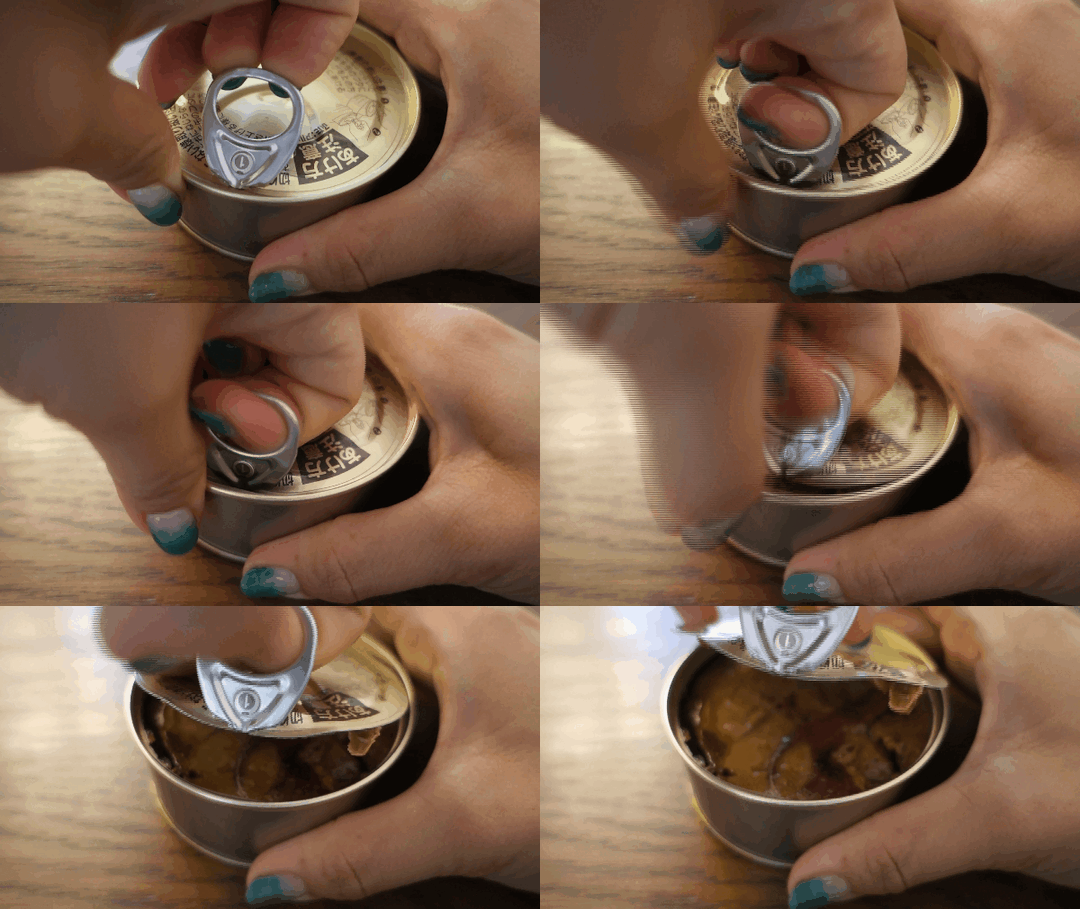
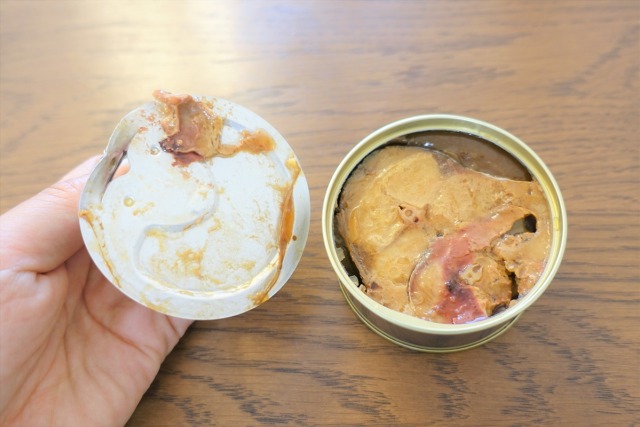
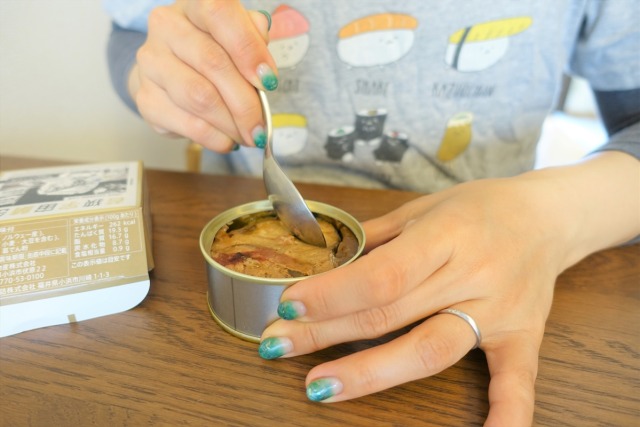
Normally, when opening a can of fish, you can expect a tiny spurt of oil to pop out, but as we mentioned, even the smallest droplets can put the crew in jeopardy. Luckily, Haruka found that opening a can of Wakasa Space Mackerel was completely dry.

There were no liquids at all in the can!

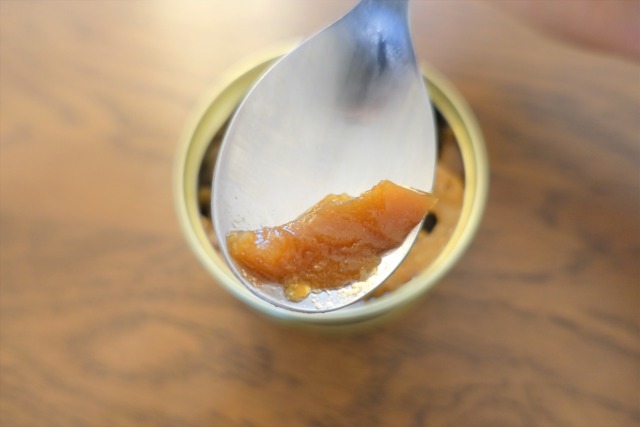
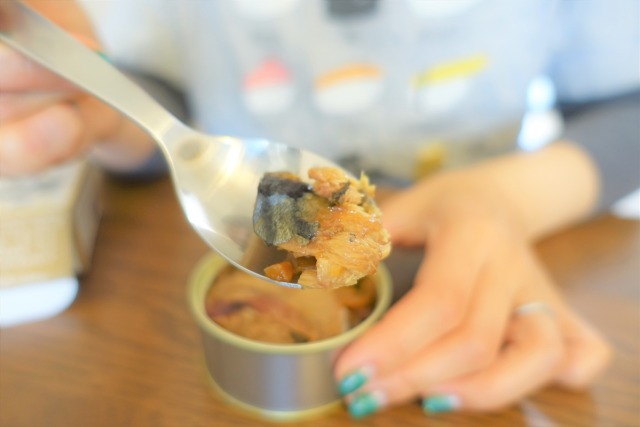
Instead, the sauce had a more gelatinous consistency that was made with the help of a starchy powder from the kudzu plant. Kudzu powder is used in a lot of Asian dishes, especially desserts like mizu manju.

Haruku was able to easily cut right into the fish with a spoon. It had a very delicate and fatty consistency.

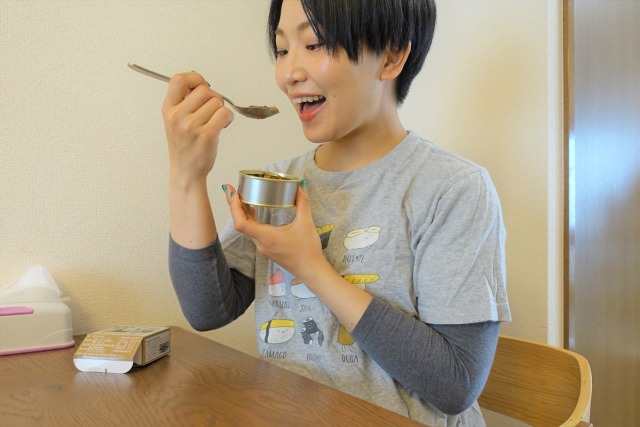
The taste was amazingly good too. The sauce seemed extra rich and sweet and it had a very hearty taste of home cooking, which was the last thing she was expecting from space food.

Apparently, it’s been said that in low gravity people’s sense of taste is weakened. That’s why the makers of Wakasa Space Mackerel made sure to jack up the taste in each can through additional sugar in the sauce.

It wasn’t just a literal out-of-this-world experience but a culinary one as well. Haruka felt whisked out of her kitchen chair and onto the outer surface of the ISS, where she was tasked to repair the starboard photovoltaic radiator.

If you’d like to join her out there among the stars, keep an eye out for Wakasa Space Mackerel next time you visit Fukui Prefecture, or order some online from your favorite online Japanese space food retailer.

Photos: ©SoraNews24
● Want to hear about SoraNews24’s latest articles as soon as they’re published? Follow us on Facebook and Twitter!

We try the second round of Mister Donut’s collab with Japanese confectionary maker Gion Tsujiri

https://ift.tt/q2iDAvR Dale Roll
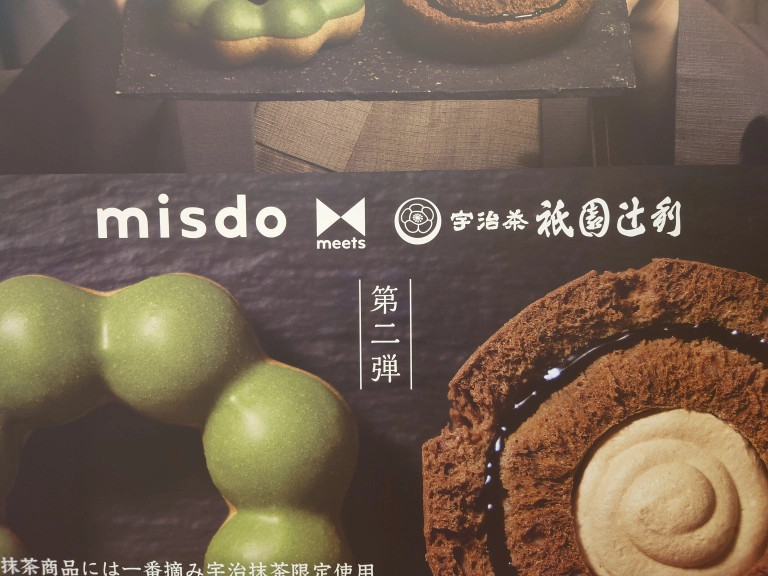
Five new types of donuts with matcha and hojicha flavors? Count us in!

Mister Donut, or “Misdo” as it’s colloquially known in Japan, is currently doing great things with Kyoto-based Japanese confectionary maker Gion Tsujiri. They had only just released the first round of Misdo meets Gion Tsujiri donuts last month, and now are already moving on to a whole new set of matcha and hojicha-flavored donuts.

Like the first round, the second round, which just came out on April 27, features the flavours of Uji Matcha, or green tea, and Uji Hojicha, or roasted green tea, this time in different donut forms. There are altogether five donuts in Round 2 of the Misdo meets Gion Tsujiri collaboration. Three of them are matcha-flavored Pon de Ring donuts, which is Mister Donut’s original recipe of chewy donut holes attached together in a ring. The other two are “old-fashioned” donuts flavored with hojicha. You can buy each one individually or together in the “Gion Tsujiri Eat and Compare Set” (1,003 yen [US$7.65]), which comes with an original paper shopping bag (while supplies last).

The marketing of this second round asks its customers, “Matcha Pon de Ring or Hojicha Old Fashioned: which one’s for you?” There’s no way we could give an honest answer without tasting them all, so our taste-tester, Japanese-language reporter Tasuku Egawa, went to Mister Donut on the release day to try them out. Though it had only been the first day of the donuts’ release, the paper shopping bags were already sold out. Nevertheless, all five donuts were still available, so he snatched one of each and brought them home for a diligent taste test.

First up was the Pon de Ring Double Uji Matcha donut (170 yen).
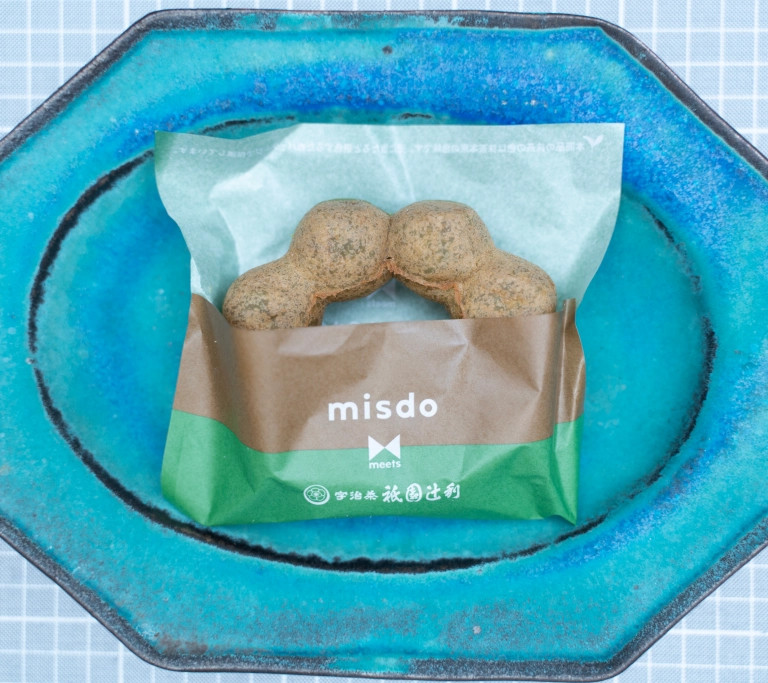
This one had one side coated in matcha chocolate.
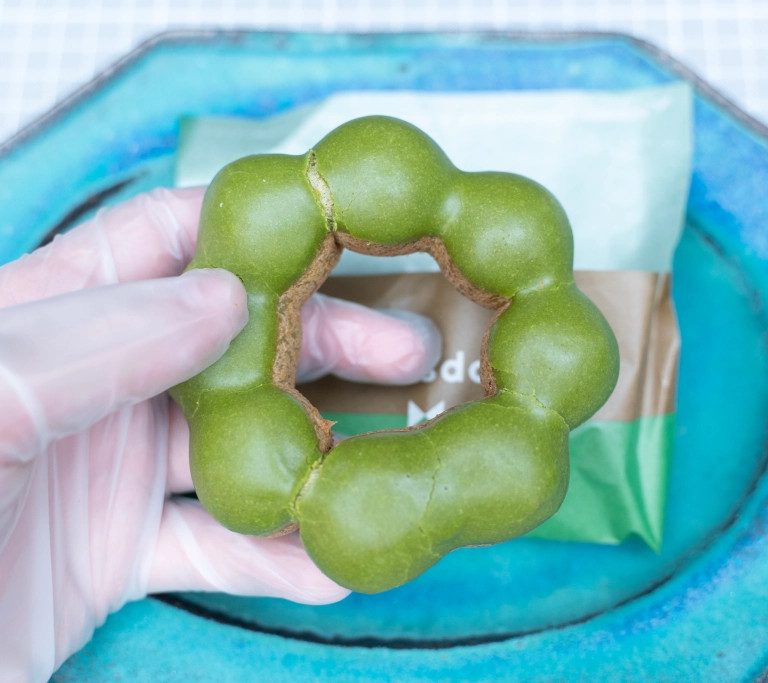
Breaking the donut apart revealed an interior of vibrant green, so the dough was clearly infused with matcha before baking. True to its name, it had a double punch of matcha.
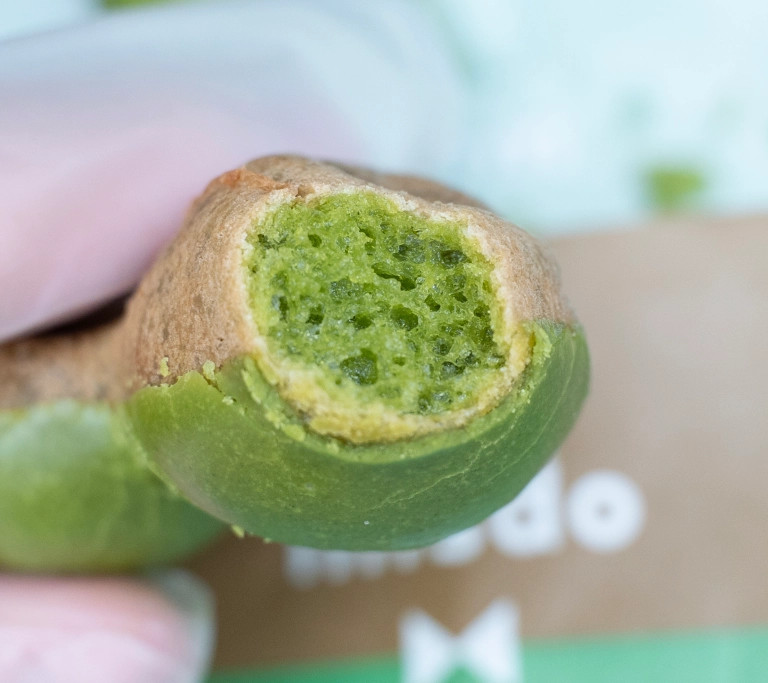
The donut as a whole was sweet, but the dough had the bitterness of true matcha infused into it. It was strong enough to surprise Tasuku and was a pleasant contrast from the usual matcha-flavored sweets, which are generally more sugar than matcha. It’s precisely because it’s a very simple recipe that you can really get a feel for the quality of the ingredients. This was a good start to Tasuku’s taste test.

Next, Tasuku tried the Pon de Ring Uji Matcha Azuki donut (190 yen). This donut, dusted with brown sugar, looked really good, and Tasuku’s first impression of it was that it was heavy.
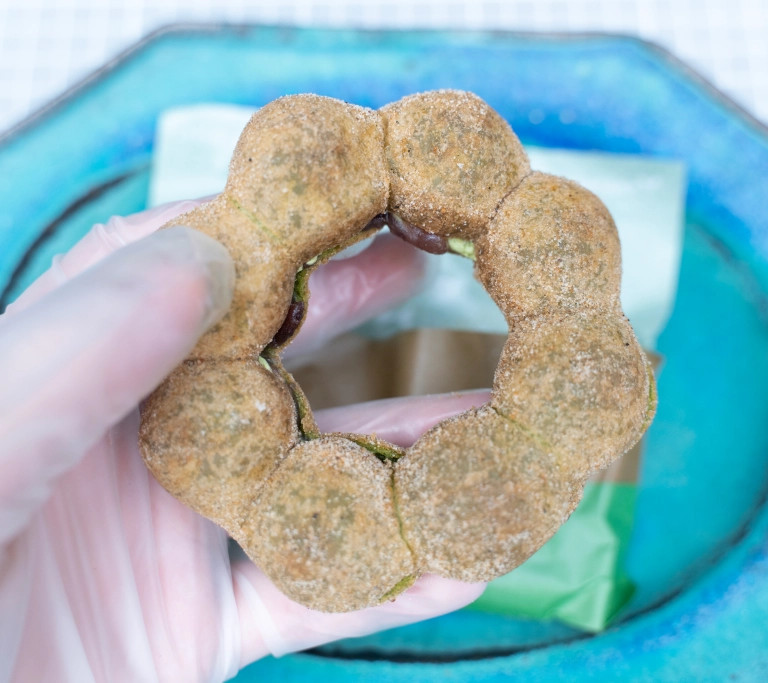
Not heavy in flavor, but heavy in weight. It had a significant heft to it that surprised him. He might even say it was the heaviest Pon de Ring donut he’d ever held.
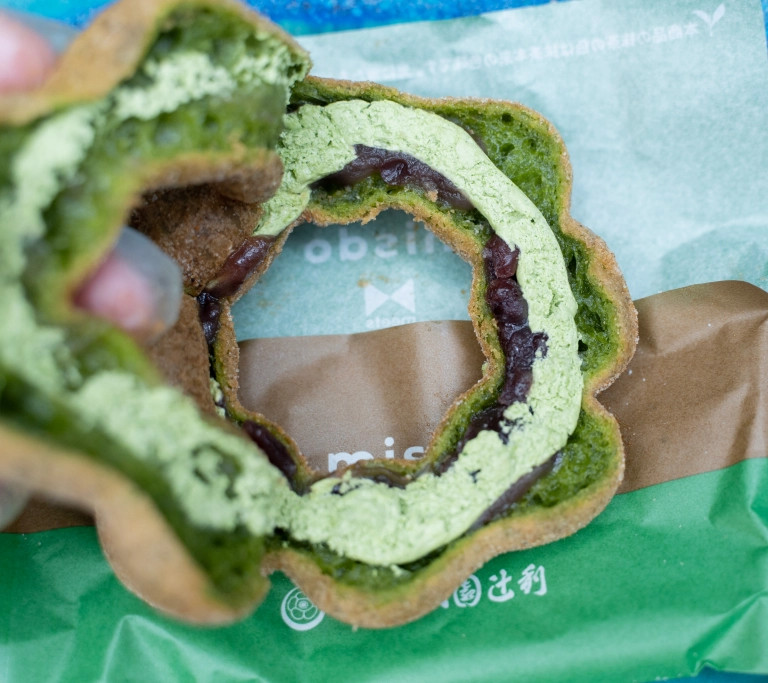
That’s because it was a sandwich-style Pon de Ring with a filling of red beans and matcha whipped cream. Combined with the Japanese brown sugar and the matcha-infused dough, this donut was a smorgasbord of Japanese flavors. What’s more, the dough was beautifully moist, possibly owing to the water content of the red beans and the whipped cream. This one was really good!

The last of the matcha Pon de Ring donuts was the Pon de Ring Uji Matcha Warabimochi donut (190 yen). In this one, Tasuku experienced a novel deliciousness.
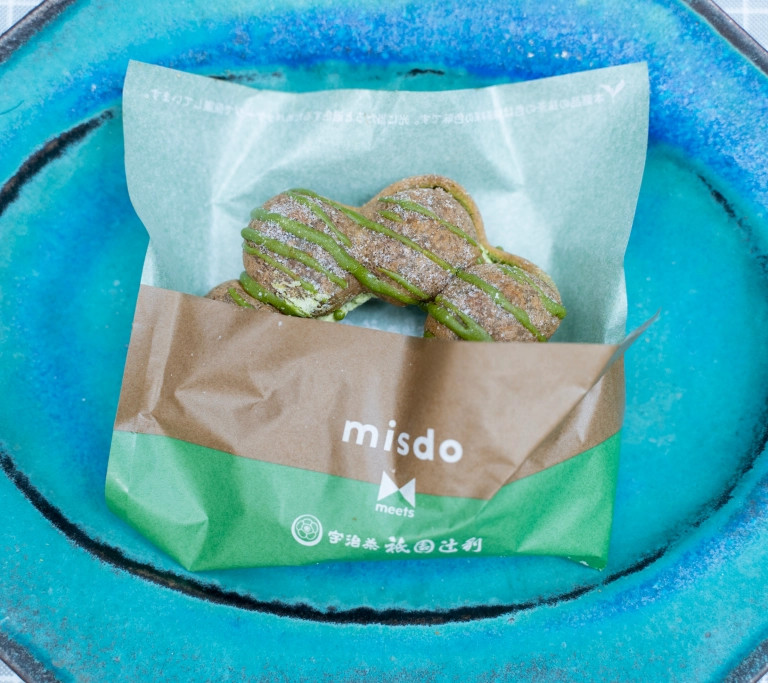
This one was just as heavy as the Azuki donut. This is likely also due to the fact that it was a sandwich-type, and Tasuku was excited to see what was inside.
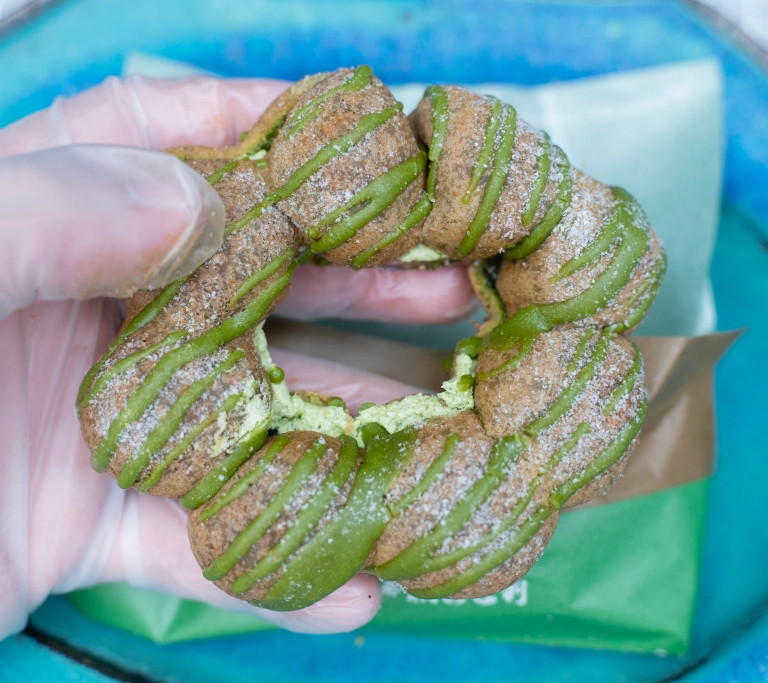
It might be hard to tell from the picture because it’s translucent, but underneath the matcha whipped cream was a filling of warabimochi, a jelly-type dessert. It looked mouthwateringly good.
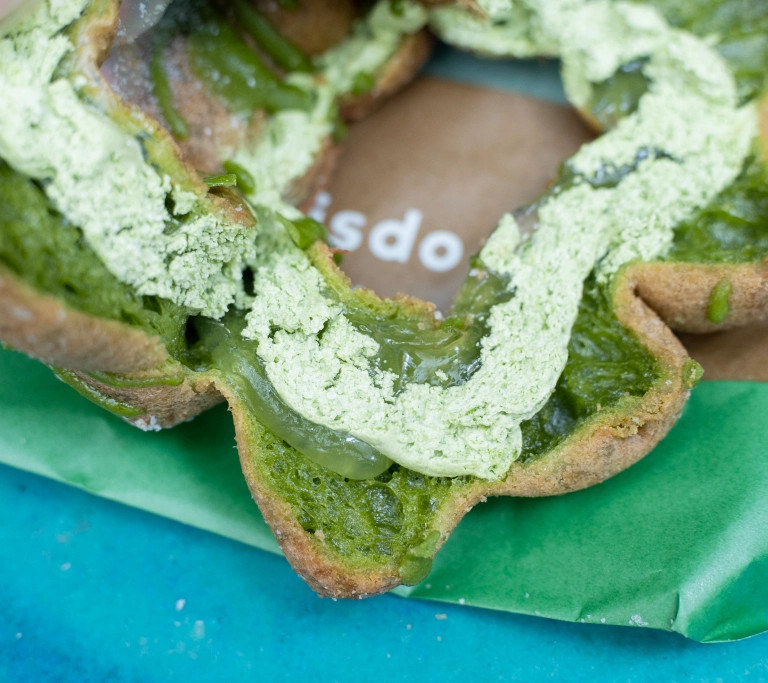
Combined with the doughy texture of the donut, the warabimochi and its slipperiness lent the whole donut a very jiggly texture, and all the toppings combined added a nice moisture to the donut. It was the first time Tasuku had ever tried a Pon de Ring like that. The donut was also light on sugar, which was supplied by the simple sweetness of the warabimochi. The combination of matcha-flavored dough and warabimochi was extremely flavorful. For Tasuku, out of not only the three matcha donuts, but all five of the donuts, this was his favorite.

That’s not to say that the hojicha-flavor old-fashioned donuts were not good, however. Tasuku also liked the Old-Fashioned Uji Hojicha donut (180 yen).
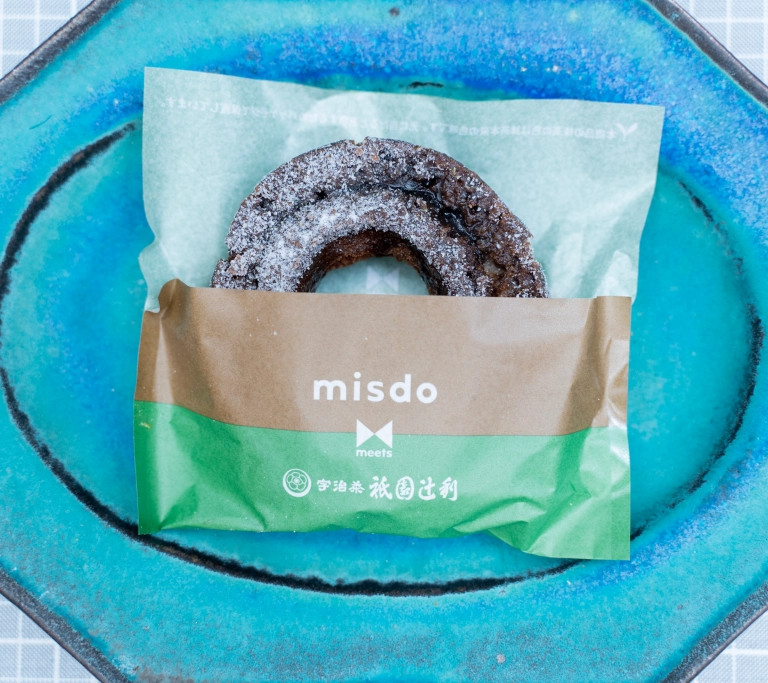
It may be hard to tell from the photo, but this donut had a different color from a regular Old-Fashioned donut. Perhaps because of the hojicha mixed into the dough, it was a nice ochre brown color instead of the usual light brown.
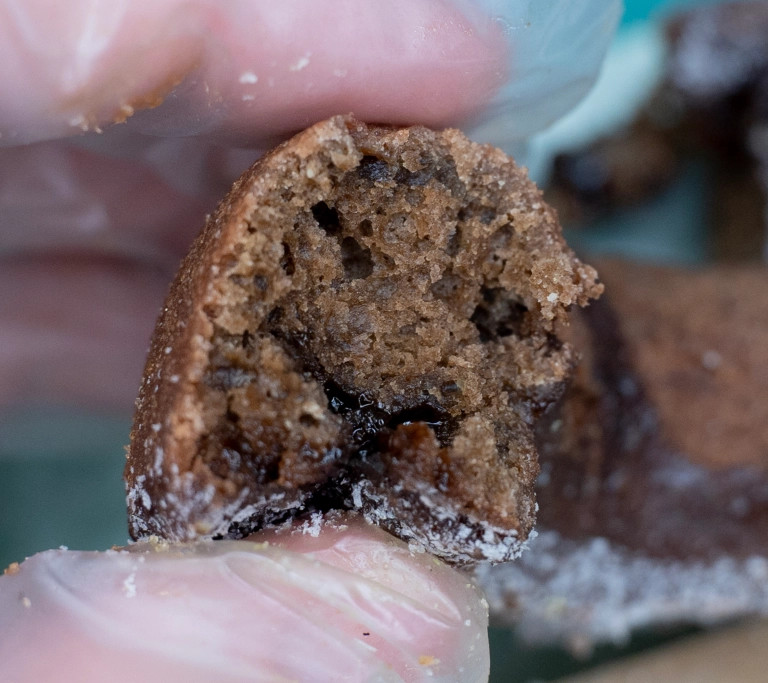
One side was soaked with a hojicha glaze, giving it a nice moistness. Even without eating it, Tasuku could smell the hojicha in it.
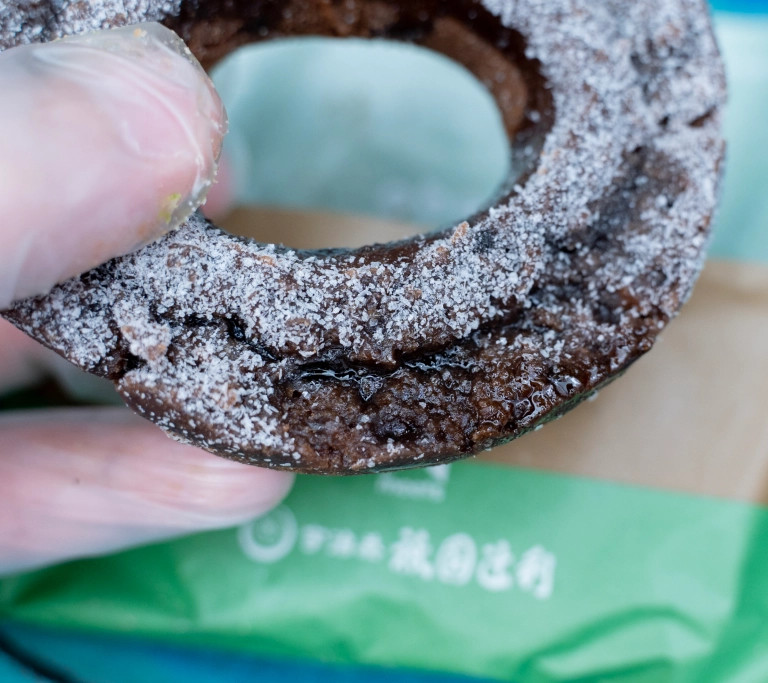
As such, he expected it to just about taste like a cup of hojicha tea, but in actual fact, it had a strong sweetness to it. Tasuku didn’t object to that; that sweetness combined with the fragrant taste of hojicha made for a surprisingly good pair.

Lastly, Tasuku tried the Old-Fashioned Uji Hojicha Whip donut (200 yen). This one looked like it was going to be the most luxurious of all the donuts. It even came in its own special box!

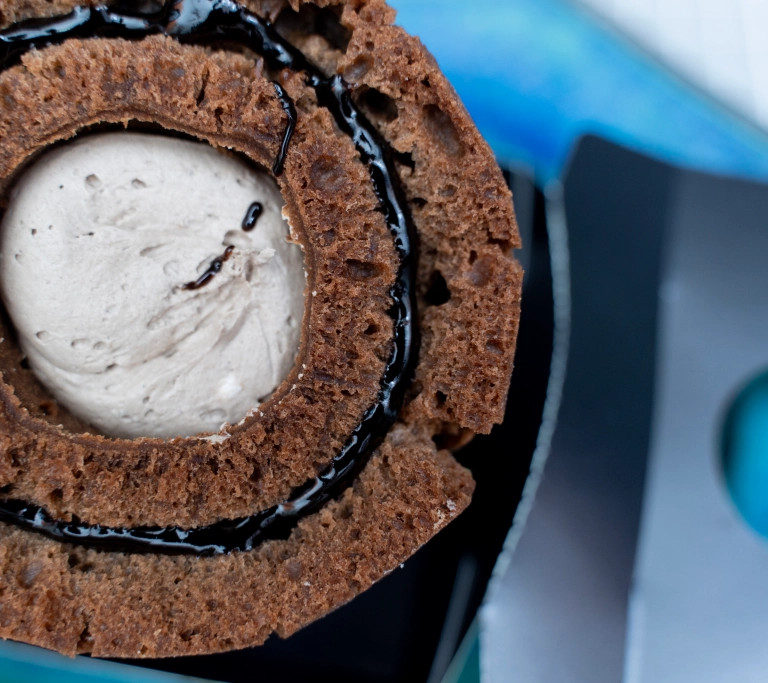
The donut inside was topped with some kind of syrup, and had some kind of creamy substance in the middle. This turned out to be a hojicha-flavored whipped cream.

I bet you’re wondering how you’re supposed to eat a donut whose hole has been stuffed with whipped cream without making a huge mess. Worry not: the bottom of the donut was lined with hardened chocolate, providing a barrier for keeping the whipped cream in place.
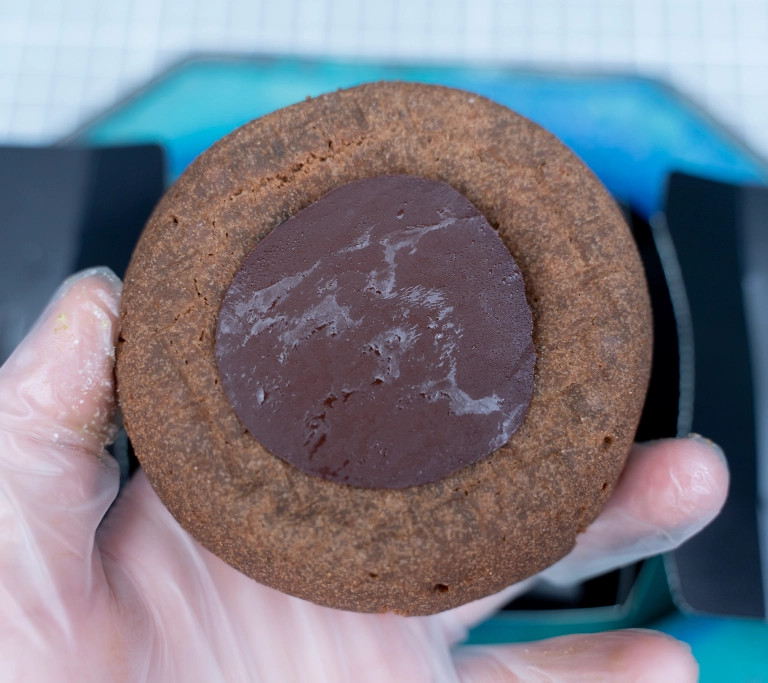
A quick taste test determined the syrup drizzled in the center of the donut’s dough was hojicha syrup.
And that’s not even all. Hiding underneath the hojicha whipped cream was a filling of warabimochi!
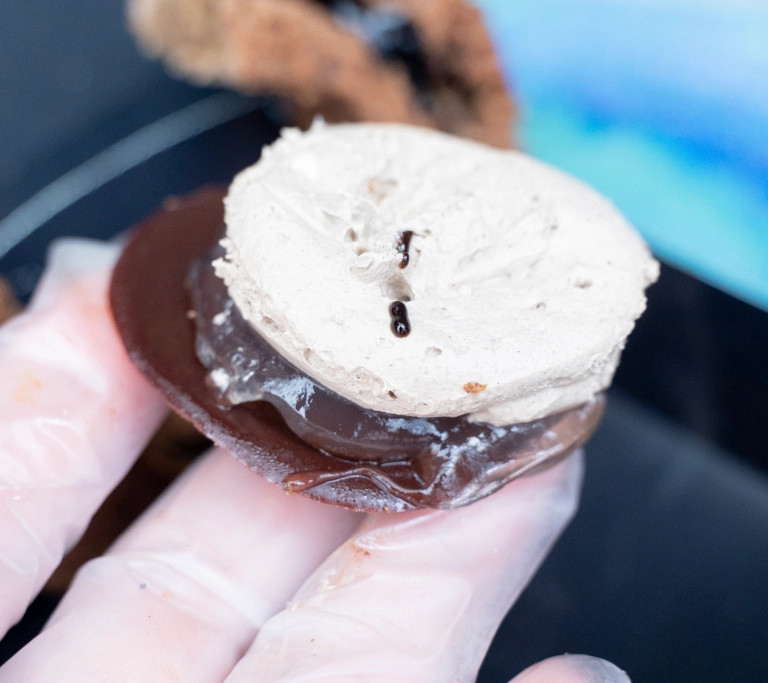
Tasuku took it all apart for the purposes of this article, but he doesn’t recommend doing that if you try this donut. The warabimochi is slippery, which makes it easy for it to fall off the chocolate slab. Tasuku accidentally dropped it when trying to reassemble the donut, which resulted in a bit of a catastrophe.
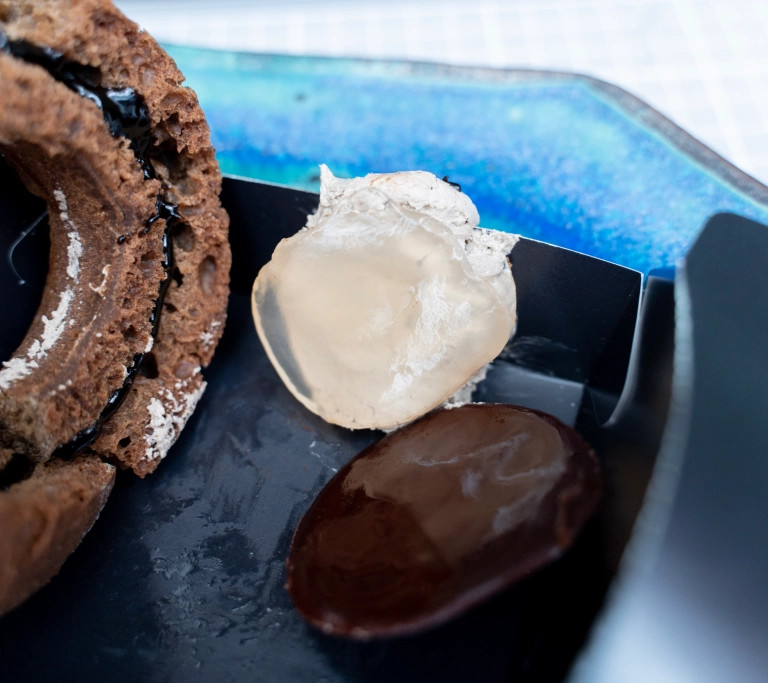
In any case, the intricacy of this donut and the lengths to which its inventors went to put it together were really interesting. Upon tasting it, Tasuku was just about punched in the face with its sweetness. It was much sweeter than he’d anticipated, but he supposed that was just the way of the Old-Fashioned donut. That sweetness was augmented by the chocolate and the whipped cream, making it a sugar overload. Out of the five, Tasuku would say that this one was by far the sweetest.

Sadly, Tasuku would have to say that the mild flavor of the warabimochi and the taste of the hojicha syrup were quite overwhelmed by the other elements of this donut. However, the warabimochi did retain its unique, jelly-like texture, which came through nicely in each bite. It was still an undeniably delicious donut, and the many elements in it made it exciting, but Tasuku would have to say that the balance of flavors was just not quite there for this one.

So, in answer to Mister Donut’s question, “Which donut is for you?” Tasuku would have to say he’s throwing his hat in the matcha Pon de Ring camp, especially since that warabimochi one was just so good. However, it was a close margin. If you’re aiming for sweetness, the hojicha Old-Fashioned donuts have the edge. Which one is for you? You’ll just have to try them to find out. They’re expected to be around until the end of May, so hurry over to your neighborhood Mister Donut and give them a try before it’s too late!

And if you’re looking for more Japanese sweets-inspired collabs with Gion Tsujiri, be sure to check out McDonald’s Japan’s latest selection of desserts, too!

Images © SoraNews24
● Want to hear about SoraNews24’s latest articles as soon as they’re published? Follow us on Facebook and Twitter!

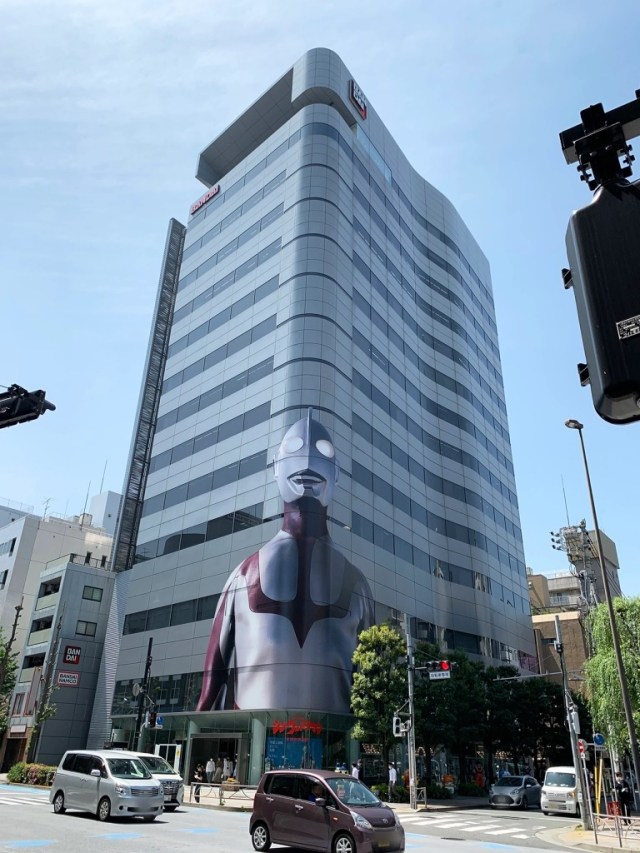
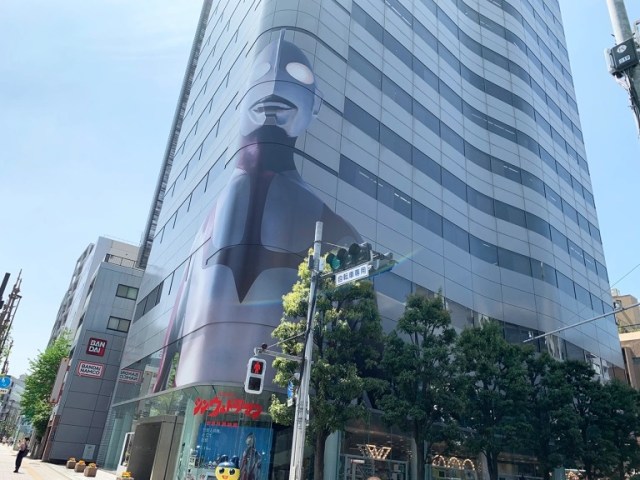
1:1-scale Ultraman artwork appears on headquarters of Japan’s biggest toymaker【Photos】

https://ift.tt/D8U6NXk Casey Baseel

Other anime and tokusatsu heroes can be seen on the sidewalk below.

With so many of Japan’s anime series taking place in Tokyo, fans might half-expect to suddenly find themselves walking past their favorite characters on the streets of the capital. But come on now, this is real life we’re talking about here, and-

Oh, wait, it turns out there is a street in Tokyo where heroes such as Dragon Ball’s Son Goku and Anpanman are just hanging around on the sidewalk. There’s a reason for this, and it’s that this is the sidewalk right in front of the head office of Bandai, Japan’s biggest toymaker and otaku-oriented merchandiser, in Tokyo’s Asakusa neighborhood.

▼ Good to see Doraemon has returned from his near-death experience at the bottom of the sea.

You’ll even find tokusatsu icons Ultraman and Kamen Rider standing guard, ever vigilant as they keep an eye out for a crisis that needs their attention.

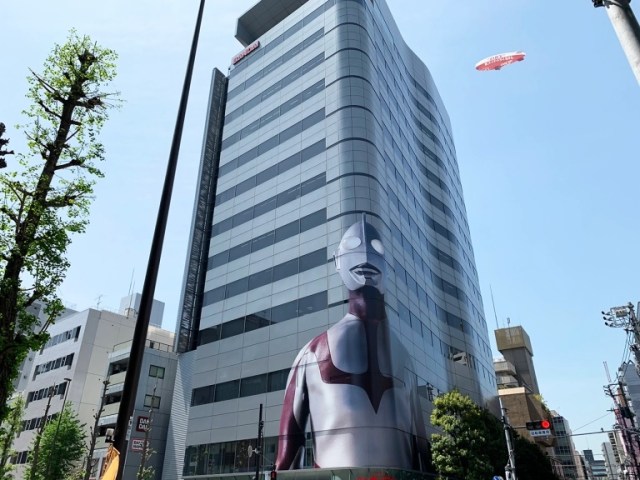
As cool as the statues are, though, we have to admit it’s a little anti-climactic seeing Ultraman in human size. After all, he fights full-size kaiju with his bare hands on a weekly basis, so really he should be a lot bigger. He should be….

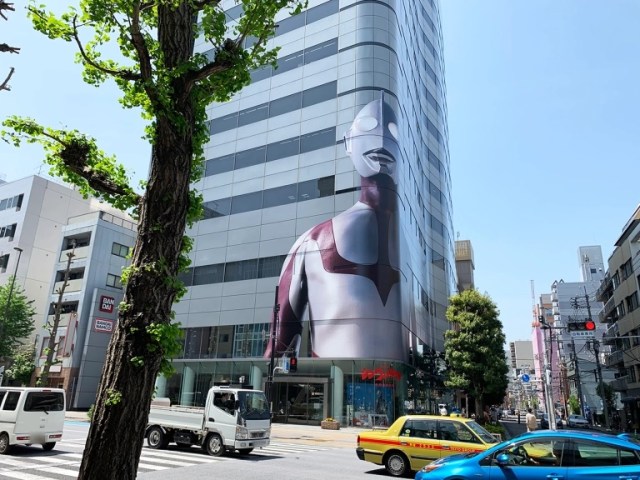
…this big.

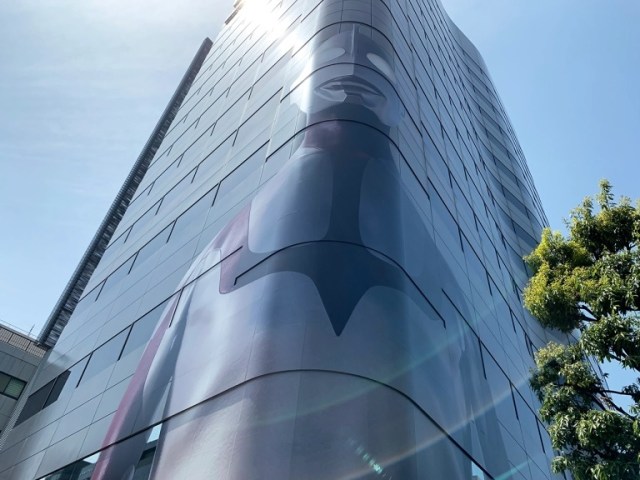
Ah, that’s more like it. Though he’s not a permanent part of the exterior, right now the Bandai building is sporting 1:1-scale artwork of the hero, as part of the runup to the release of Shin Ultraman, the franchise’s newest theatrical installment.

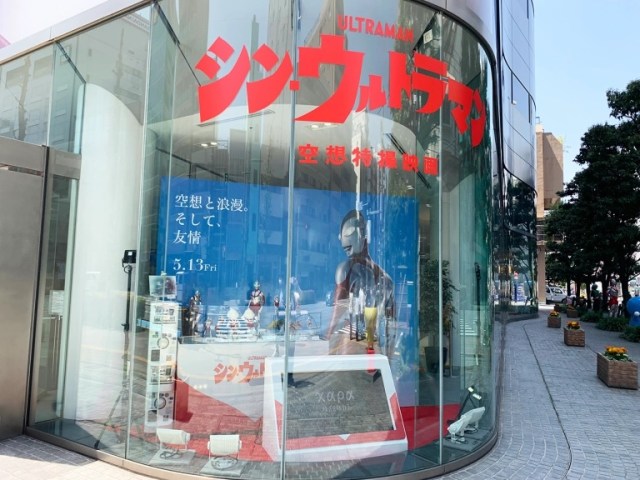
▼ There’s a Shin Ultraman display at ground level too.

Shin Ultraman is being produced by Hideaki Anno, who also directed Evangelion and Shin Godzilla. Out of those three titular stars, though, Ultraman’s unalloyed heroism makes him the most reassuring to see rendered in full-scale.

We can probably expect the ultra-sized art to be up at least until Shin Ultraman premiers in theaters on May 13, so we might pick up an Ultraman chicken burger and go back to have lunch with the big guy before then.

Location information
Bandai Headquarters Building / バンダイ本社ビル
Address: Tokyo-to, Taito-ku, Komagata 1-4-8
東京都台東区駒形1-4-8

Photos ©SoraNews24
● Want to hear about SoraNews24’s latest articles as soon as they’re published? Follow us on Facebook and Twitter!
Taste testing 7-Eleven Japan’s five frozen curries to see which ones nail it

https://ift.tt/bz1Ho4K Shannon

Frozen curry may not sound appetizing, but 7-Eleven can make anything great.

We love what 7-Eleven Japan is putting down lately, whether it’s delicious smoothies you can blend yourself or Zero Cider Triple drinks.

In recent news, our Japanese-language reporter P.K. Sanjun noticed an advertisement for 7-Eleven’s frozen food section and saw that they’d apparently renewed their frozen curries in April.

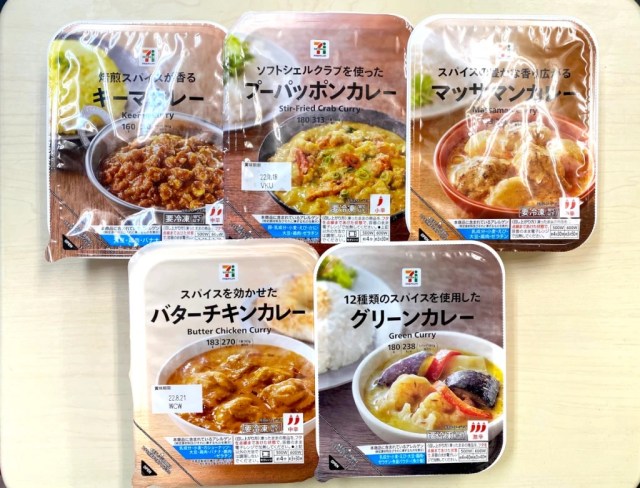
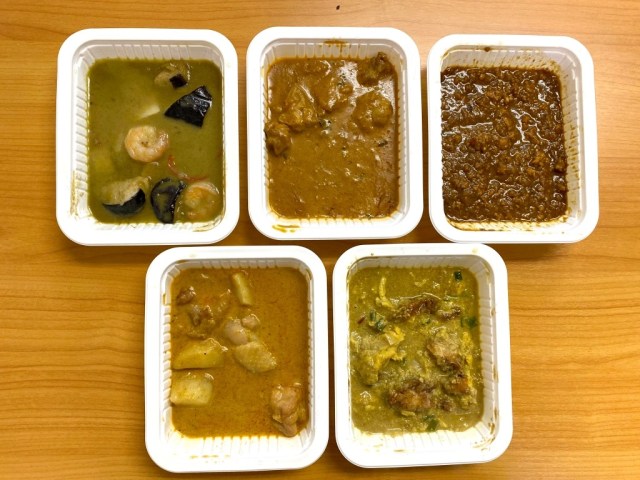
Since he hadn’t tried them before, he decided to see if they were any good — though he didn’t exactly have doubts. Here are the five types he rounded up.

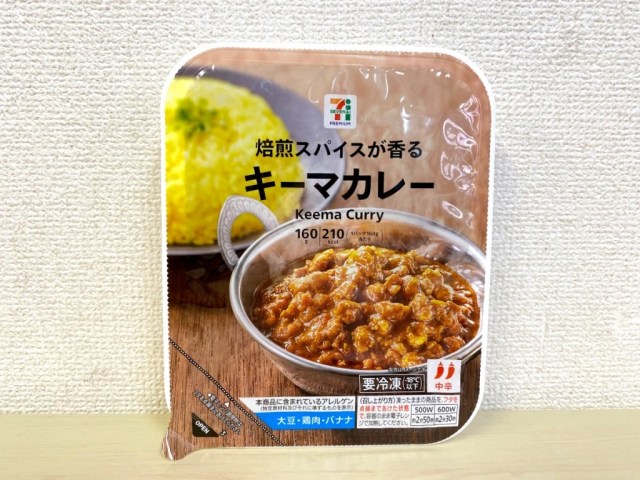
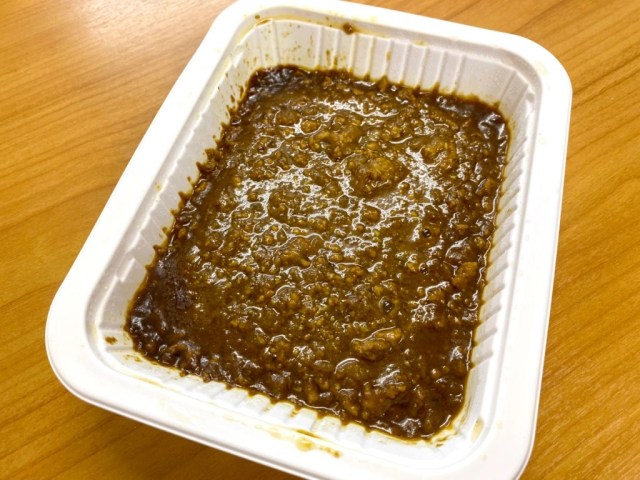
▼ Keema Curry for 397 yen (US$3)

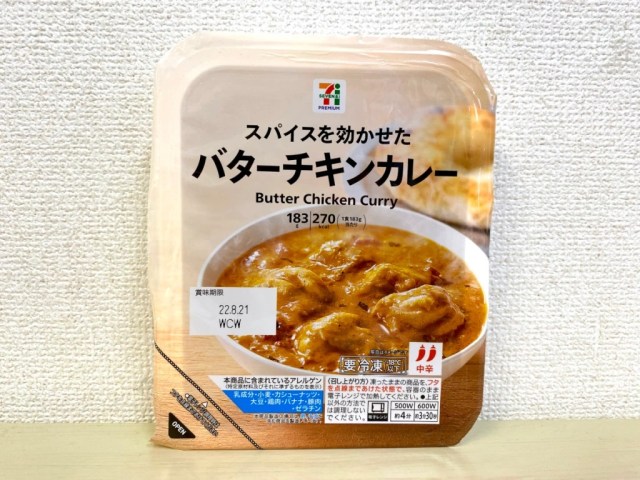
▼ Butter Chicken Curry for 375 yen

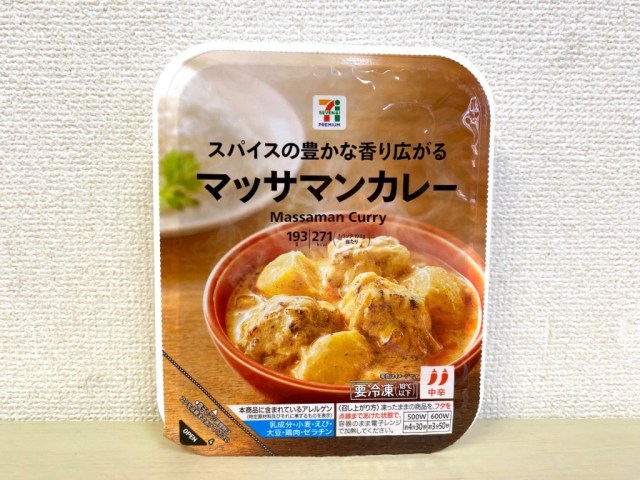
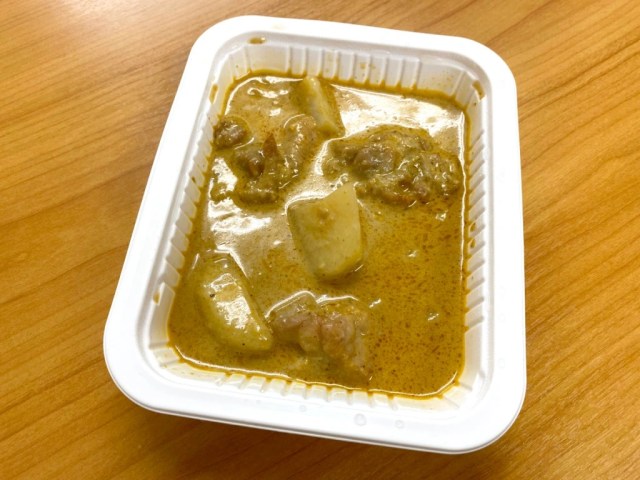
▼ Massaman Curry for 397 yen

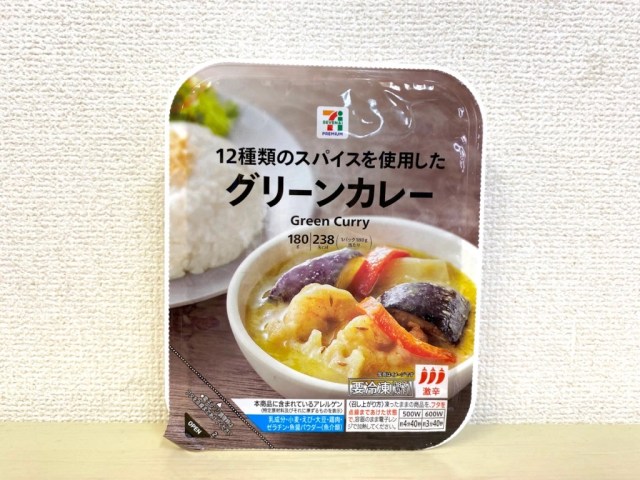
▼ Green Curry for 397 yen

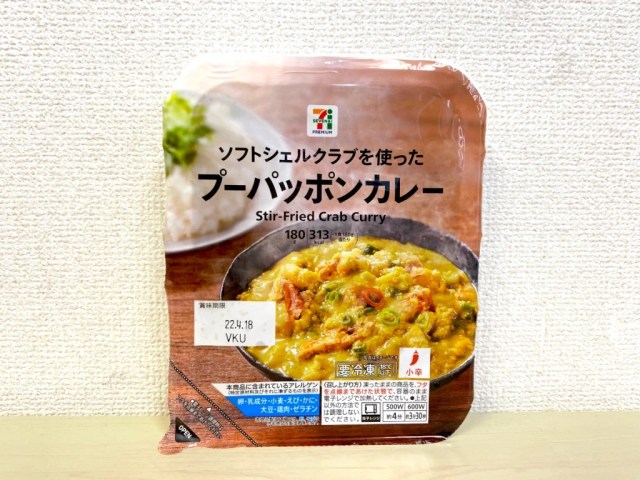
▼ Stir-Fried Crab Curry for 375 yen

He decided to try all five for a ranked taste test. The recipes for the keema, butter chicken, massaman, and green curry were renewed in April, but since he hadn’t tried the stir-fried crab curry before, he decided to try that one as well.

▼ He wasn’t planning on just eating it plain either.

▼ And what curry doesn’t go well with cheese?

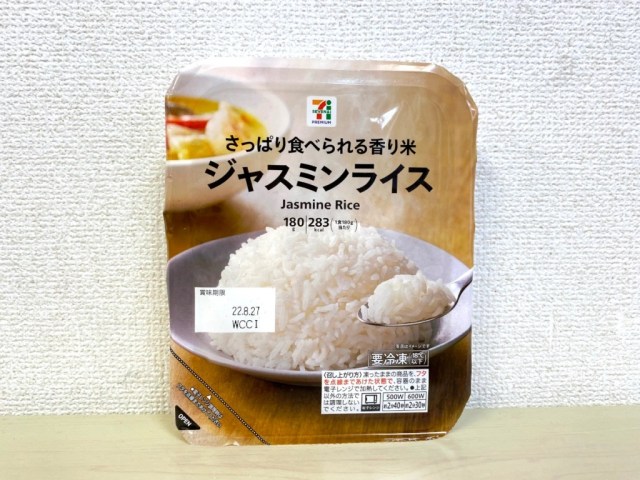
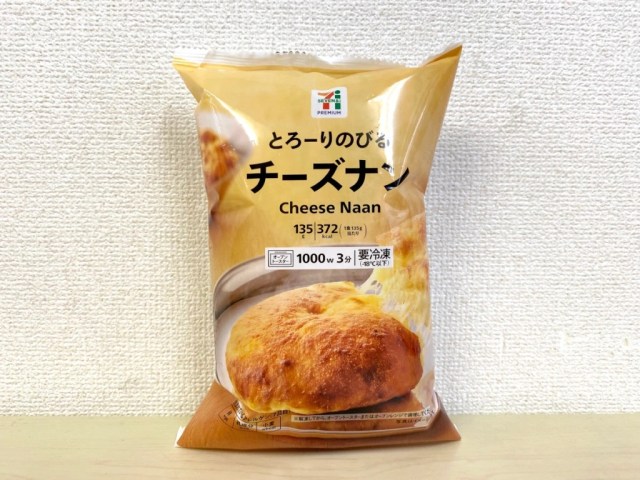
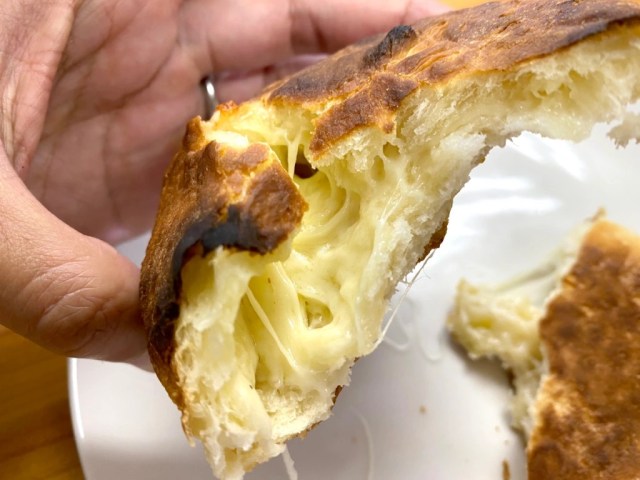
He also found another pleasant surprise — they had sides to go with them! They sold jasmine rice for 159 yen a pack and cheese naan for 268 yen each. He could recreate an entire curry restaurant experience in his own home.
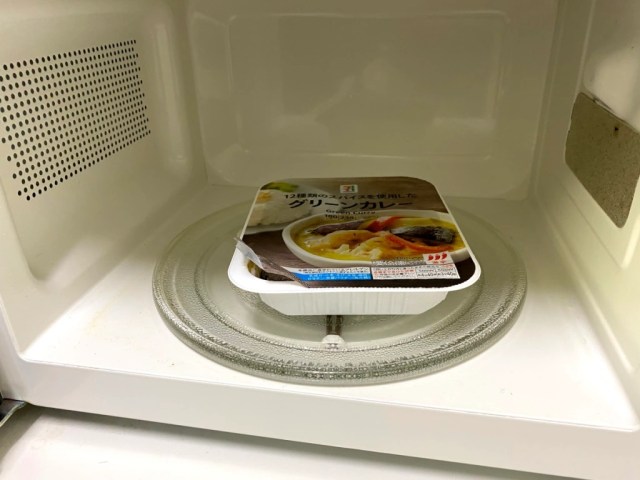
▼ They’re super convenient to make, too. Right in the microwave!

Everything just needed to be heated up, with the exception of the cheese naan, which also called for a toaster. Still, it’s pretty convenient as far as frozen food goes.

With all of the curries and fixings prepared, P.K. Sanjun was ready to rank these curries from least mind-blowing to most delicious.

▼ Ranking: begin! What curry do you think this is?

Coming in fifth place was the butter chicken curry. He rated it as such because he wished it was more on the sweeter side. That doesn’t mean it’s not good, but if you’re like him and enjoy a sweet butter chicken curry, you might be disappointed. The mild taste and spices made up for it.

▼ Next was a Thai-style contender.

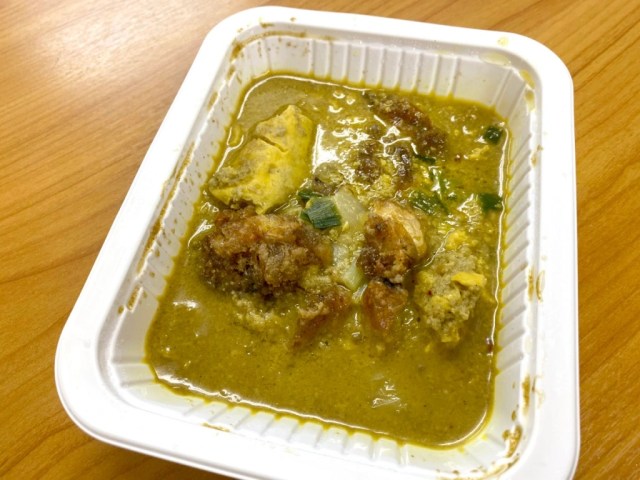
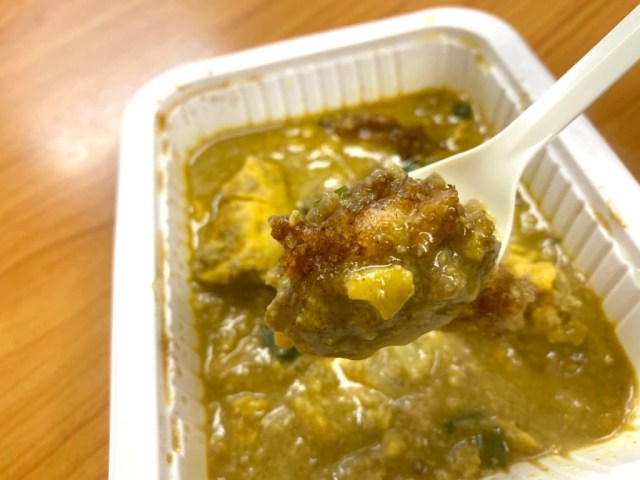
In fourth place was the stir-fried crab curry. This Thai curry is also a sweeter curry and consists of crab, eggs, and more. P.K. Sanjun had had the real deal in Thailand before, so he was excited to see it sold at 7-Eleven. The soft-shelled crab and flavor were good, but weren’t mind-blowing. He’s not complaining, though, especially considering the price.

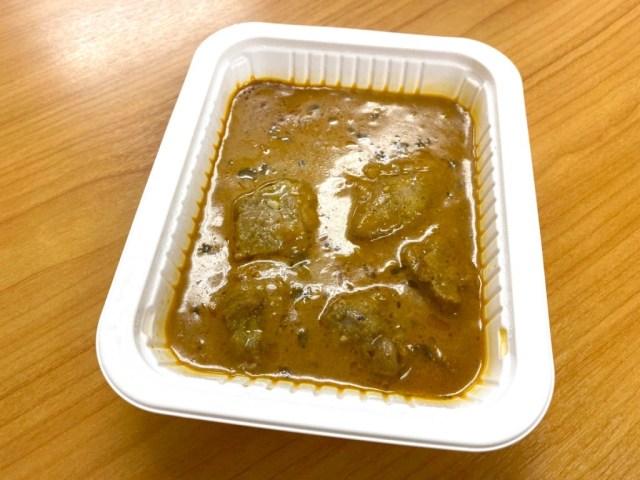
▼ Can you tell what this is just by looking at it?

In third place was the Massaman curry, a Thai dish inspired by Indian and Malay curries. The lemongrass-enhanced curry was very easy to eat, and he thought it tasted better than some restaurant versions. Pretty impressive for a convenience store! If you can’t handle a ton of spice, though, note that P.K. Sanjun would describe this as having a medium spice level.

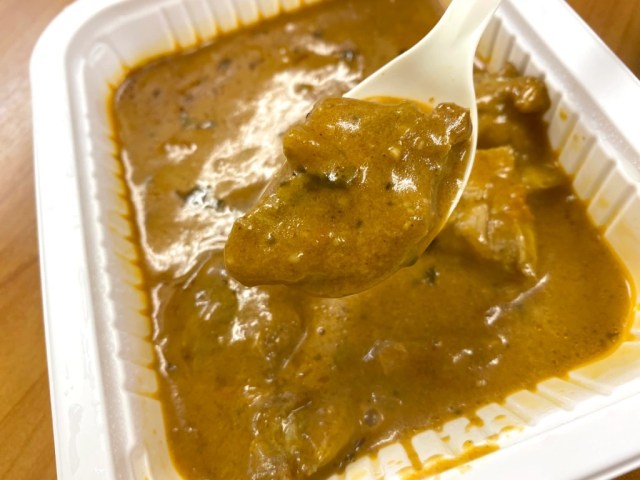
▼ We can’t say we’re surprised this popular variety made second place.

Coming in second place was the keema curry. He could really taste the onion and ground meat umami flavors that define a good keema curry. If you want a really meaty tasting curry, this is the one to get. It wasn’t too spicy, and they didn’t skimp on the meat like some other places tend to do. A+, 7-Eleven.

▼ The color gives this one away.

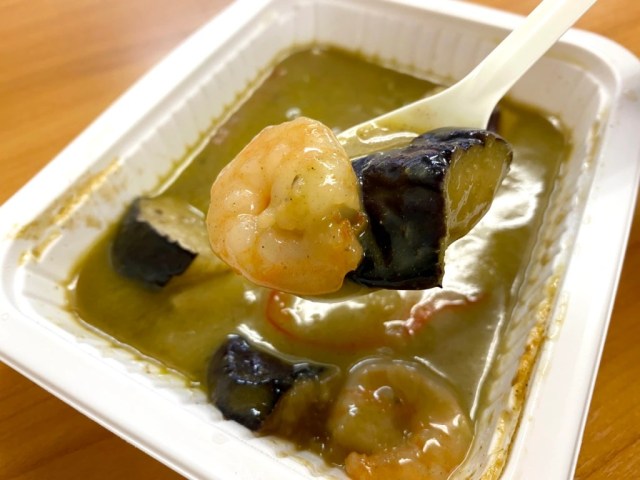
And finally, taking first place in P.K. Sanjun’s ranking was the green curry. It tasted sweet at first, then dissolved into a pleasant spicy aftertaste. There are a lot of places that can get this delicate balance wrong and tip too far in one direction, but he thought 7-Eleven did an excellent job with this one. It also had a good variety of fillings like shrimp, eggplant, and peppers in big chunks. He definitely recommends you grab a pack.

▼ Don’t forget the side dishes!

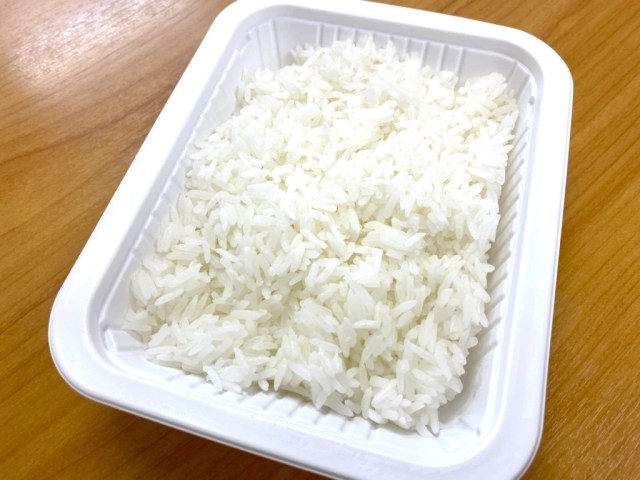
The jasmine rice and cheese naan were pretty good, too. The cheese naan wasn’t as rich as it would be at a restaurant, but for home eating it’s perfectly fine. The jasmine rice paired nicely with all of the curries as well.

▼ Can you believe these are less than 400 yen each?

In conclusion, P.K. Sanjun didn’t think any of the frozen curries were flops. They all taste pretty good, and you can get them all for less than 600 yen even if you add in a pack of jasmine rice. Give them a try–you’ll be pleasantly surprised!

Images: ©SoraNews24
● Want to hear about SoraNews24’s latest articles as soon as they’re published? Follow us on Facebook and Twitter!