Páginas

martes, 2 de marzo de 2021

This is the absolute worst train to fall asleep on in Tokyo…or wait, maybe it’s the best?【Pics】

https://ift.tt/2PuZ2PX Casey Baseel

Oversleep and miss your stop on this train and you’ll be stranded in the middle of nowhere, which might just be the start of a beautiful adventure.

One of Japan’s favorite places to catch a few extra Zs is in the train, since if you can grab a seat, the soft swaying and rhythmical sounds as the carriage makes its way down the tracks can be very relaxing. “But won’t you sleep through your stop?” you might be asking, but this isn’t such a concern to most people. Living in Japan, you spend so much time riding trains that your body starts to get used to the time between stops on your local commute or leisure time circuit, and you’ll usually wake up naturally shortly before you arrive at your intended destination, and even if you do oversleep, if you live in a big city like Tokyo, trains run frequently enough that getting off and making a U-turn ordinarily isn’t such a hassle.

However, you might have noticed that we said you’ll usually wake up and that making a U-turn ordinarily isn’t a hassle. But if you were really sleeping deeply (say, because of a busy day, or maybe one too many Asahi Super Drys), what’s the absolute worst train in Tokyo to oversleep on and end up at the end of the line for?

This one.
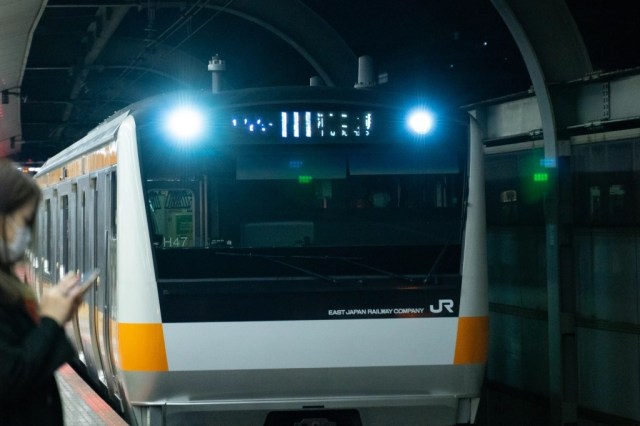
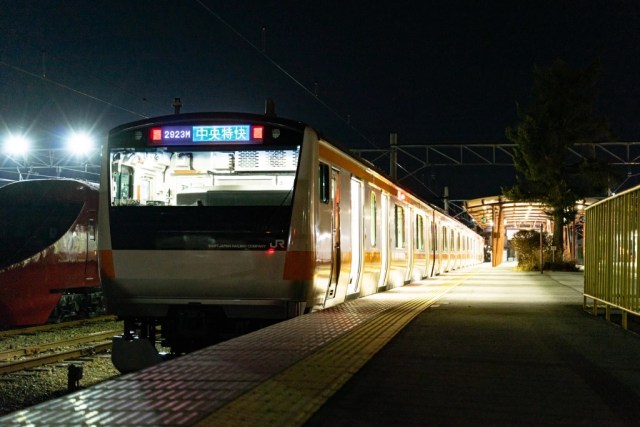
That there is a train on the JR Chuo Line, which runs across the center of downtown Tokyo, connecting Tokyo and Shinjuku Stations. But the Chuo Line keeps going west out of downtown, and this particular Chuo Line train, which departs Tokyo Station’s Platform #2 at 7:12 p.m. on Saturdays, is the one you want to keep from sleeping too soundly on.
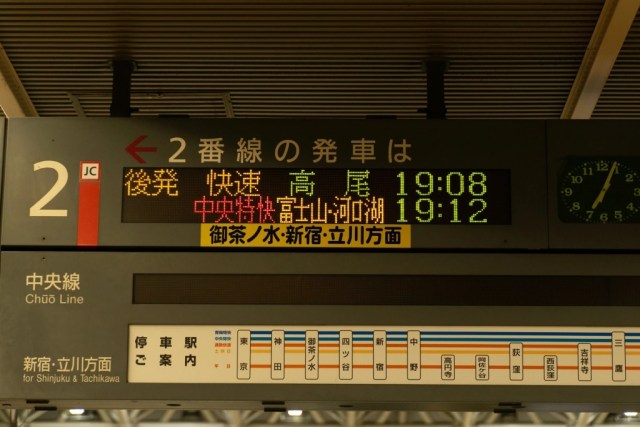
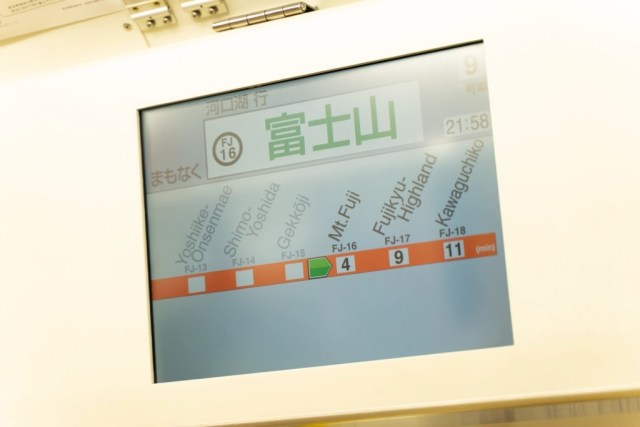
Why? Because this train goes all the way to Kawaguchiko Station, which is two stations even farther away from Tokyo than Mt. Fuji Station, and by the time it arrives, there are no trains out of the area until the next morning.

So naturally, we hopped on the train to ride it all the way to the end.

▼ The route from Tokyo Station to Kawaguchiko Station

It takes about three hours to make the 114-kilometer (71 miles) trip, but since the train passes through downtown and the west Tokyo suburbs, there’s no fancy ticketing or seating system like you’d find on the Shinkansen, nor any attendants coming by to make sure passengers have gotten off where they wanted to. For the first leg of the journey, it feels like any other Tokyo train, and on a Saturday night there were plenty of other passengers making their way around town.
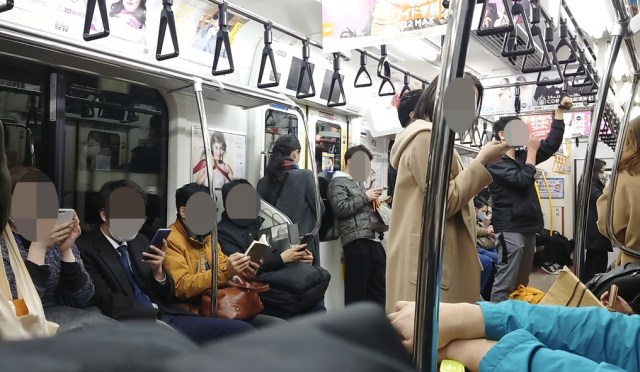
But after we passed Shinjuku and headed into the suburbs, the train gradually began emptying out. Fewer people-watching opportunities and the fading lights of the big city meant less visual stimuli to keep our minds focused, and soon enough, we felt our eyelids getting heavy and we drifted off to sleep.
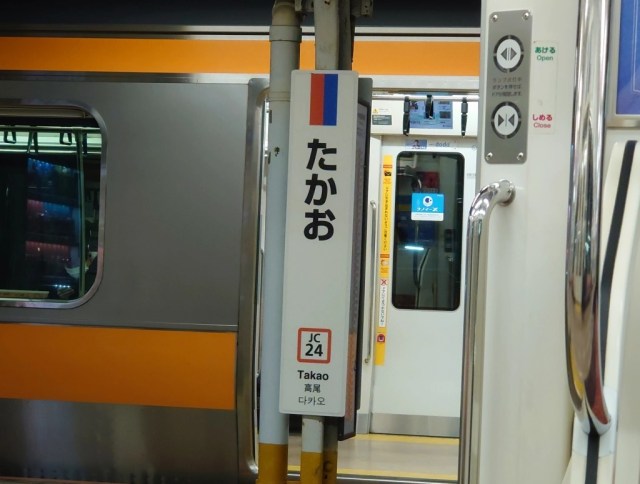
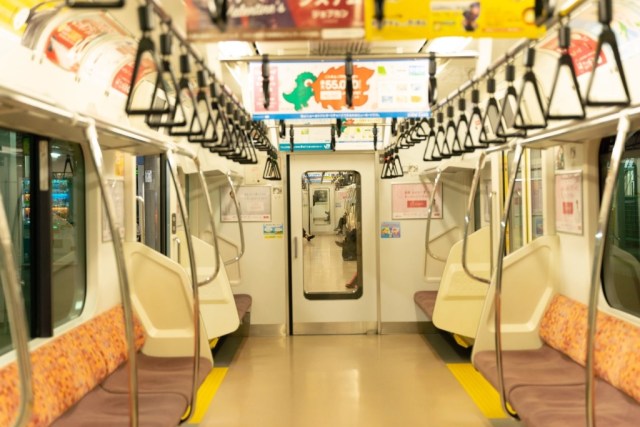
By the time we got to Takao Station, in the foothills near Tokyo’s favorite day-trip mountain hiking trails, it was almost completely dark outside, and there were just 5 to 10 people on each of the train’s 10 cars.
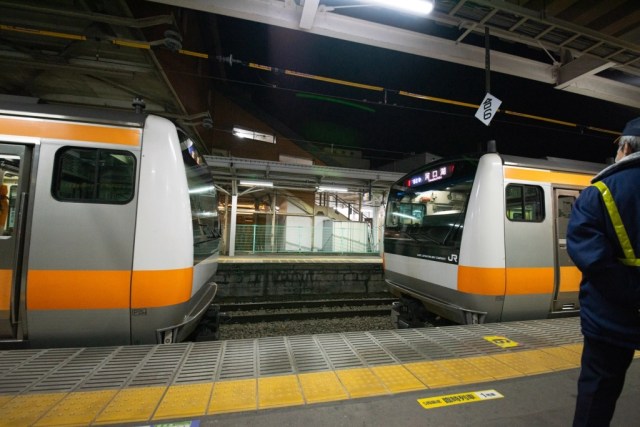
We had even more personal space once the train got to Otsuki Station, in Yamanashi Prefecture, at around 10 o’clock. Here, the train splits into two sections, with only cars 7 through 10 continuing on to Kawaguchiko, and now there were only about 10 people on the entire train.
You know you’re far from home when straight-up “Mt. Fuji” shows up on the map.
Finally, at 10:10 p.m., we pulled into Kawaguchiko Station. The train was now down to only four passengers, and the other three, presumably locals, quickly hurried for home as we looked around and snapped some pictures.
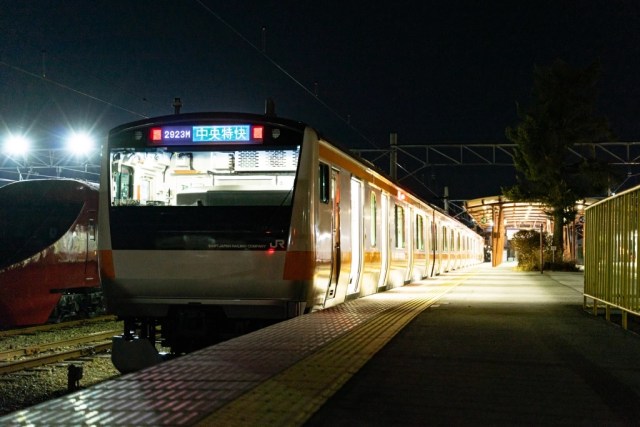
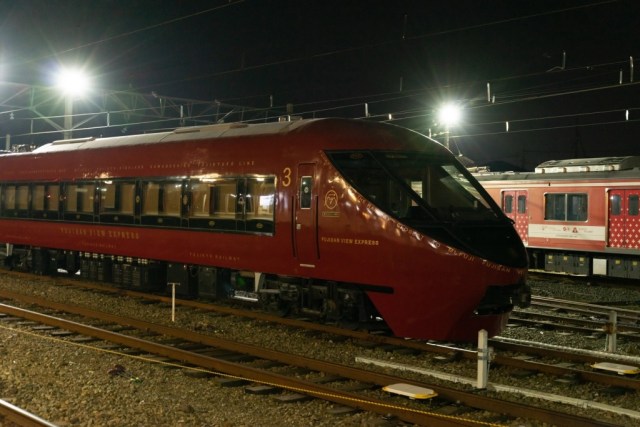
Kawaguchiko Station itself is charmingly rustic, and thanks to its proximity to Mt. Fuji and Lake Kawaguchi it’s no doubt filled with lively tourists during the summer travel peak. At 10:15 on a freezing-cold night in February though? Not so much.
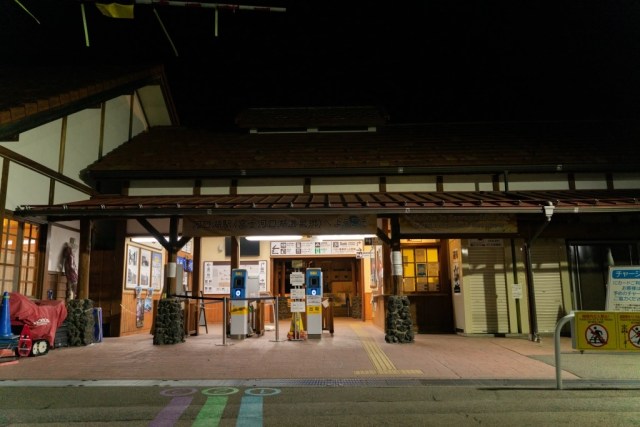
We didn’t see anyone in the arrival lobby that the automated ticket gates lead into, and it took a bit of searching before we could find even a single station employee.
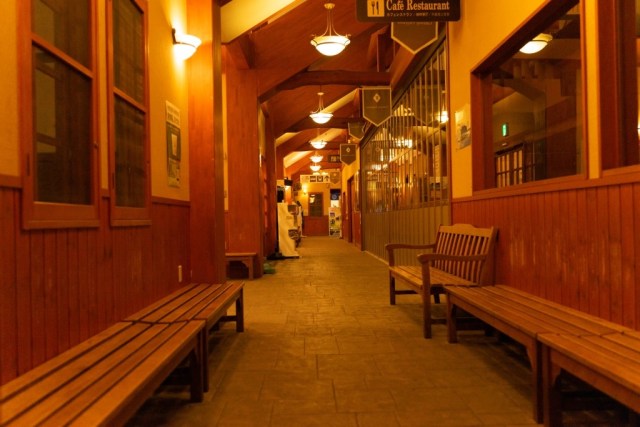
Like we mentioned earlier, at this time of night there’s no train back to Tokyo, or anywhere for that matter. After the 7:12 departure from Tokyo arrives, there’s just one other local train that comes into Kawaguchiko Station, and then the building shuts down for the night.
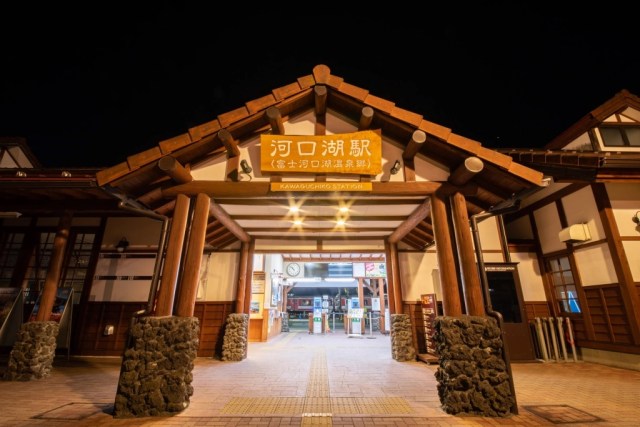
Unfortunately, this means that if you do somehow end up here by accident, you’ve now got to find somewhere, or someway, to spend the night, since loitering in the station until morning isn’t an option. Hopping a taxi back to Tokyo probably isn’t going to happen either, considering how empty the town’s streets are at this time of night.
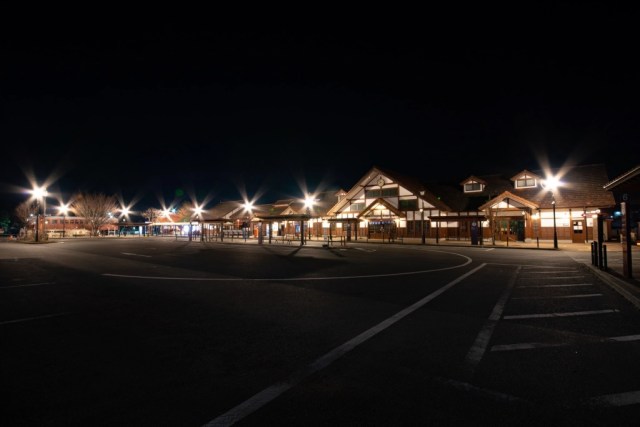
So we whipped out our phone and ran a search for nearby cheap chain restaurants, hoping to find a fast food joint to kill some time in. We had absolutely no results for Yoshinoya or Matsuya, but there is one branch of Yokohama-based beef bowl chain Sukiya, which is 1.6 kilometers from the station.
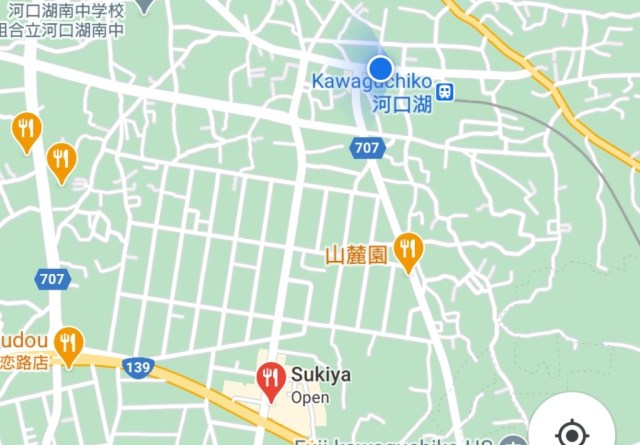
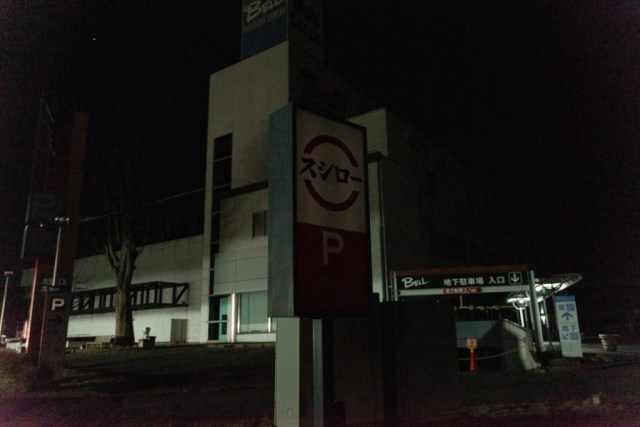
So it was time to start walking. We exited the station and hung a left, and it wasn’t long before we were in a residential neighborhood. However, none of the lights were on, and the only people in town who seemed to be awake were the clerks at the two convenience stores we walked by.
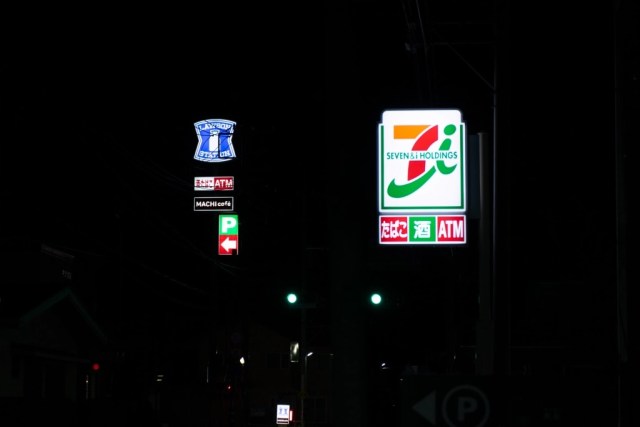
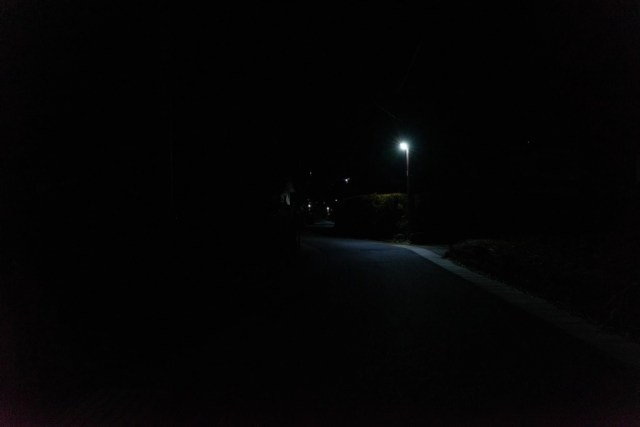
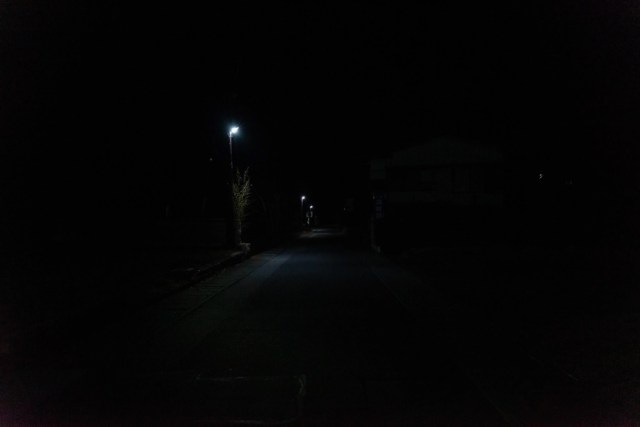
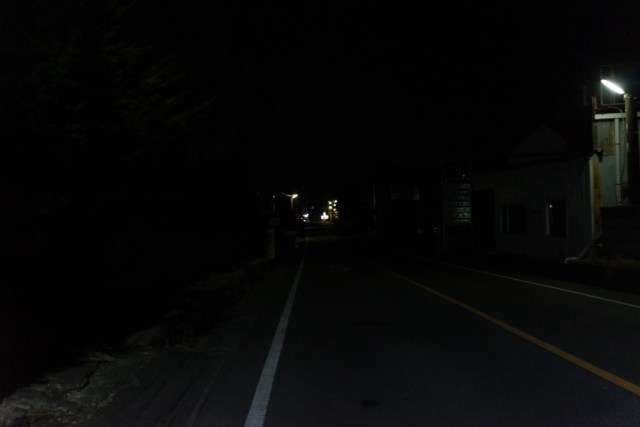
Living in Tokyo, it’s normal to find yourself wanting the occasional break from the noise and congestion. Here, though, we had the extreme opposite, with large, lengthy pools of inky darkness between the sparse street lights.
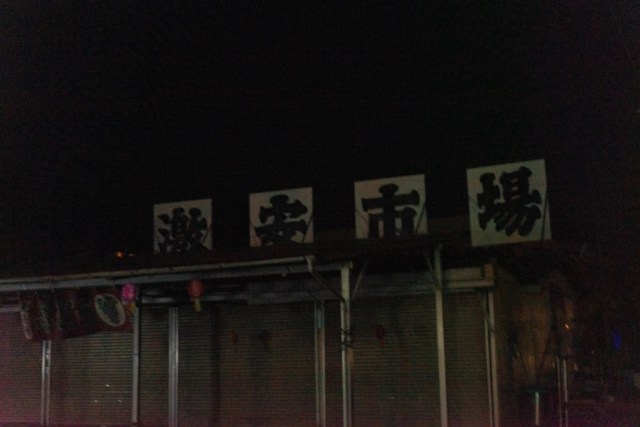
Occasionally we’d come across a supermarket or one of those casual department stores you’ll find in rural Japan, with its lights off and shutters closed for the day.
▼ The sign says “Super Cheap Market,” but we have no idea what they sell.
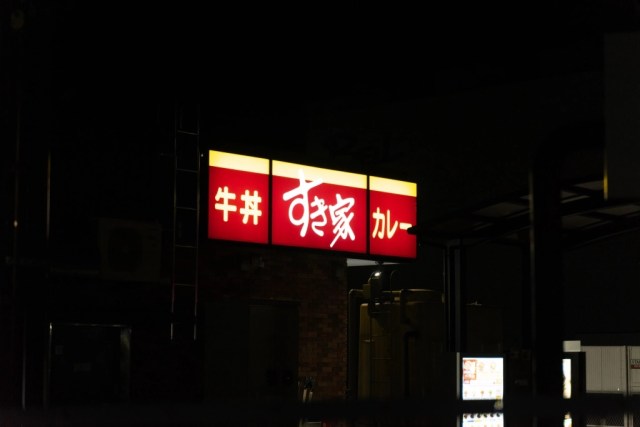
Eventually, we arrived at Sukiya, which was still open and serving at midnight. If you were looking for a place to sit down inside, this was pretty much the only option we’d found so far.

▼ The sign says “Sukiya,” but it’d be just as accurate if it said “oasis.”
Most restaurants still open at this time of night are pretty accommodating of customers lingering over their meals, but still, you can’t sit there nibbling on one beef bowl for five hours until sunup. So since Kawaguchiko Station is near Lake Kawaguchiko, we decided to do some sightseeing and go see the Mt. Fuji-adjacent body of water. We’d heard that Yagisaki Park has some nice views, so we headed there.
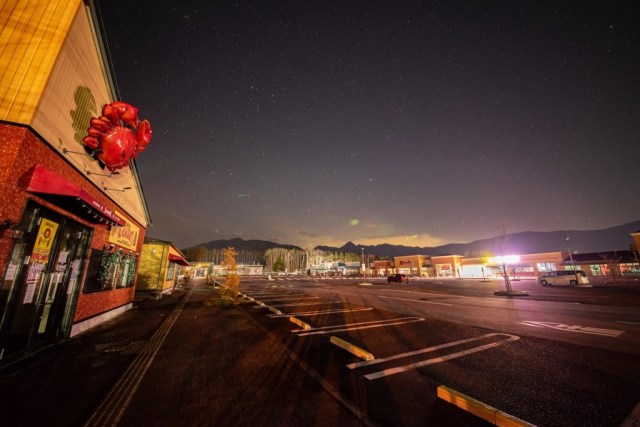
It’s about three kilometers form Sukiya to the park, and the first part of the route takes you by the Forest Mall Fuji Kawaguchiko shopping center. At 1 a.m., it was closed, but there was a casual restaurant open across the street, the second oasis we’d found in two and a half hours of walking. Aside from ourselves, the only people moving around were the drivers of a few modified cars roaring up and down the road, who looked like they might possibly be the same people we’d seen inside Sukiya.

But as we got closer to the park, the streets got smaller, emptier, and darker

much darker.

We honestly wish we’d had a flashlight, as more than once during the night we stumbled on an uneven patch of ground we hadn’t noticed in the darkness. We were lucky enough to make it to Yagisaki Park without completely face-planting, though.
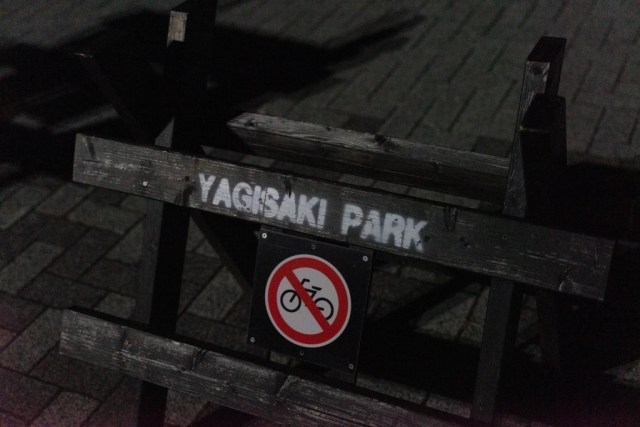
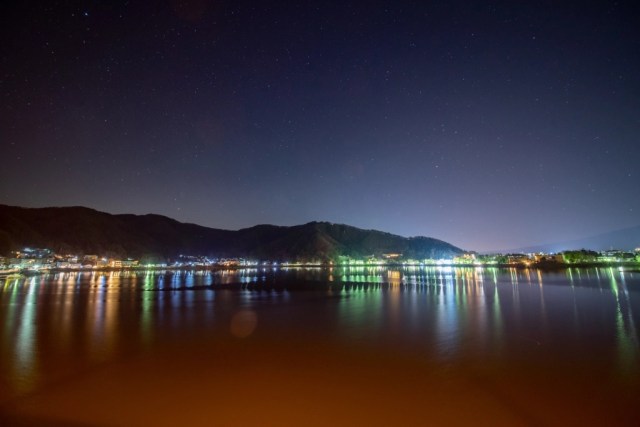
Yagisaki Park sits right on the water’s edge, and is a great place from which to gaze upon Mt. Fuji during in the day. It’s pretty much deserted at this time of night, but it also has a different kind of beauty to offer, as the few surrounding sources of light, such as the Kawaguchiko Ohashi Bridge, reflected off the still water, which had become like a black mirror.
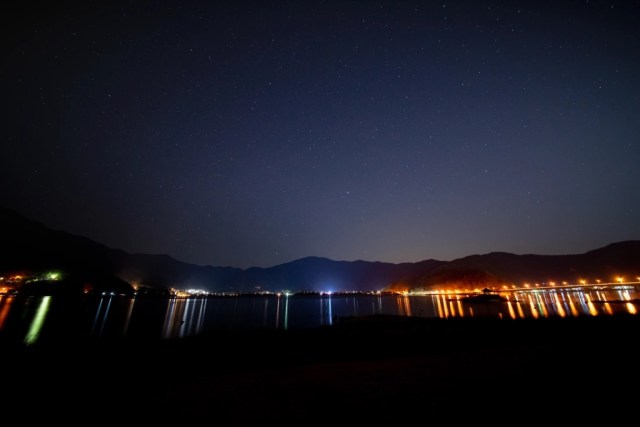
Overall though, there’s far less light pollution than what we’re used to in Tokyo, which allowed us to get some truly amazing shots of the starry sky.
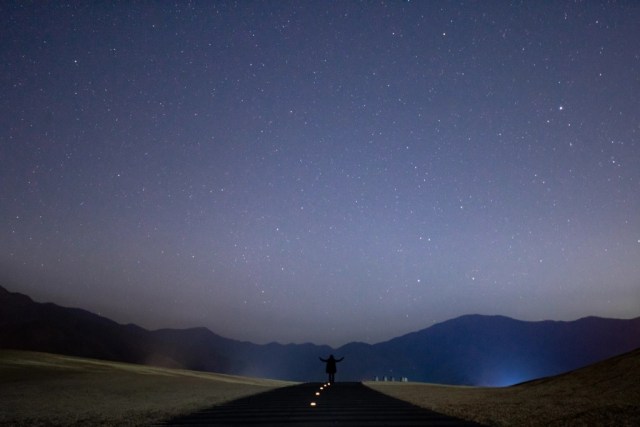
It was now a little after 3 a.m., so we had some time before the first train out of Kawaguchiko Station at 5:03. Since the Kawaguchiko Ohashi Bridge had looked so nice from the park, we decided to stroll over to it for a few more photos.
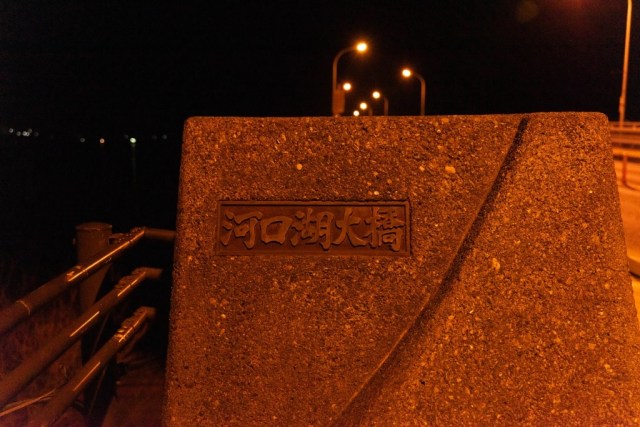
And sure enough, the view from here was lovely as well. As a matter of fact, even though we couldn’t spot it until we looked at the below picture, this is where we got our first glimpse of Mt. Fuji, whose gently sloping base can be faintly made out at the far right.
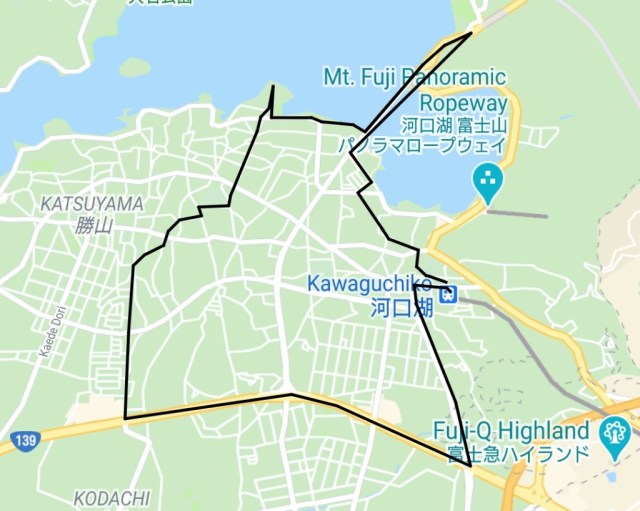
We then plotted out a slightly roundabout route back to the station, so that we’d be able to hop on the train shortly after reaching the entrance.
As the sky started to lighten, we felt a twinge of regret that we’d be heading back to Tokyo without seeing Mt. Fuji in all of its visible glory. Still, we’d come all the way here, so at exactly five o’clock, three minutes before the first train of the morning was leaving, we took a few steps back from the station building to snap one last photo of it to commemorate our trip, which is when we suddenly noticed…
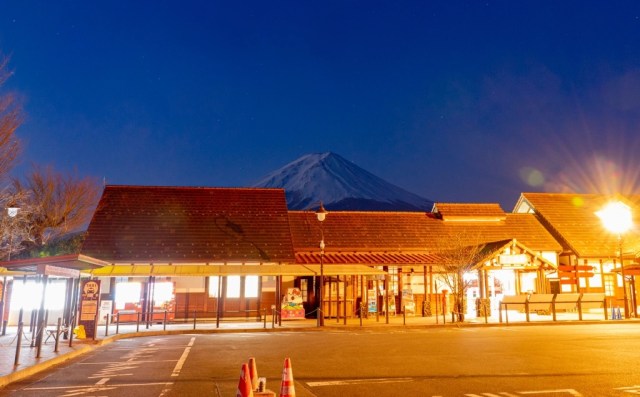
Mt. Fuji itself was out early to see us off!
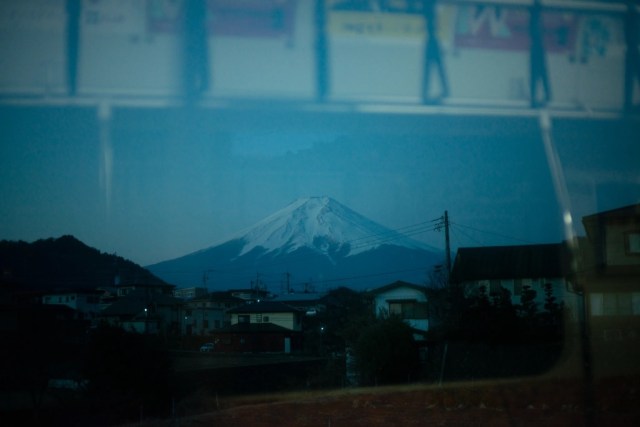
There’s something about seeing Japan’s tallest mountain that puts people in a reflective mood. As we rode back towards Tokyo, we couldn’t help feeling that yes, you can definitely make a case that the Saturday night Tokyo-to-Kawaguchiko train is the worst train to fall asleep on if you’re judging by how far from downtown you’ll end up and how few amenities there are. But on the other hand, we won’t be forgetting our night in Kawaguchiko anytime soon, and next time we find ourselves dozing off, we’ll probably be dreaming of more adventures like this one.

Photos © SoraNews24
● Want to hear about SoraNews24’s latest articles as soon as they’re published? Follow us on Facebook and Twitter!

Living the hotel life across Japan – Monthly plan lets you jump between 35 hotels, 12 prefectures

https://ift.tt/2OfH1V6 Casey Baseel

Want to hop between Tokyo, Kyoto, and everywhere else between Hokkaido and Kumamoto? This is the plan for you.

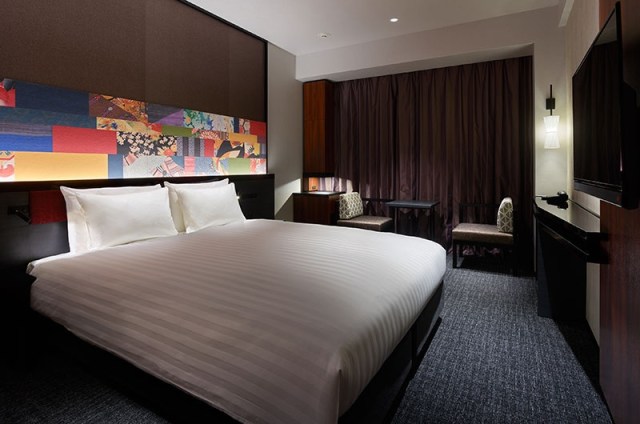
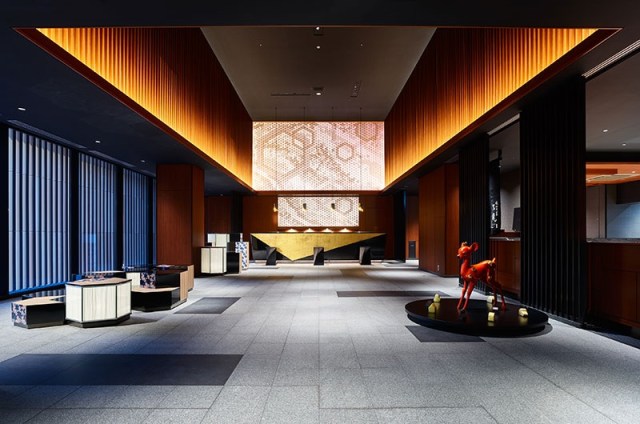
Recently, we’ve seen a number of hotels in Japan start offering long-term stay packages, letting you spend a whole month in luxurious accommodations for less than you might spend on a similarly equipped apartment in their neighborhoods. The latest to join in on this trend is Japan’s Mitsui hotel group, but instead of locking you into staying at one hotel, its amazing new plan lets you stay at dozens of hotels across the country for an extremely low monthly rate.

The service is called the Hotel Dokodemo Pass (dokodemo being the Japanese word for “anywhere”), and it’s a monthly plan that lets you stay at any of 35 Mitsui group hotels in 12 different prefectures, with a base price of 150,000 yen (US$$1,450) a month, plus an additional 500 or 2,000 yen per night (depending on room type), and allows you to jump from one to the other as often as you’d like.

▼ Mitsui Garden Hotel Ginza-gochome

That total works out to still just 165,000-210,000 yen a month, which is far below the rent you’d pay for a high-rise condo in neighborhoods like Tokyo’s Ginza or Kyoto’s Shijo, both of which are among the hotel options for the plan. Up to two guests are allowed per room at those prices, and if 30 days isn’t enough you can also extend the plan (at the same rates) to 60 or 90 days.

▼ Mitsui Garden Hotel Kyoto Shijo

The plan covers seven hotels in Tokyo , in neighborhoods such as Ueno, Otemachi, and Shiodome, and five in Kyoto, where locales include Sanjo, Kawaracho, and the Kyoto Station vicinity.

▼ Mitsui Garden Hotel Kyotoeki-mae (Kyoto Station)

The complete list of cities stretches from Japan’s northernmost prefecture of Hokkaido all the way down to southern Kyushu and consists of 35 properties in Tokyo, Kyoto, Sapporo, Sendai, Kanazawa, Osaka, Okayama, Hiroshima, Fukuoka, Kumamoto, and three locations in Chiba.

▼ Mitsui Garden Hotel Kanazawa

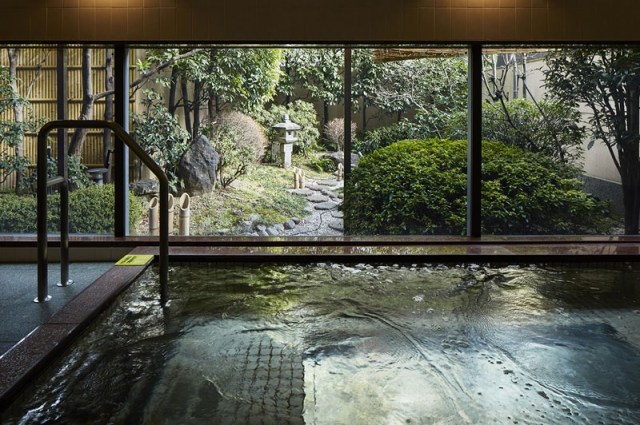
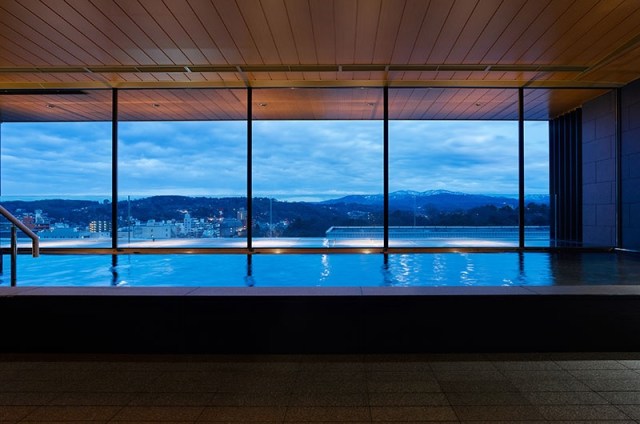
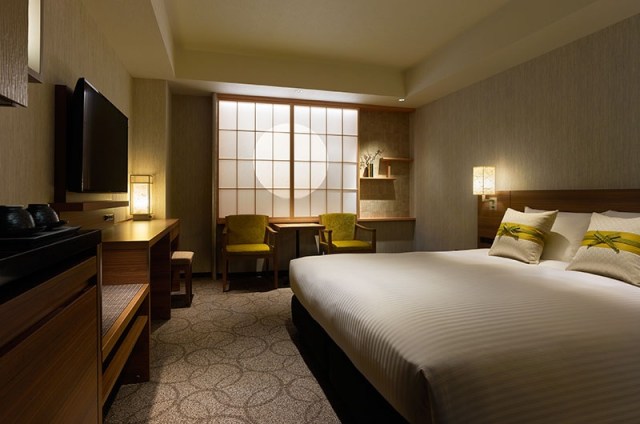
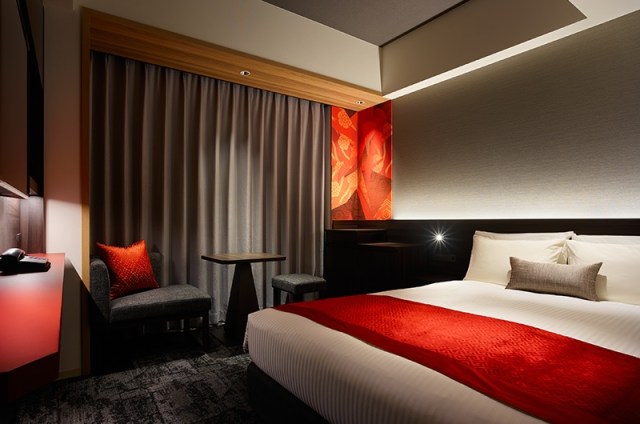
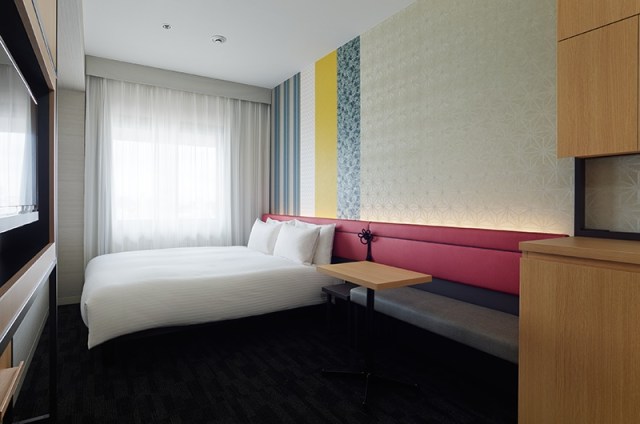
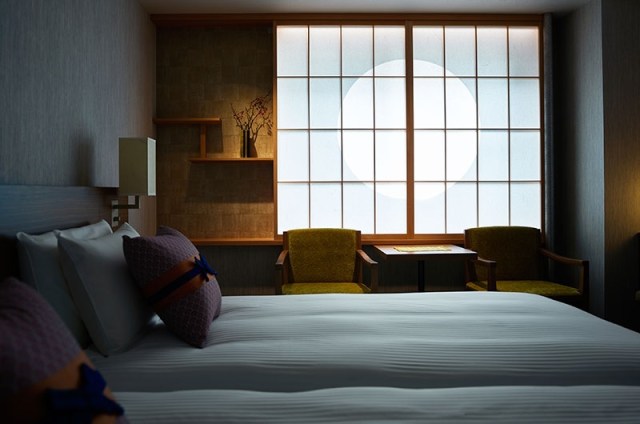
In addition to amenities such as free Wi-Fi, complementary toiletries, maid service, and fresh towels and pajamas, many of the hotels also offer access to their fitness centers or Japanese-style bath facilities, which offer a chance to experience traditional Japanese bath culture while taking in some beautifully tranquil views.

▼ Mitsui Garden Hotel Kyoto Sanjo

▼ Mitsui Garden Hotel Kanazawa

Given the expected high demand for the Hotel Dokodemo Pass, Mitsui is limiting availability to 100 parties, to be chosen by a lottery system. Applications can be made online here until March 5, with winners informed by March 10 and the first night of their stay to be sometime between March 20 and April 10, regardless of whether they select the one, two, or three-month pass.

Source: Mitsui Fudosan Hotel Management
Top image: Mitsui Fudosan Hotel Management
Insert images: Mitsui Fudosan Hotel Management (1, 2, 3, 4, 5)
● Want to hear about SoraNews24’s latest articles as soon as they’re published? Follow us on Facebook and Twitter!
lunes, 1 de marzo de 2021

10 yakuza members arrested for stealing sea cucumbers from ocean

https://ift.tt/305GiZk Master Blaster

More wayward souls caught up in the glitz and glamour of the illegal sea cucumber trade.

A few years ago we reported on the growing problem of yakuza crews catching large amounts of sea cucumbers without a license. As odd as it may seem, sea cucumbers fetch a high price in some countries such as China where they’re used in cuisine and sometimes as a folk remedy.

▼ They’re also used in questionable ASMR videos.

Sea cucumbers also aren’t as strictly regulated by Japan as other seafoods, making them easier to ship abroad in large quantities without drawing attention. According to some reports, the sea cucumber black market can be as lucrative as drugs for organized crime groups in Japan.

▼ This news report from early last February suggests that the yakuza even have informants from within the coast guard feeding them info

In response, the government said they would tighten the rules surrounding sea cucumber exports, but it looks as if little has improved with the arrest of 10 scuba-diving gangsters as recently as 1 March.

The incident occurred on 25 August of last year. A Hokkaido Prefectural Police patrol car spotted a car parked on the shore in the town of Omu, and questioned the driver. At that same time a rubber boat loaded with oxygen tanks, radios, and other equipment came ashore.

There were no sea cucumbers on the tiny craft, but that’s in keeping with past incidents. In some cases the poached echinoderms are loaded onto a high-performance speed boat capable of outrunning the coast guard, and whisked away. When the literal coast is clear, they are then loaded on to trucks and prepared for export.

▼ In this incident in Kagawa last June, 12 men were caught on tape and arrested trying to move 100 keys of mucusy contraband

So, knowing that something was clearly going on, the police investigated the incident further and connected 10 members of the Asahikawa branch of the Yamaguchi-gumi yakuza family, including one 57-year-old boss.

As of 2018, the maximum penalty for poaching sea cucumbers was six months in prison, which isn’t a huge stretch for mobsters. Still, it’ll be a hard six months of having to awkwardly answer the question: “What are you in for?”

Jokes aside, this is a serious problem that may be doing irreparable harm to the ecosystem of the ocean, and it’s been going on for too long. However, it is often said that problems are just opportunities in disguise. Combine that with the old adage which states “if you can’t beat them, join them,” and there might be a way we can all work together here.

It seems all someone would have to do is start a good old fashioned fake news campaign, declaring that ground-up cockroaches cure erectile dysfunction. Then, slip in a few YouTube videos with that Matrix red-pill music in the background and a #WhyDoYouThinkTheyreCalledCockroaches hashtag, and before you know it demand will be so big you’ll have yakuza goons going from building to building, “robbing” homes and businesses of their roaches.

Everyone’s a winner!

Source: Jiji.com
Top image: Pakutaso
● Want to hear about SoraNews24’s latest articles as soon as they’re published? Follow us on Facebook and Twitter!
Shinkansen ice cream sales suspended on board bullet train, sell out online

https://ift.tt/3sGrDju Oona McGee

These Shinkansen-exclusive ice creams are so famous they even have their own hashtag.

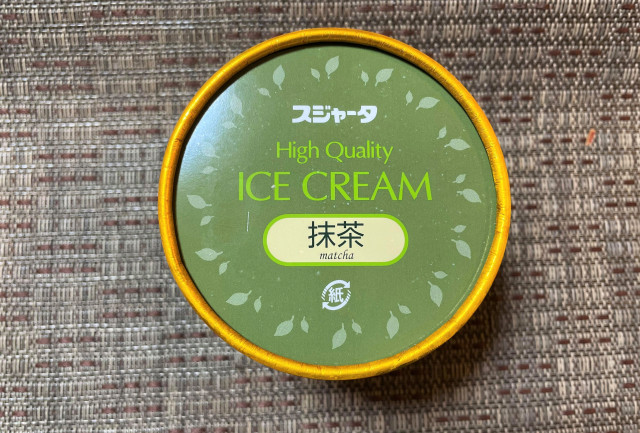
When you take a trip on a Japanese bullet train, there are a lot of things to look forward to on the journey, including the onboard trolley service, where you can purchase Sujata ice cream, a treat so rare it can’t be purchased anywhere else.

Now, with passenger numbers down during the pandemic, one Shinkansen line has sadly suspended sales of the ice cream onboard from February. However, they’ve decided to make everyone’s dreams come true by offering the Shinkansen-exclusive ice cream for sale online, and it’s so popular it sells out within minutes every time there’s a restock.

▼ Our Japanese-language reporter K. Masami failed to get an order in for the new ice creams until she got lucky on the third restock.

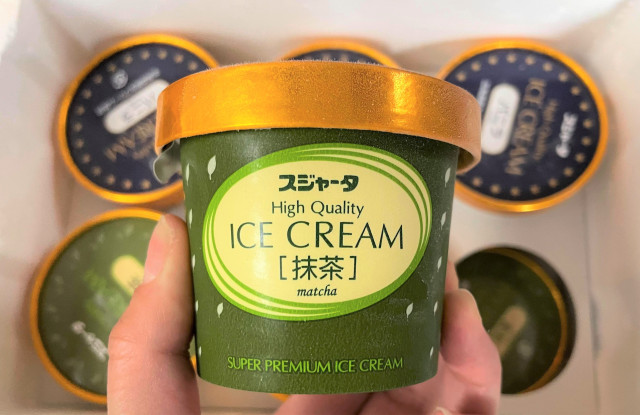
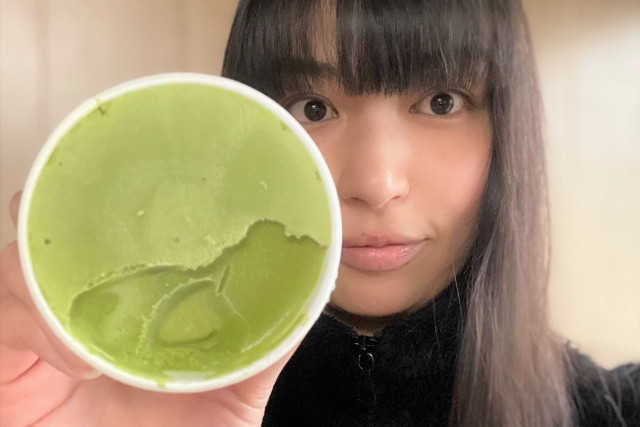
The Sanyo Shinkansen, which connects Shin-Osaka in Osaka with Hakata Station in Fukuoka, is selling the ice creams online in 12-piece boxes, containing either all vanilla, all matcha or six of each variety. Masami got the mixed set and immediately went to open one of the matcha ice creams first, as it’s the one she always chooses when riding the Shinkansen.

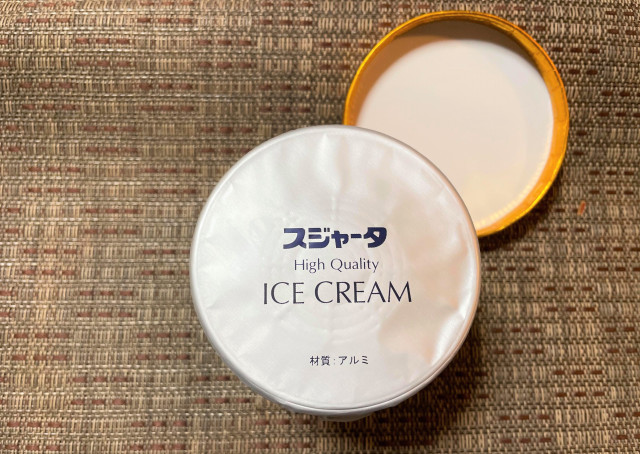
Peeling off the foil lid, Masami was curious to see if the home-delivered ice creams would have the same hardness as the ones served on the train. Sujata ice creams are so famous for their hardness they even have their own hashtag on social media–“Shinkansen sugoi katai aisu” (“super hard Shinkansen ice cream“)–with photos and videos showing people unable to insert the spoon into the super-stiff ice cream.

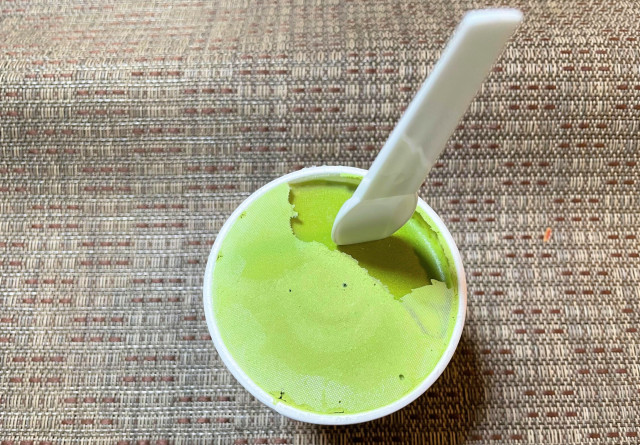
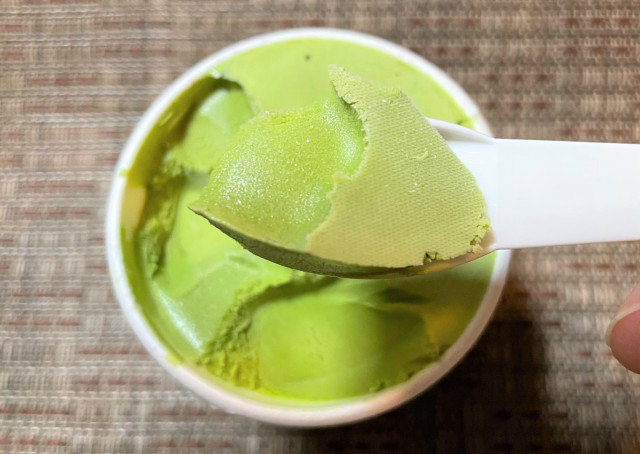
▼ Masami took hold of the attached spoon and went to stab it into the dessert, but no matter how hard she tried, it just wouldn’t penetrate through the surface.

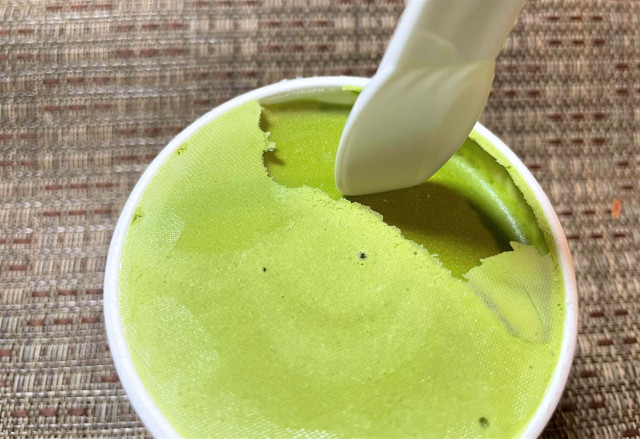
▼ No doubt about it, this was the genuine super hard Shinkansen ice cream!

Letting go of the spoon leaves it standing upright on its own in the tub, a sight so familiar to Sujata ice cream fans it should really become the logo for the brand. As fans will know, it takes about ten minutes for the ice cream to soften up just enough to allow the spoon to slide into the still-hard ice cream–which means you should order it way in advance of reaching your stop–so Masami left the tub for a while and came back to it once she was able to pick up a good spoonful.

As soon as she managed to tease the dessert out onto the spoon, Masami dropped a dollop onto her tongue and closed her eyes. The delicious taste of the rich, high quality matcha ice cream melted ever so slowly over her taste buds, immediately whisking her off to a seat on a bullet train, where the only destination that mattered was the bottom of the tub inside her hand.

Currently, the end-date for online sales of the ice cream is yet to be announced, although the company has said they’ll be available online until the day before onboard sales resume. So if you’d like to try the famously hard ice creams in the comfort of your own home, the time to purchase them is now, and at 4,800 yen (US$44.97) for a box of 12, including tax and shipping, it’s a lot cheaper than having to buy a ticket on the bullet train to try one.

Related: West Japan Railway Food Service Net Company
Photos © SoraNews24
● Want to hear about SoraNews24’s latest articles as soon as they’re published? Follow us on Facebook and Twitter!
Who actually writes Japan’s Letters from Little Sister and schoolgirl love letter capsule toys?

https://ift.tt/2NQWsmK Casey Baseel

It turns out there’s a division of labor between who comes up with the words and who writes them on the papers.

The bar for strangeness is set pretty high in the world of Japan’s capsule toys. After all, right now you can find machines selling such oddities as figures of gorillas wearing randoseru backpacks or Shiba dogs with their heads bursting out of ukiyo-e woodblock artwork.

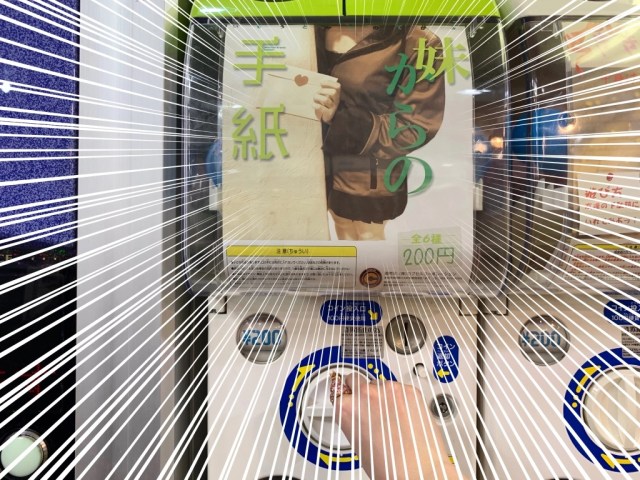
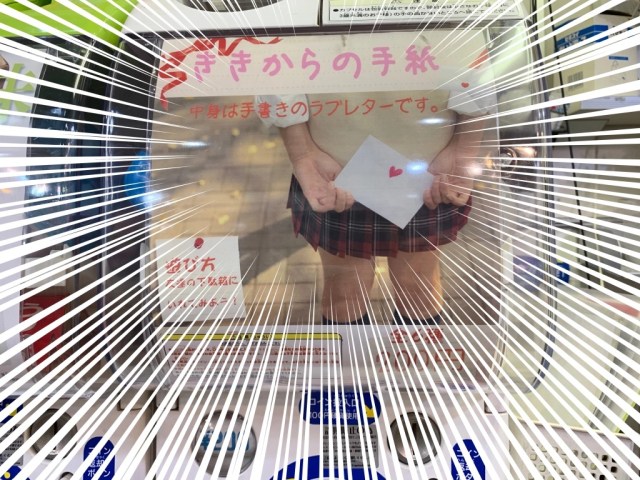
But even by gacha toy standards, manufacturer Capsule Corporation’s Imoto Kara no Tegami line is pretty out there, since the name translates to “Letters from Little Sister,” and each capsule includes a letter filled with deep sibling devotion to and/or frightening possessiveness of Big Brother, like in the letter than says “Who was that girl I saw you with? Onii-chan KILL Onii-chan…What did the two of you do together? I won’t forgive you.”

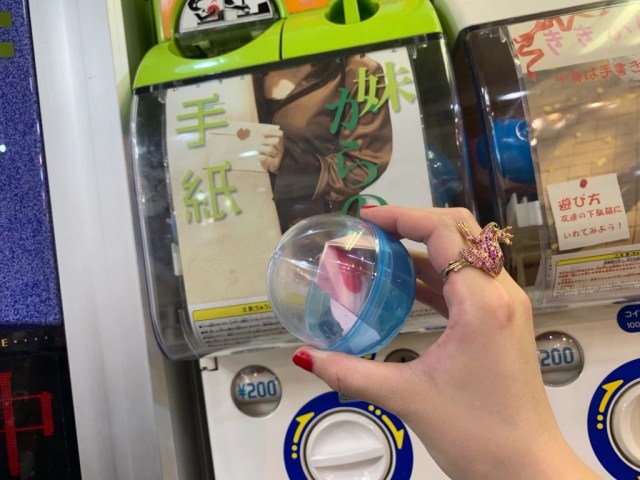
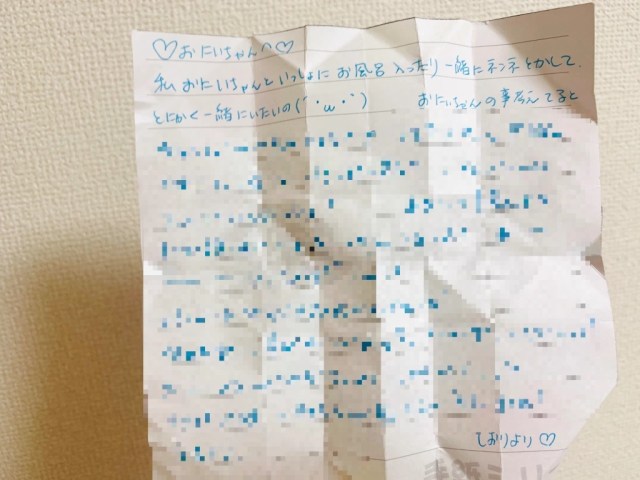
The letters come on pieces of paper folded up and nestled inside the capsules, and while some are printed with a hand-written font, others actually are written by hand.

But who’s actually putting pen to paper? That was the question put to Capsule Corporation CEO Hideaki Eto by magazine Nikkan Spa, and at the risk of shattering the illusion, he revealed that the letters are not, in fact, written by teenage girls. “They’re generally written by women in their 20s, 30s, or 40s” Eto explained. Most of the time, it’s one or two women writing the expressive, brightly colored characters, but when things get busy, they bring in five or six part-timers to help with the extra workload.

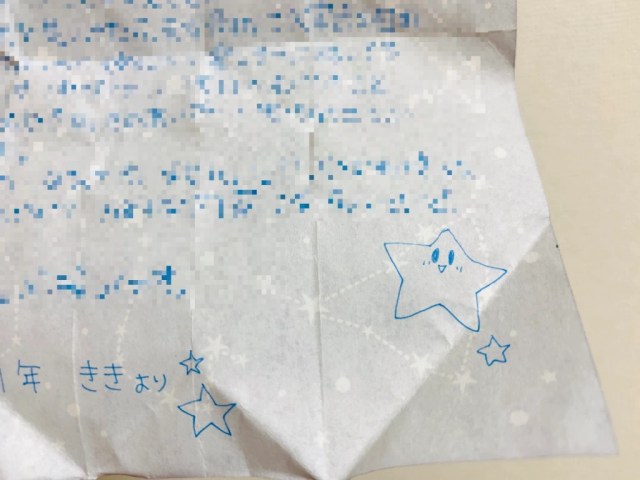
In addition to Letter from Little Sister, Capsule Corporation has a second line of hand-written letter capsule toys called Letters from Kiki, which contain love letters from a schoolgirl. For these, the handwriting is done by maids who work at a maid cafe the company manages.

▼ A Letter from Kiki

But while that answers the question of who’s writing the letters in a physical sense, it’s someone else who’s writing them in the sense of thinking up the words that go into the letters in the first place. So Eto also revealed the identity of the person composing the Letters from Kiki, and it turns out it’s…Eto himself! “I’m the one who composes them. I get really fired up writing love letters in the middle of the night.”

However, Eto isn’t ready to pull back the curtain on all of his company’s secrets, and so he declined to say who’s composing the Letters from Little Sisters series. If we had to put money on it, we’d bet that he’s handling that duty too.

Source: Nikkan Spa via Livedoor News via Jin
Photos © SoraNews24
● Want to hear about SoraNews24’s latest articles as soon as they’re published? Follow us on Facebook and Twitter!
Naomi Watanabe is moving to the U.S., switching base of operations to outside Japan

https://ift.tt/eA8V8J Casey Baseel

Multi-faceted entertainer says she’s been preparing for the transition for years.

In Japan, when a celebrity steps away from intensive activity in the entertainment industry, they’re often described as “graduating.” So it came as a surprise for fans on Monday when Naomi Watanabe, one of Japan’s most popular entertainers, announced that she’ll be graduating from regular Japanese TV work at the end of this month.

However, Watanabe isn’t fleeing the spotlight, but crossing the ocean, as she’ll be moving to the U.S. and switching her focus to the American/English international media sphere.

Watanabe broke the news bilingually, in Japanese and English, through her Instagram account. “I wanted to let you all know that I will be based out of the U.S. starting April!” she excitedly announced, saying that she’s been working towards the transition especially hard for the last two years. She’s also already signed with not one, but two talent agencies, Los Angeles-based ICM Partners, which operates in the movie, TV, music, and new media sectors, and New York modeling agencies IMG Models, suggesting that she intends to continue her multi-faceted career that spans comedy, acting, music, and fashion.

One day prior to her Instagram announcement Watanabe appeared on Japanese variety program Hayashi-sensei no Hatsumimigaku where she talked about her international ambitions, with the 33-year-old saying she wants to play the lead role in an American comedy movie by the time she’s 40.

▼ Watanabe was in New York for work in October of last year.

Watanabe, who spent time studying abroad in the U.S. in 2014, hasn’t said what part of the States she’ll be making her home, though she’s been the owner of a home in New York since 2019. Previously, she’d been considering trying to split her time evenly between Japan and the U.S., but the current coronavirus situation makes such frequent international travel a health risk and logistics nightmare, and so with her representation contracts set with ICM and IMG, the timing was right to pounce across the Pacific, though she says she still hopes to be able to work on occasional Japanese projects. “I’m going to go study to become a super entertainer that you guys can have a lot of fun watching,” Watanabe promises, and her many fans will surely have their eyes on her, no matter where in the world she is.

Sources: Instagram/watanabenaomi703, Oricon News via Hachima Kiko
Featured image: Instagram/watanabenaomi703
● Want to hear about SoraNews24’s latest articles as soon as they’re published? Follow us on Facebook and Twitter!