Páginas

lunes, 30 de enero de 2023

McDonald’s Japan is changing the ingredients in Chicken McNuggets

https://ift.tt/iIJ9qme Casey Baseel

Wait, what exactly goes into a McNugget anyway?

Sure, McDonald’s Japan has some unique menu items, like the “for-adults” Nikuatsu burgers that kicked off the new year, or the Asian Juicy sandwich lineup that’s just around the corner. There’s still plenty of overlap with the chain’s U.S. menu, though, and just like in McDonald’s country of origin, Chicken McNuggets are a long-time big-seller in Japan.

So it came as something of a shock to many people when McDonald’s Japan announced that it’s making a change to the ingredients in its Chicken McNuggets. We didn’t even know that was possible. It seems like the ingredient list should be pretty straightforward and non-flexible, right? After all, aren’t Chicken McNuggets just made of chicken and…uhh…nug…gets…?

Wait a second, just what the heck are chicken McNuggets made of? It’s a question we’ll admit to not having given much thought to before now, sort of like how we happily chowed down on Cup Noodles Mystery Meat for years without confirming its true composition.

Let’s start with the reassuring part first: McDonald’s Japan’s current Chicken McNuggets are made of chicken and breading, and the new-recipe ones are going to be too. The company isn’t going to be replacing the poultry with plant-based meat, nor with any other chicken substitute of more dubious or nebulous origin. Actually, you could make the argument that the ingredient shift is an upgrade. Currently, the meat that’s used for McDonald’s Japan’s Chicken McNuggets is a mix of ground chicken breast, thigh, and skin. The revised recipe, though is getting rid of the thigh meat, so the new McNuggets will be a breaded mix of breast and skin.

McDonald’s Japan says the change is a result of the company’s continual reevaluations of their supply chain in order to provide safe and delicious food in an environmentally sustainable way at competitive prices, without going into specific details about how removing thigh meat from the mix helps them achieve that goal.

Some online commenters in Japan say they’re intrigued at the prospect of more breast meat producing leaner, more refined-tasting McNuggets. On the other hand, thigh meat tends to be juicier, and others have expressed concern that the on-their-way thighless McNuggets may be lacking in moistness and flavor.

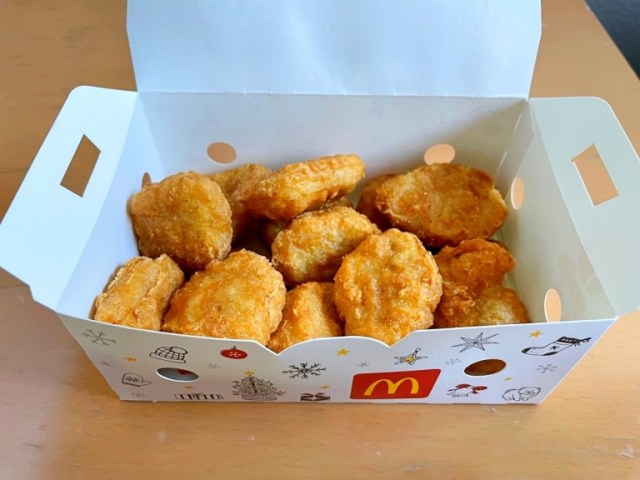
▼ Just to be safe, we took a commemorative photo of what we guess we’ll have to soon start calling “McNuggets Classic.”
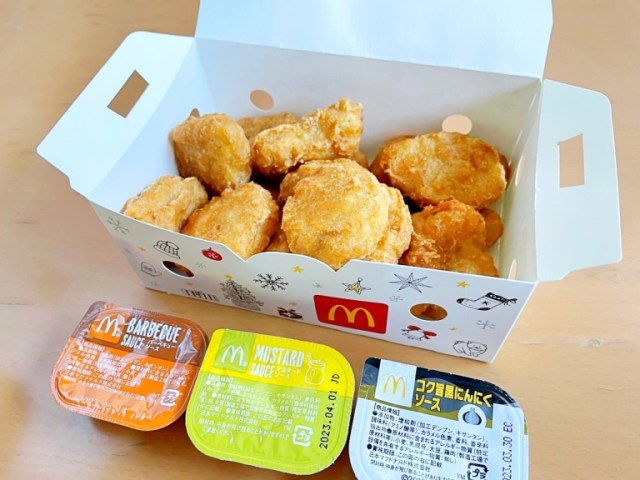
There’re also one wild-card elements that aren’t addressed in McDonald’s announcement. First, the chain hasn’t revealed what the proportional mix of ingredients in either the old or new McNuggets is, so it’s just as possible that the thigh meat is being replaced entirely with cheaper, greasier skin as it is lean breast, or any other ratio in between.

For now, though, if you want one last taste of the breast-thigh-and-skin McNuggets, time is running out, as McDonald’s Japan says branches will begin transitioning to the new recipe from February 1.

Source: McDonald’s Japan
Featured image: Pakutaso (edited by SoraNews24)
Top image ©SoraNews24

Insert images: Pakutaso, SoraNews24
● Want to hear about SoraNews24’s latest articles as soon as they’re published? Follow us on Facebook and Twitter!

Fun with Kaki No Tane rice cracker ice cream sandwiches【Taste test】 

https://ift.tt/cE9ZTp6 Master Blaster

Just when you thought ice cream couldn’t get any better.

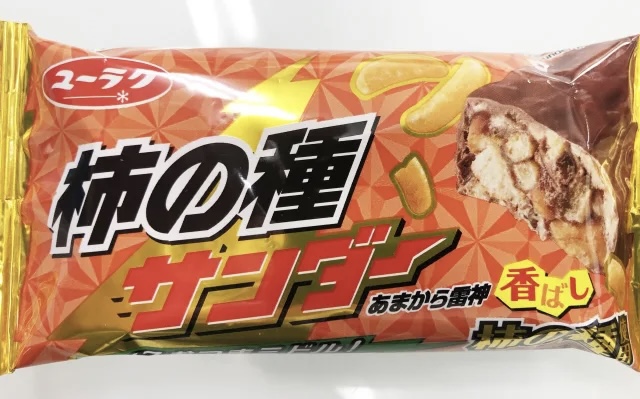
Kaki no Tane is a long-running and beloved Japanese snack. It name literally means “persimmon seeds” but they are actually salty rice crackers in the shape of persimmon seeds. Although they are often great on their own, they can also complement other snacks such as Black Thunder chocolate bars fantastically.

▼ Kaki no Tane Thunder

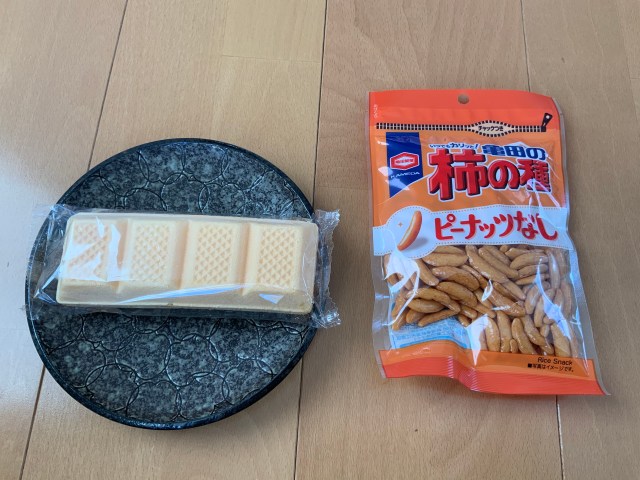
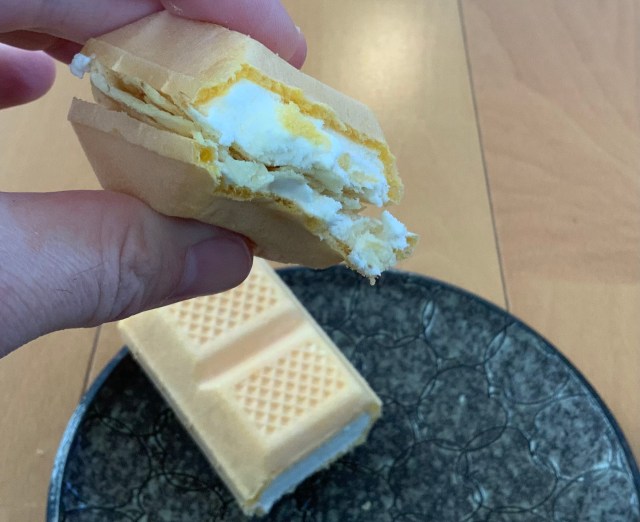
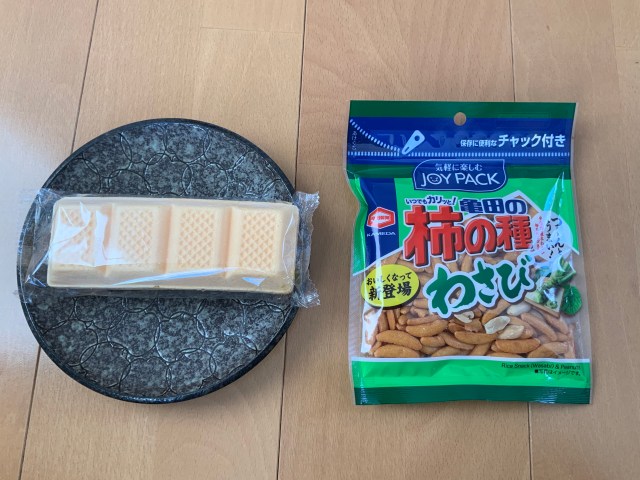
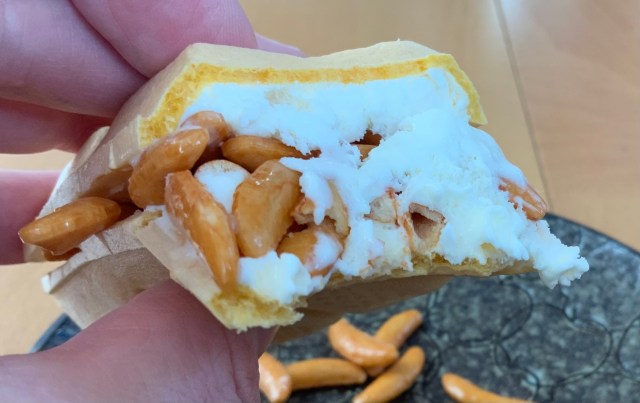
And now, thanks to a tip from the official Kaki no Tane Twitter account, we have yet another way to enjoy them. The simple recipe involves putting a bunch of these snacks into a vanilla monaka ice cream, which is a bar of ice cream encased in a wafer. 

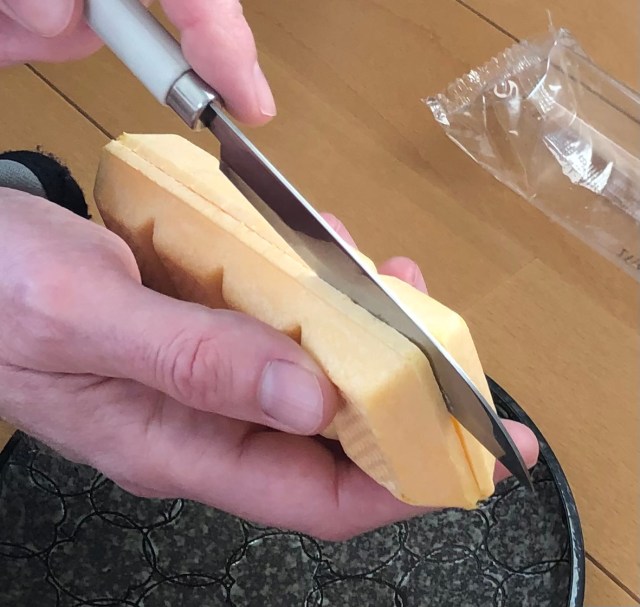
The high structural integrity of the monaka makes this recipe a cinch. Just cut it in half along the crease.

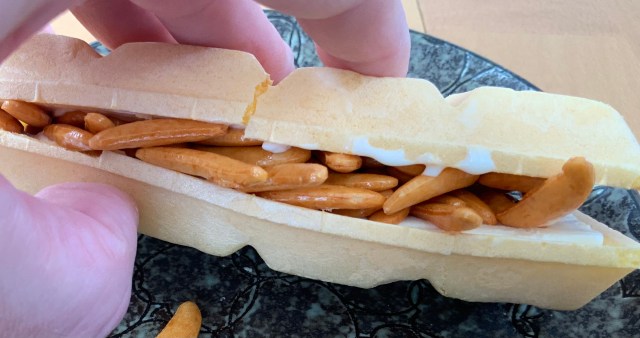
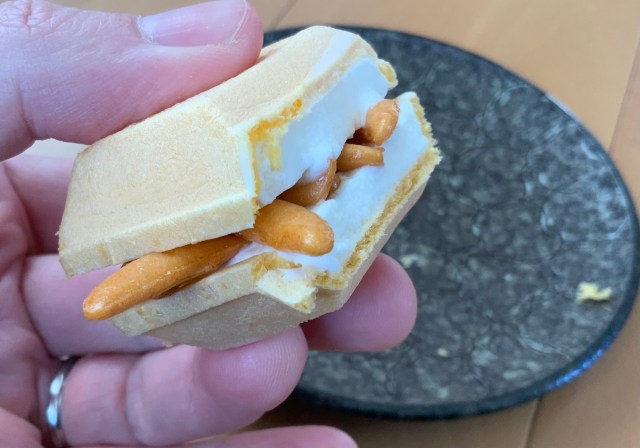
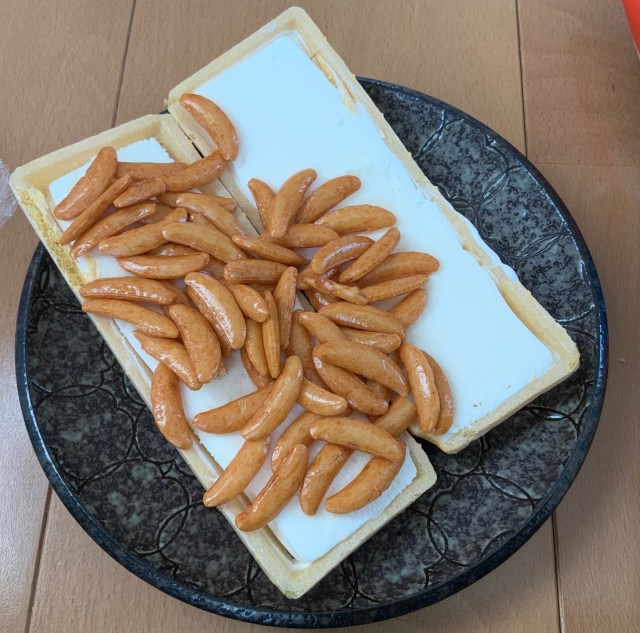
Then, put in the Kaki no Tane. They seem to recommend a generous amount.

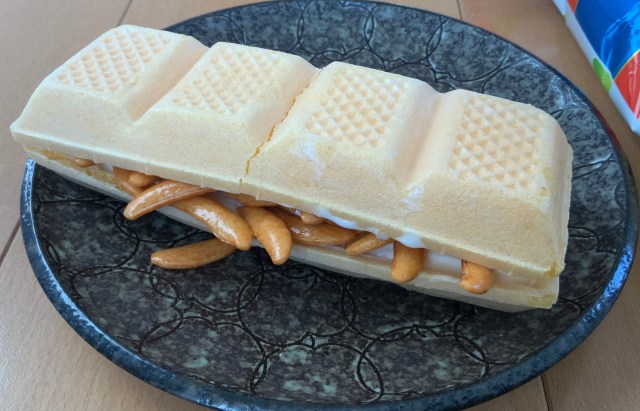
Finally, close it up!

It’s at this point that I should address a serious controversy about Kaki no Tane. As you can see in the tweet, the standard snack includes peanuts mixed in with the crackers. The presence and amount of peanuts has long been a divisive issue among Japanese people, and in 2020 a vote of over 25,000 people resulted in the company changing the cracker-peanut ratio from 6:4 to 7:3. And since then, a special ironic version of Kaki no Tane featuring all peanuts and no crackers was released to assuage peanut sympathizers.

I personally am firmly in the “peanuts suck” camp of this debate and decided to use the plain cracker-only version of Kaki no Tane for this recipe. 

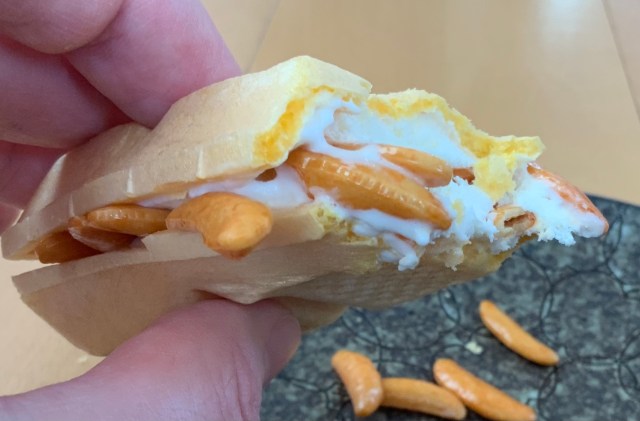
I was pretty much expecting this to be a slam dunk, but I think my expectations were too high. It was definitely tasty but not quite at the level of the Kaki no Tane Black Thunder bar.

I think the problem was that Kaki no Tane are seasoned with soy sauce which among other flavors, has a distinct umami taste. When mixed with the vanilla ice cream the umami seemed disproportionately strong and not really harmonious with the other flavors.

On the other hand, my biggest concern was the hardness of all the crackers but that actually wasn’t a problem at all. They were crunchy but yielding enough that it was very easy to eat. Overall, I think if I had used a chocolate ice cream monaka, it might have been better.

This kind of experiment is a good example of the contrast effect. That’s when our senses are thrown off by contrasting things. A famous example of a visual contrast effect is that optical illusion with the checkered floor and shadow where two squares look like different shades but are actually the same.

▼ In this image A and B are the same shade of grey though they don’t look like it because the contrasting shades of the squares next to them affect how we see them.

Image: Wikipedia/Edward H. Adelson

In the same way when two contrasting tastes are put in close proximity it affects how we sense them.  For example if you add a small amount of spicy food to something sweet, it will taste sweeter. The opposite is also true in that spicy food with a touch of something sweet will seem even spicier.

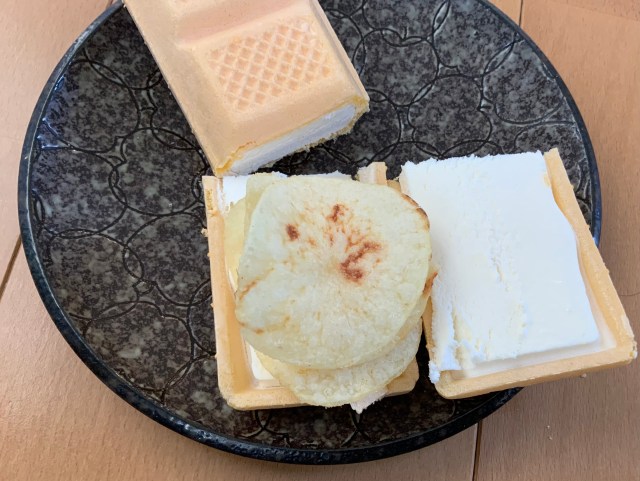
It’s part of the reason salty-sweet foods are so good. Speaking of which, since Kaki no Tane are harder to come by outside Japan, I thought I would try the same thing with normal salted potato chips.

The chips were a lot less noticeable than the Kaki no Tane but the salt on them did make the ice cream sweeter as expected.

And since we were playing around with the contrast effect, for my final trick I will try some wasabi flavored Kaki no Tane. Unlike a lot of other wasabi flavored chips and crackers, these really do pack a punch of that wasabi sting. Unfortunately, these ones were only available with peanuts, so I’ll have to pick out the legumes myself and feed them to a crow or something later.

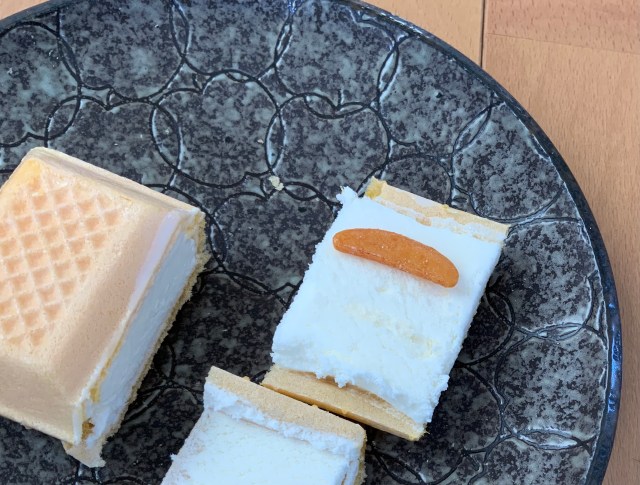
In order to get a contrast going I figured putting a single Kaki no Tane into a square of monaka would give it just enough of a sweet boost. It worked a bit, but the salty potato chips were much more effective.

Then, I tried going the other way and loading it up with wasabi crackers. This didn’t quite work either, once again because the umami soy sauce seasoning once again stuck out like a sore thumb, even overpowering the spiciness. At this point I might even begrudgingly accept that the peanuts might have helped balance things out here.

In the end, I thought the potato chips and ice cream was the best combination, but the others had their charm too proving once again that Kaki no Tane is a very versatile snack. However, it seems that much like with peanuts, it’s really important to find exactly the right balance with Kaki no Tane and ice cream as well.

Source: Twitter/@kameda_kakitane via Tokyo Bargain Mania
Photos © SoraNews24 (Unless otherwise noted)
● Want to hear about SoraNews24’s latest articles as soon as they’re published? Follow us on Facebook and Twitter!
Groper arrested in Japan insists he did not grab both breasts, but just one

https://ift.tt/LTHpWkt Casey Baseel

Japanese language quirk made charges ambiguous, but he probably didn’t help his case by clearing that up.

On Tuesday night, a criminal incident occurred in the town of Nikko, Tochigi Prefecture. A mountain resort famed for its beautiful natural scenery and historical buildings, Nikko is a popular destination for leisure travelers in east Japan, and on the night in question a 24-year-old woman from another part of Tochigi was at a hotel in the city, no doubt expecting to have a pleasant evening enjoying the local hospitality. Unfortunately, a 60-year-old Tochigi resident who was also at the hotel decided to enjoy himself by squeezing the woman’s chest without her consent.

Details are still scarce, with the exact location within the hotel where the groping took place, any events leading up to it, and whether the victim knew the man or not all unclear. What does seem clear, though, is that the touching was unwanted, as the police were summoned and the man arrested on suspicion of forced indecency, the customary legal charge for groping in Japan.

The vast majority of the time in Japan, criminals admit to their wrongdoing when caught. In this case, though, the man has denied the charges…or at least he half-denies them. When told he was being arrested for grabbing the woman’s breasts and body, he asserted:

“I touched her breast, but I did not touch both of them.”

Odds are that declaration was met by baffled silence by whichever law enforcement member was taking his statement, but Twitter commenters had the following to say:

“…what?”
“That’s his defense?”
“Well, at least he’s honest.”
“How can you live to be 60 and still be so dumb?”
“So, if it’s just one, does he think it’s OK?”
“Is there some sort of custom in Tochigi that it’s all right as long as you’re just grabbing one?”
“One breast or two, I’m pretty sure it’s still the same crime.”

And yes, what the last commenter said is correct. Anti-groping laws don’t operate under American pro football “It’s not a catch if the receiver doesn’t have two feet down” logic, and so there’s no “It’s not a grope unless you’ve got hands on both breasts” leeway.

Linguistically, the accused does have kind of a point, though. In the Japanese language, there’s generally no difference between singular and plural nouns. Ringo, for example, is the word for both “apple” and “apples,” and mune can be used for both “breast” and “breasts.” So when the man was told he was being arrested for touching the woman’s mune, it could be interpreted as either one or both, and he wanted to make it clear that while he was admitting to touching the woman’s mune, he denied touching ryomune (“both breasts”)

Maybe he thinks that limiting the scale of the groping to one half of the woman’s chest will make it easier to bargain for a lighter punishment. As in the case of the other man in Japan who recently admitted to robbing a taxi driver but denied that he used impolite speech in the process, though, it’s unlikely to get him off the hook.

Source: Tochigi TV via Yahoo! Japan News via Otakomu, Twitter
Top image: Pakutaso
● Want to hear about SoraNews24’s latest articles as soon as they’re published? Follow us on Facebook and Twitter!
How to pick out the best anago eel and other things we learned at the anago processing center

https://ift.tt/GeaOl4J Casey Baseel

Getting hungry and knowledgeable on a visit to Japan’s number-one anago prefecture.

While travelling trough Shimane Prefecture, on the northern side of the western tip of Japan’s main island of Hokkaido, our Japanese-language reporter Tasuku Egawa stepped into a restaurant for lunch. As he looked over the menu, he noticed a large number of anago (conger eel) dishes, so he figured he’d order a few…

and they were all amazingly delicious.

Really, though, Tasuku should have seen this coming. Shimane now catches more anago than any other prefecture in Japan, and it’s becoming one of the area’s representative foodstuffs. The Shimane cities of Hamada and Ota, in particular, are gaining fame among foodies looking for tasty anago, and both towns’ tourism departments now promote local restaurants that specialize in it.

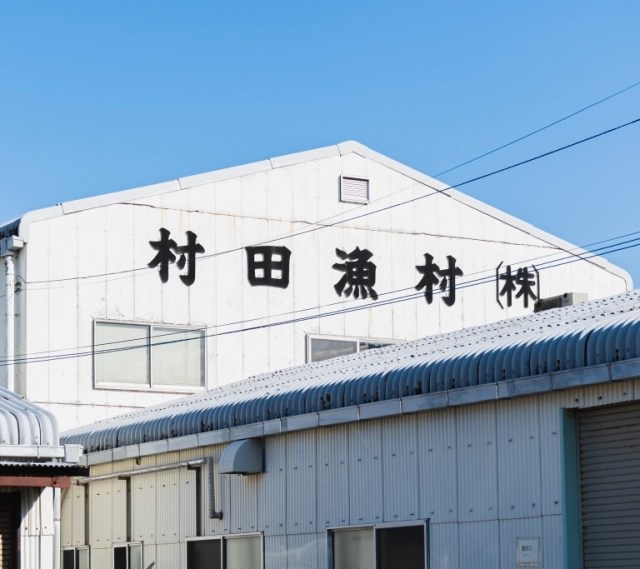
So Tasuku decided to go deeper into the world of Shimane anago by visiting Murata Gyoson, a Hamada company that runs an Anago processing center.

▼ Murata Gyoson

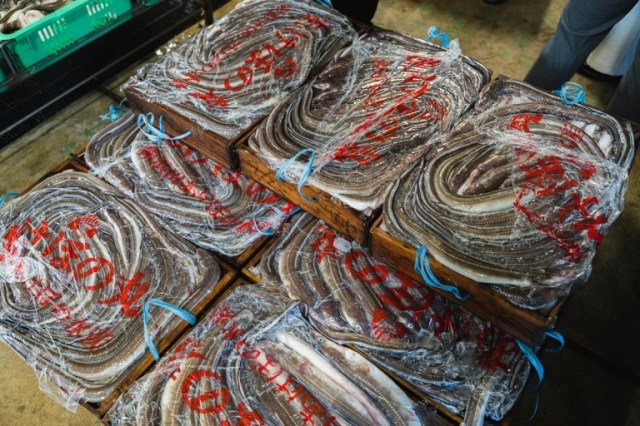
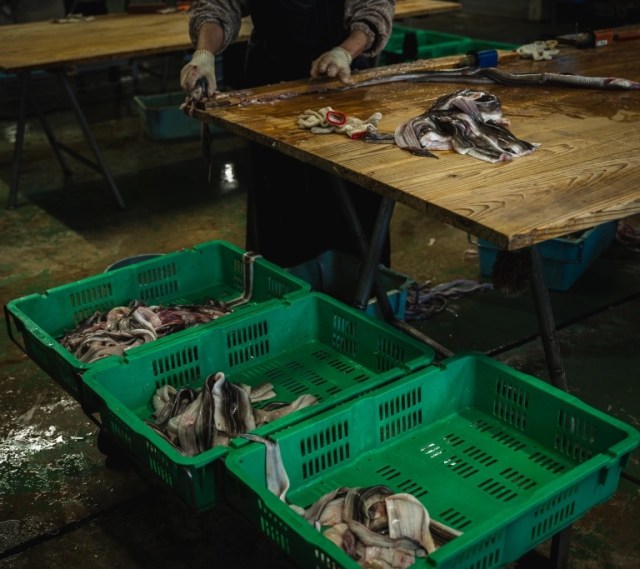
“Processing center” might have you imagining a lot of industrial robots whirring about, but much of the work of cleaning and preparing anago is still handled in a traditional, old-school way here. As Tasuku entered the building and walked past the shipping dock, he saw wooden crates filled with whole anago which had just been purchased at auction that morning.

▼ Prices vary by the day, but a crate typically sells for somewhere between 15,000 and 25,000 yen (US$116-US$194).

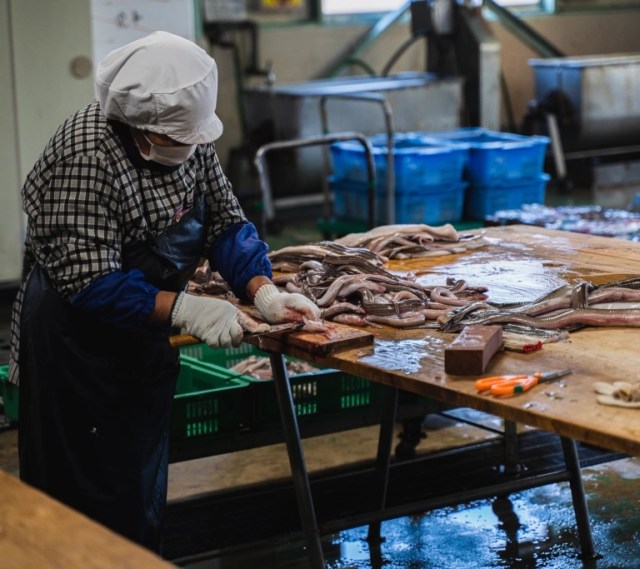
Once the anago are removed from the crates, a worker starts filleting them by hand with a knife.

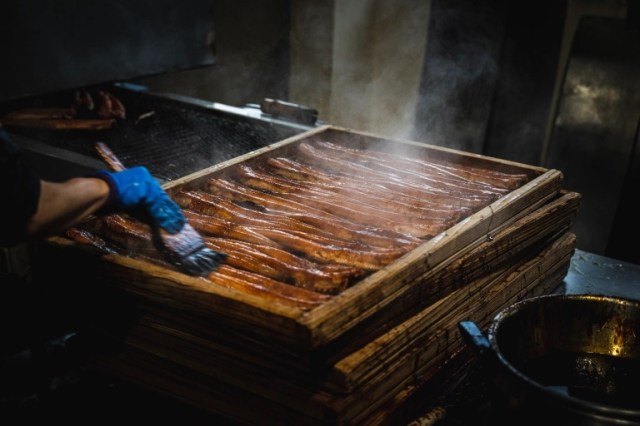
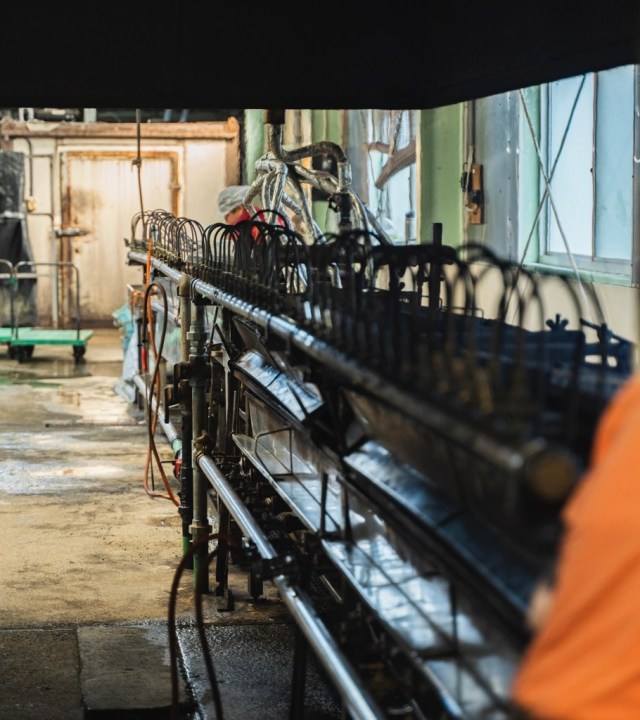
One of the most popular ways to cook anago is kabayaki, in which the eel is treated with a sweet soy-based glaze. So after fileting them, Murata Gyoson brushes them with the sauce and puts them on the conveyor grill of its kabayaki machine.

This isn’t a “set it and forget it” process, though. Workers carefully adjust the strength of the flames so that each fillet is properly cooked but not burned, preserving its flavor and moistness.

Once they’re cooked, the filets are given an additional brushing of glaze

…and packaged for shipping.

But as he watched the mouthwatering start-to-finish kabayaki process, Tasuku noticed something else. As the worker sliced the anago, she separated some of the pieces into separate piles.

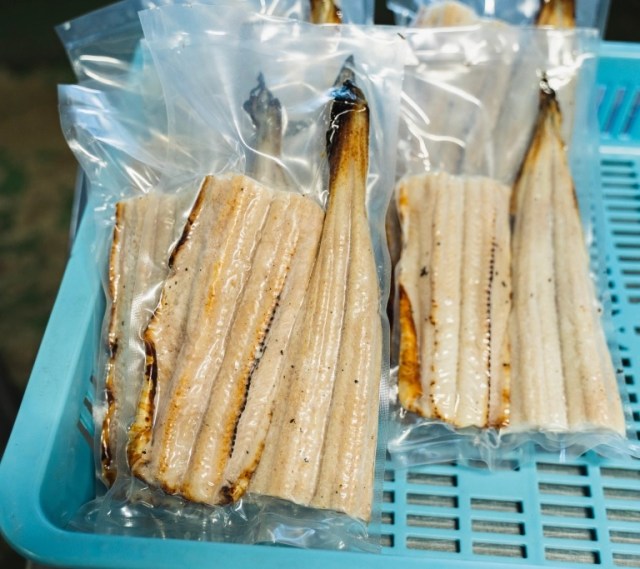
That’s because not all of Murata Gyoson’s ends up as kabayaki. Large anago that are judged to be of especially high quality instead become shirayaki anago, lightly grilled without glaze so that the natural flavor plays a larger role.

▼ Shirayaki

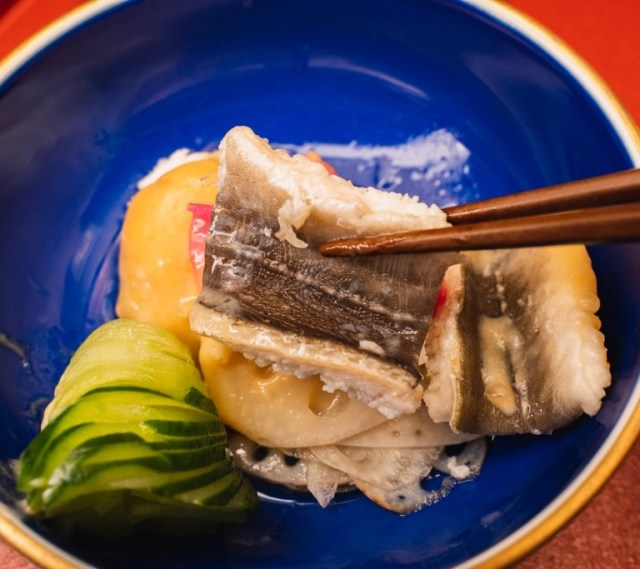
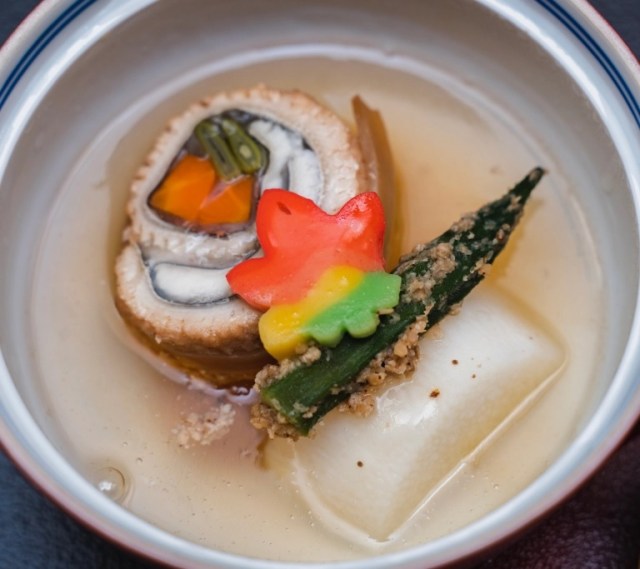
Beyond shirayakai, the largest, most pristine pieces of anago have the exalted fate of being used for ni-anago, parboiled eel.

So this got Tasuku wondering: How do you determine how high the quality of anago before actually taking a bite of it? Thankfully, Murata Gyoson was happy to provide some handy pointers that you can use the next time you’re picking out anago at the grocery store or fish market.

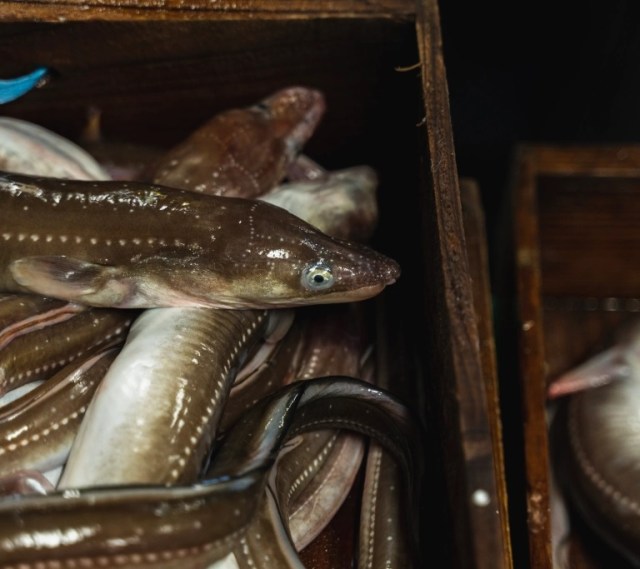
1. Check the eyes. This pretty much goes for all seafood, but the clearer and brighter the eyes are, the fresher the anago is.

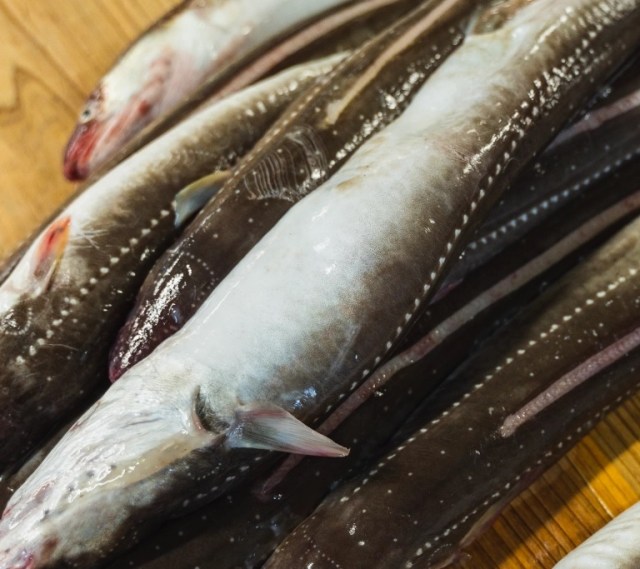
▼ Having just been caught that morning, this anago’s eyes mark it as especially fresh.

2. Go for the gold (skin color). At a glance, most people would say anago are silver, white, or gray. If you’re looking at a really fresh, high-quality example, though, the skin will have a golden shine to it, like in the photo here.

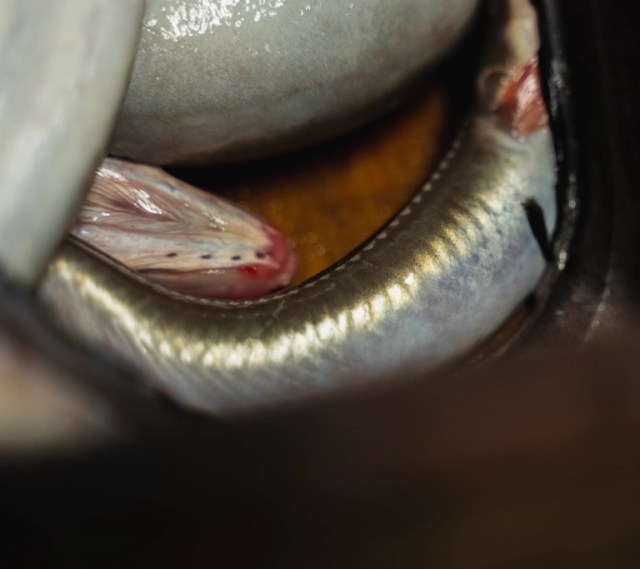
3. Compared to the first two visual checks, this one can be kind of hard to determine if you haven’t spent a lot of time looking at eels, but high-quality anago has a tight, firm stomach. The looser and flabbier the belly, the more likely it is that the anago has had some damage to its internal organs, which can make the flavor of its meat gamey. Softer-stomached anago are also more likely to have lived their lives in warmer waters, where the type of prey available for them to have fed on can also contribute to gaminess.

▼ Firm-stomached anago

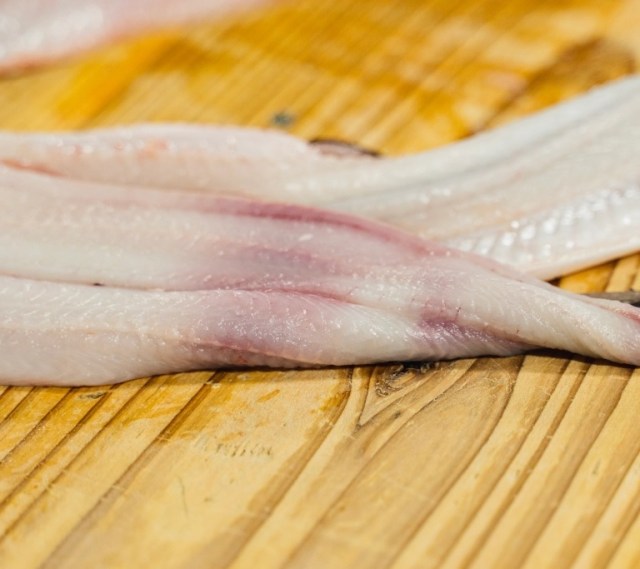
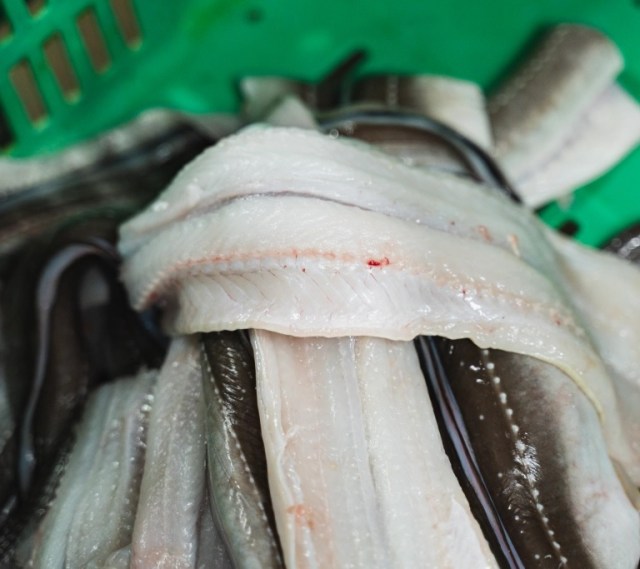
4. And last, once the anago is fileted, you can tell higher-quality meat by its color. Average-quality anago will have red or yellow hues to it…

…but top-notch anago will be white, like this.

Armed with this knowledge, Tasuku now feels more confident in being able to select the tastiest anago out of his options at the supermarket, and also in choosing how to cook it. Still, it’s going to be hard to beat professionally prepared caught-that-day anago, so he knows what he’ll be ordering when eating out on his next trip to Shimane.

Related: Murata Gyoson
Photos ©SoraNews24
● Want to hear about SoraNews24’s latest articles as soon as they’re published? Follow us on Facebook and Twitter!
domingo, 29 de enero de 2023

Black Thunder chocolate brings us the future of Valentine’s Day: Crabs!

https://ift.tt/QbE2Oxl Master Blaster

And Crab Thunder is coming up with new and inventive ways to give us crabs.

It’s something few are talking about but everyone realizes; Valentine’s Day as we know it is at a major crossroads. Regardless of the difference between how it’s celebrated around the world, the current state of environmental and geo-political affairs has made it more difficult than ever to awkwardly express deep, complex feelings with slips of paper or candy.

No one knows this more than the popular Japanese chocolate bar brand Black Thunder. For years, they have been a thought leader in Valentine’s Day, playing games of 5-D chess with other chocolatiers and ensuring strong sales as the definitive Japanese Valentine’s gift to firmly say: “Hey, it’s a holiday but let’s not read too much into it, eh? Alright then, have a good one, buddy!”

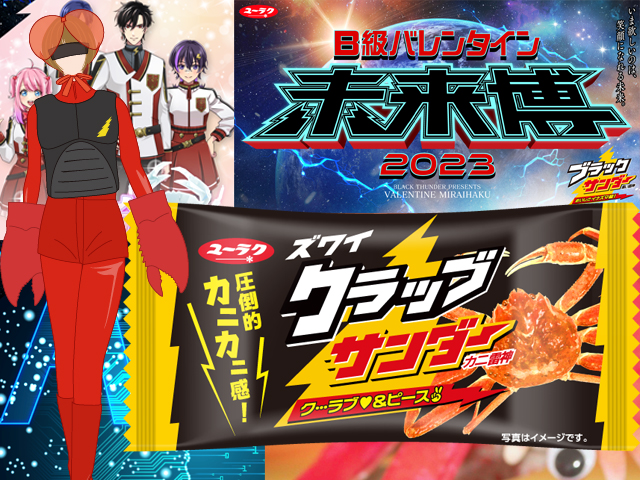
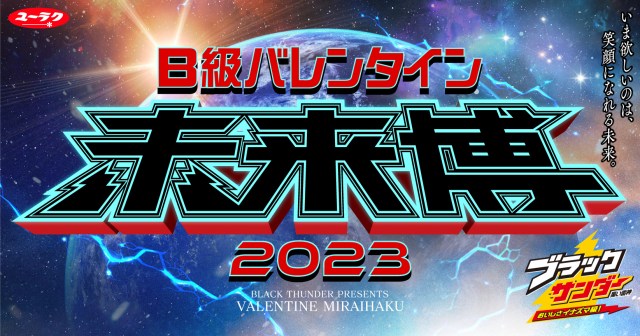
But even they are feeling the sheer gravity of current events, from the pandemic, which reduced human interaction considerably, to the soaring prices of food. That is why Black Thunder is calling for us all to come together and hammer out what form the future of Valentine’s Day will take in the first-ever B-Class Valentine Future Expo 2023.

Rather than it being a threat to Valentine’s Day, Black Thunder is seeing the current situation as an opportunity to make it into something better and more relatable than the original holiday ever was. Through the B-Class Valentine Future Expo, they plan to build back better, focusing on six crucial points.

1. The future of giving

In Japan, and all over the world, chocolate is a common gift for Valentine’s Day. However, climate change is putting the global cocoa bean supply into jeopardy. So, what food can replace it as a symbol of love and peace? I think we can all agree it has to be crab.

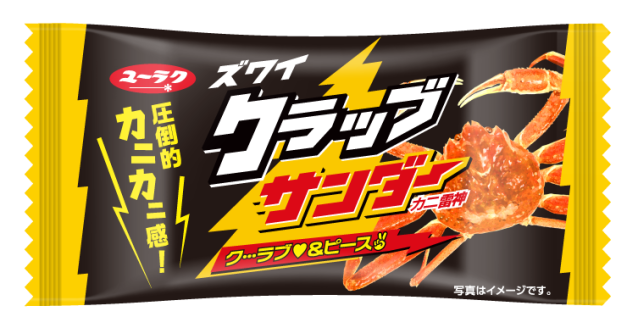
Their hard shells belie tender and sweet creatures that can look quite a bit like little scuttling hearts if you squint your eyes hard enough. Also, because of indistinctions between L and R and B and V sounds in Japanese, the “rab” part of “crab” is a homonym for “love” which is why Crab Thunder: C…rab & Peace is in development, which replaces chocolate with crab and boasts an “overwhelming crab feeling!”

Once you envision a Valentine’s Day where everyone gives each other crabs, you’ll begin to see the future that Black Thunder wants us all to have.

2. The future of receiving

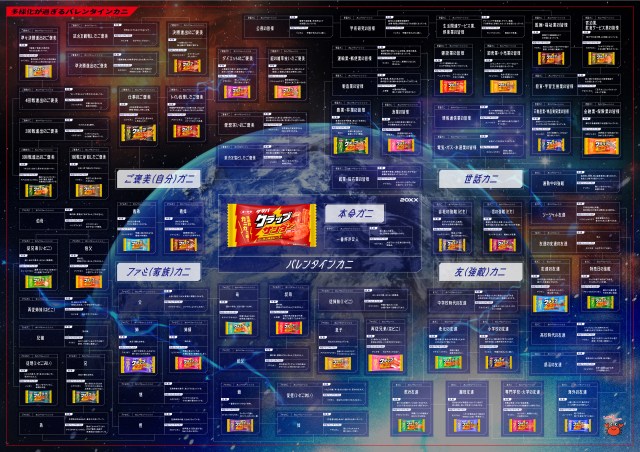
Crab Thunder: C…rab & Peace is just the launchpad of all that the Valentine’s Day of the future can be. Mother Nature has been kind enough to bless us with a wide and diverse range of crab species and Black Thunder will take advantage of this by creating a range of Crab Thunders suited for every conceivable recipient on Valentine’s Day, such as your cousin’s daughter (striped shore crab) or acquaintances in financial and insurance industries (Japanese spider crab).

▼ The complete road map to Crab Thunder species and their intended recipients

※For illustrative purposes only

3. The future of sharing

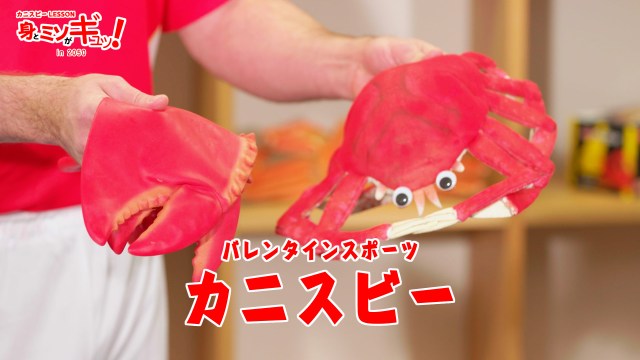
Remote working and social distance has made us drift further apart and also become less active, so why not bring people together and improve health by creating a traditional Valentine’s Day sport? Black Thunder has decided to do just that and are developing the game of Kanisbee (Crabsbee) which is expected to be completed by 2050.

4. The future of telling others how you feel

Even before the world became the way it is, Valentine’s Day has always been hard for those who struggle to express their feelings. Black Thunder is blazing a trail in this regard as well by developing a “Feeling Expressing AI” that can use a digitized voice tell our secret crushes how we feel with revolutionary advancements in split-second presentation and split-second calculation.

5. The future of enjoying being single

And how could we forget the fact that Valentine’s Day has traditionally alienated the large population of single people. And a certain segment of this population has immersed themselves into dating simulators rather than experience dating in a real fulfilling life. For them, Black Thunder has created Riaju Gakuen (Fulfilling Real Life School) which is different from other dating simulators in that it simulates dating in a real fulfilling life.

6. The future of clothing

Another pitfall of Valentine’s Day is knowing who and who not to give chocolate to. To this end, we can once again learn from the noble crab and dress up like one. Black Thunder consulted top designers and came up with the Motome Chocosuit, a crab-themed outfit that sends a clear message of: “I’d like very much to receive some chocolate” and, of course, “I’d like very much to receive some crab” once the transition to Crab Thunder is complete later this century.

For those of us without a shellfish allergy, these truly are some exciting prospects for the future of Valentine’s Day, and if you would like to learn more about Kanisbee, Feeling Expressing AI, or any and all of these concepts that will be realized in the years to come, the B-Class Valentine Future Expo 2023 will be held at Pick Up Rankin in Shibuya, Tokyo, on 3 and 4 February.

And for those of us who can’t make it, a B-Class Valentine Future Expo 2023 website will be launched on 31 January, giving us more insight into advances and moonshots in the field of Valentine’s Day sustainability.

▼ Keep an eye on the Black Thunder Twitter account for a link when the website opens

This all might sound ridiculous, or possibly even unhinged, but remember this chocolate bar has been spot on about Valentine’s Day trends in Japan so far. Remember, we once thought they were crazy for selling school desks last Valentine’s Day, but they sold out!

So we should heed the call when Black Thunder encourages us all to participate and help create the Valentine’s Day that we want to live in together.

Event Information
B-Class Valentine Future Expo 2023 / B級バレンタイン未来博2023
Address: PickUp Rankin Shibuya Chikamichi, Tokyo-to, Shibuya-ku, Dogenzaka 1-1-1
PickUpランキン 渋谷ちかみち 東京都渋谷区道玄坂1-1-1
Dates: 3 and 4 February, 2023

Images: © Yuraku Confectionary Co., Ltd.
● Want to hear about SoraNews24’s latest articles as soon as they’re published? Follow us on Facebook and Twitter!
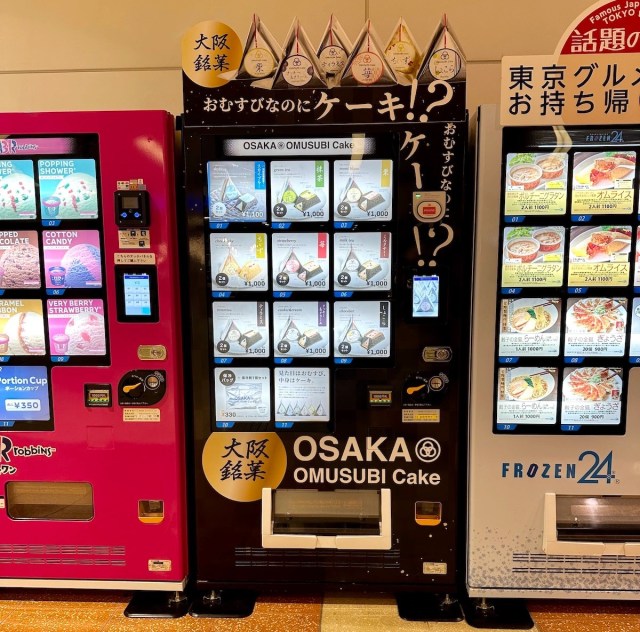
Japanese vending machine sells…onigiri cakes!?

https://ift.tt/4yTmVZB Oona McGee

Now that’s a sentence we never thought we’d say. 

If you’ve ever visited Japan, you may have marvelled at the way onigiri rice balls are packaged up with a convenient pull-tab in the middle for ease of eating.

Now it’s time to marvel at the rice ball all over again, because it’s been given a sweet overhaul and a whole new distribution method — via vending machine.

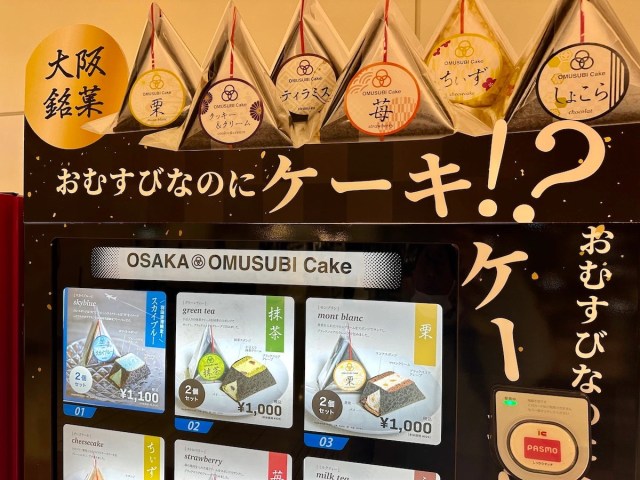
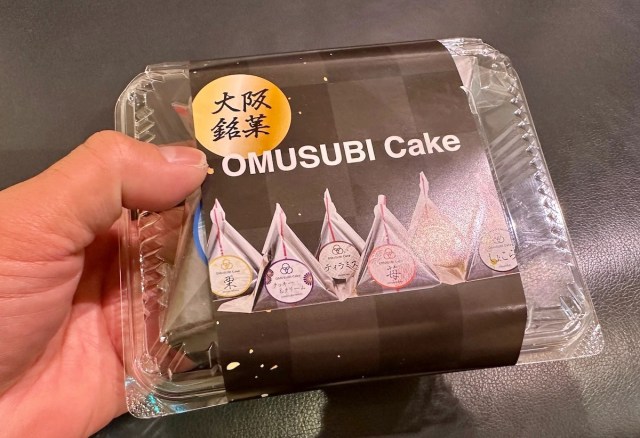
As the vending machine proudly states, these sweet morsels are called Omusubi Cake, with “omusubi” being an alternate name for a rice ball, used interchangeably with “onigiri” in Japan.

Created by the Tsukiichi pattisserie in Osaka, these rice ball cakes were carefully developed over the space of a year before making their debut in 2019, and while they’re usually only available for sale in the Osaka region, this new vending machine is giving Tokyoites a taste of them, as the machine is located at Haneda Airport.

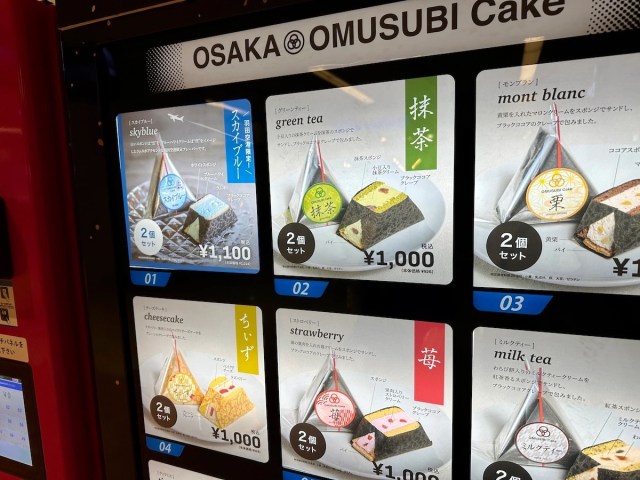
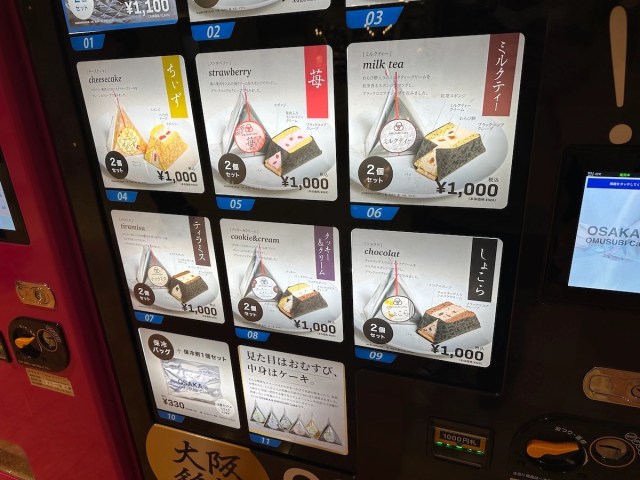
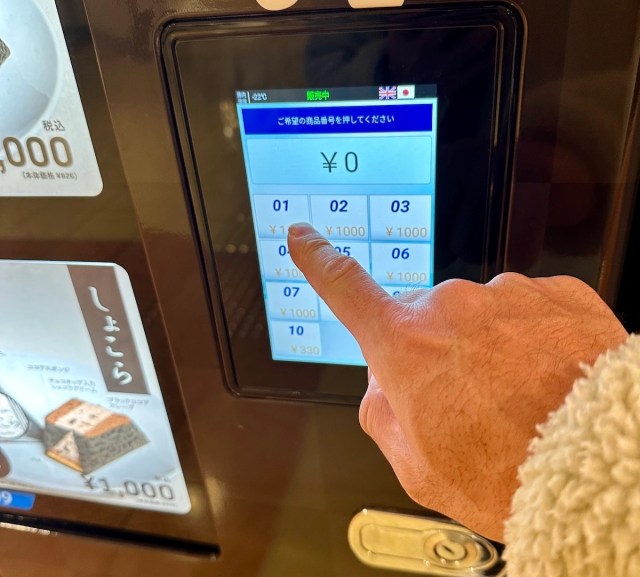
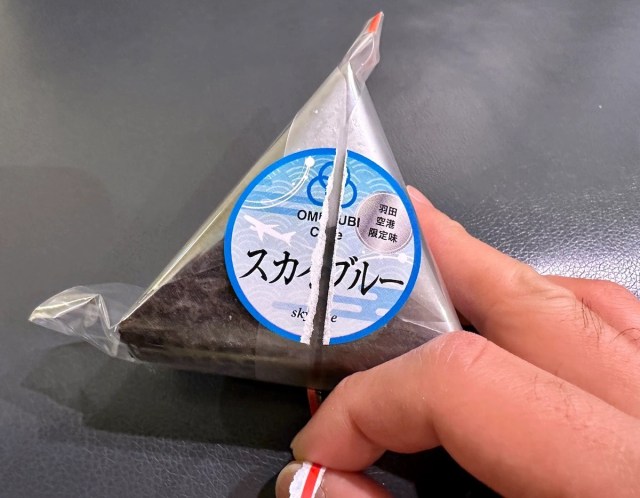
We came across the machine on a recent trip to the airport, and upon closer inspection we discovered that in amongst the nine flavours on offer, there was one that was exclusive to this machine.

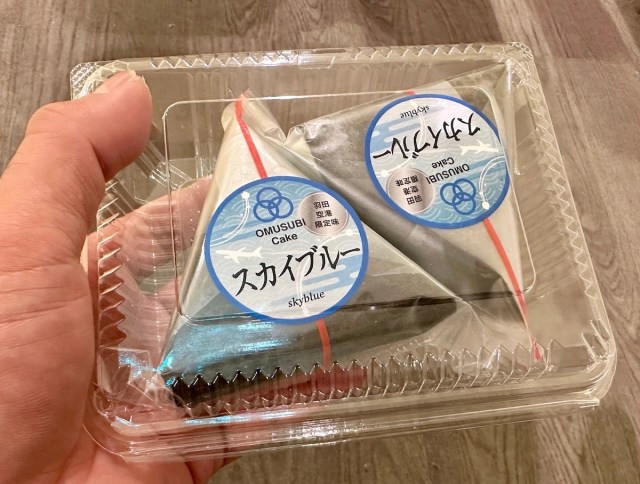
▼ All the rice ball cakes are sold in packs of two.

We immediately pressed the 01 button to select it, and fed 1,100 yen (US$8.46) into the machine to purchase it.

In just a few seconds, we were holding the prized, rare item in our hands.

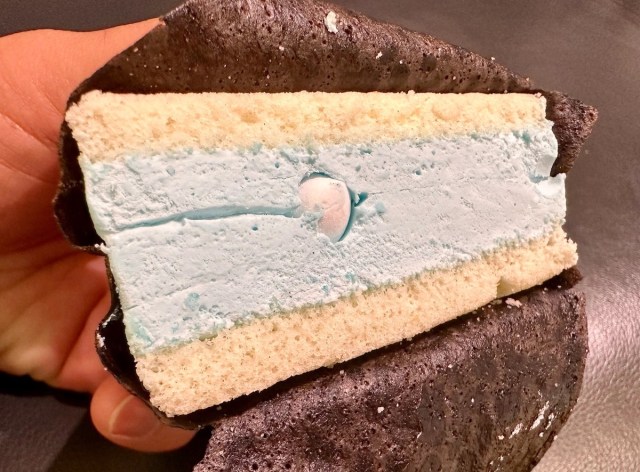
Sitting down to try it, we unsheathed the outer packaging and laid eyes on our unique discovery — the Sky Blue Omusubi Cake.

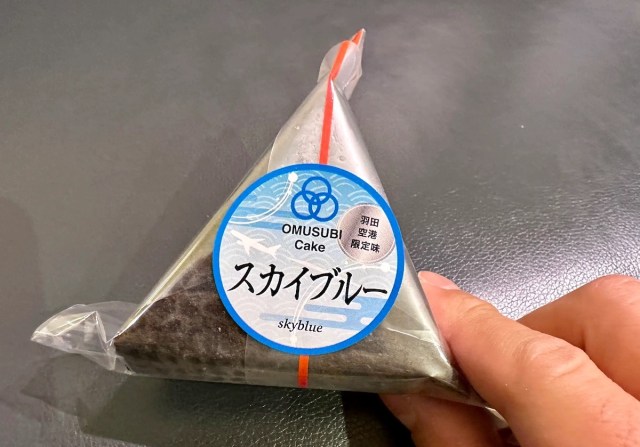
Plucking one out of the pack, this looked like a regular rice ball, and you’d probably be able to fool your friends into thinking it was, if it weren’t for the word “cake” on the packaging.

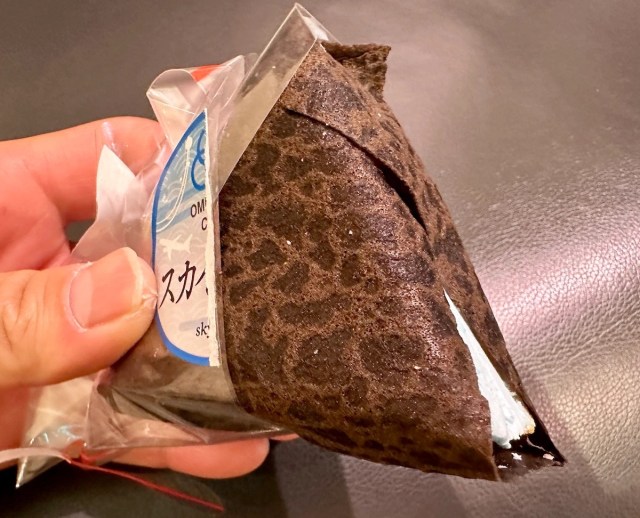
The pull-tab to open the cake was the same as the pull-tabs on regular store-bought rice balls as well.

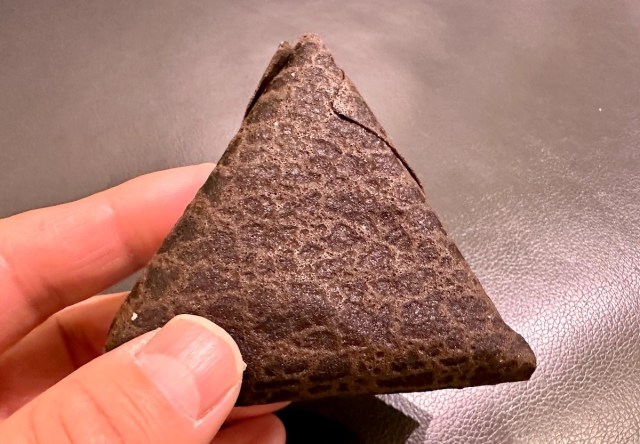
If you weren’t paying attention, even the dark outer casing could fool you into thinking this was a seaweed-wrapped rice ball!

▼ The “seaweed” here is actually a thin crepe!

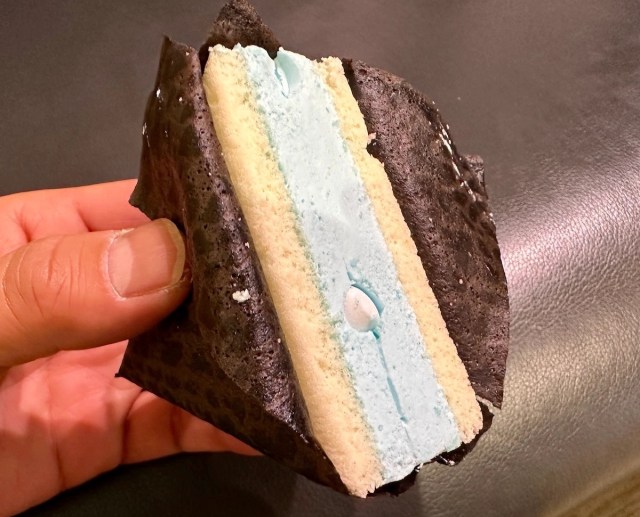
Once you take a look at the inside, however, the ruse is up, because no rice ball we’ve ever seen looks like this.

The sky-blue centre is filled with the flavours of Blue Hawaii cream and ramune, a lemonade-like soda with a very Japanese flavour. The sponge slices on either side of the filling resemble clouds in a blue sky, creating a beuatiful visual that’s also light, airy, sweet and delicious.

These Omusubi Cakes are a great treat for yourself but they’re also perfect for gift-giving as souvenirs. The only problem is deciding on which flavour to buy, because the whole range is delicious!

Related: Omusubi Cake
Photos ©SoraNews24
● Want to hear about SoraNews24’s latest articles as soon as they’re published? Follow us on Facebook and Twitter!